Spotlight on Games
>
1001 Nights of Gaming
- D -
- Da Bai Fen
This non-commercial trick-taking card game is of uncertain provenance.
It apparently originated in China in the past half century.
Employing the standard
Poker
deck, including the two Jokers, this is a fixed partnership game for
four (variants permit other numbers). Like some other Chinese
games, including the one which inspired
Tichu,
there is no dealer, but cards are distributed by players
drawing one each in sequence. But now it's not Marxist
affectation, but an important rule since at any time during
the process a player may declare. The declarer is rewarded
with the bottom six cards of the deck who then discards any
six, saving the trumps and creating void suits. Speaking of
trumps there are quite a lot of them. Besides the trump suit,
there is the red Joker which ranks above the black Joker which
outranks the Ace of the trump suit. But we're not done yet.
Each team is also said to be at a particular rank, starting
with deuces and increasing with each win. The four cards of
the declaring team's rank are also trumps; the one matching
the trump suit ranking just below the black Joker and other
three in turn just below it. This means that no fewer than
eighteen of the forty-eight cards are trumps, which can take
some mental adjustment. Scoring a hand is similar to
Tichu:
kings and tens are worth 10 points each whiles fives are worth
5, with the consequence that play takes on a new dimension
whenever any of these ranks becomes the trump rank. This is an
uncomplicated affair whose most interesting decision is
probably when to declare. Its chief drawbacks may be lack of
theme, that it doesn't differentiate itself more from other
games and that a complete match may require two to three
hours.
[Instructions]
unknown; non-commercial; unknown; 4, 6-12
Strategy: Low; Theme: Low; Tactics: Medium; Evaluation: Medium; Personal Rating: 6
- Daddy Cool
This multi-player dice game for children is set in the Arctic
among a family of polar bears. Essentially this is a
much-simplified version of the press-your-luck classic
Can't Stop,
reducing that game's multiple tracks to a single one.
In addition traps have been added to the course. The course
itself is represented by hexagonal tiles and the pawns by
wooden polar bear figures in various colors. Special six-sided
dice are used. While it can be made exciting, especially if
sufficient trash talking is injected, there's really not
enough here to raise the game above the kids-only level,
especially when so many other such games are available.
Heinz Meister; Huch & Friends; 2004; 2-6
Strategy: Low; Theme: Medium; Tactics: Low; Evaluation: Medium; Personal Rating: 5
- Dante's Inferno
Game for up to six about descending the nine levels of hell to
defeat the wayward angel Lucifer. Fancy plastic pieces always
remind me of restaurants with great views. Is it in business
for the view or the quality of the main event? Here each
player takes six identical inch-high questing figures. More
interesting are twenty-odd gray demons which come in great
variety, no two the same, but their differences have absolutely
no significance in play. These figures occupy square tiles in
four colors forming concentric rings. Borrowing liberally from
The Settlers of Catan,
each is marked with a pair of numbers which, when rolled on two
dice produce resources. These are tracked on the player display
which à la Catan also lists the possible player
actions and associated costs: move, descend, move an opponent,
flip a tile, place a tile, bring on another figure. There is
no robber baron, but on a roll of "7" a demon is placed at a
corner and as each player gets a free demon move each turn,
it will eventually encounter a player figure. The player must
roll above a certain number to evade it or be flung to the
non-productive corner. The creators of the game appear to have
wanted this played using techniques which are not optimal if
one wants to win. For example, there is a substantial body of
rules around creating the lower levels, but in practice they
go entirely unused as the most practical thing to do is simply
build up a lot of resources, go down to Lucifer and make the
roll which defeats him. If the roll fails, resources can be
spent to re-roll until it succeeds. There is little that can be
done to stop a leader. Sure, it's possible to get into pushing
contests, moving him to other tiles, but even these tiles have
about the same amount of production so it's really more a matter
of hurting oneself. To really push a figure to a non-producing
space is horribly expensive and cheaply remedied. Nor do the
demons really play any significant role as they are easily
defeated and even when successful, will probably only next
target oneself. Thus this is ultimately a contest to see who
is luckiest enough to get good production at the start, get
all the figures on the board to ensure even better production
and then go and win without any possible hindrance. By now,
some Settlers of Catan critic is probably muttering, So,
what's the difference? But the case won't stick as Catan
offers two very important edges: strategies and trading. Are you
working on roads, cities, cards or some mix of the above? That's a
valid question in Catan, but wholly absent here where everyone has
exactly the same path. And how good a trader are you? Even though
there are trading rules in Inferno, with everyone pursuing
exactly the same intermediate goals, it's almost never a good
idea. Oh, add one more advantage: at least Catan sports a theme
that makes some sense. Here one is purportedly rescuing souls,
but this gives points in Gluttony and Lust? And these same souls
are then expended to defeat Lucifer? Bits fanciers may enjoy,
but this will ultimately result in feelings of helplessness
and boredom. By the way, other efforts inspired by
Dante's weird vision are
HellRail
and
Inferno.
[Twilight Creations]
- Darjeeling
A game which might be subtitled "We will sell no tea before
its time." The board is no board at all, but a grid showing
partial crates of tea in four different varieties. Varieteas,
ya might say. On a turn a player moves along the rank or file
– expending victory points as he goes – and
claims the one he ends on, replacing the space left with a new
tile from the cloth bag. Cleverly, some tiles depict not just
one, but three halves, which are both a boon for their added
quantity and also a curse as no partial crate may be shipped.
When a player can assemble his tiles in such a way that they
create all complete crates of the same color, he is ready to
ship, maybe. With luck or planning he is near a port which
makes it more valuable and then his crates are converted to
cubes and placed on sort of shipping palette at the highest
multiplier, forcing all other palettes to lower ones and the
cubes of the unfortunate last player out of play. But the
crucial factor is that players continue to receive points every
turn on these palettes as long as they remain in position,
which makes for a very tactical game. It's critical to delay
one's large shipments until others have completed theirs. The
result: infinite standoff. It's unclear why such a
problematic shipping mechanism was ever published, especially
when others would be so easy to devise. Maybe the idea was to
camouflage the problem with production, or in this case,
over-production. There are nicely-illustrated tiles and
screens, fancy wooden crate-hauler figures, wooden palettes
and even a large scoreboard with a cutout for the palettes.
There's a surplus of cubes as well and even a "demand barometer"
(closed ramp containing balls which plays only a small role).
Only the communication
design of the scoring track is a disappointment as its
serpentine form makes it hard to quickly see whether to move
a marker left or right. Alas, it's all for naught anyway,
unless someone can devise a variant to improve matters?
Strategy: Low; Theme: Medium; Tactics: High; Evaluation: Medium; Personal Rating: 4
Günter Burkhardt; Abacus-2007/Rio Grande-2007; 2-5
[Buy it at Amazon]
- Darwin's Finches
-
In this web-published vehicle players both control the evolution
of the famous finches of the Galapagos as well as
collect finch specimens. Played with two decks of traditional
cards, the finches move and evolve from island to island, and
also change positions on an evolutionary dominance ladder. On
each turn players, restricted by the types of cards they're
holding, must determine which is the most beneficial
improvement to make. By the end they want the finch type of
which they "have the most stock" to be evolutionarily-dominant
as well as have it migrate as far as possible from the
starting point. In effect it's similar to a stock market
affair where one either acquires stock or improves a stock's
value. It's a rare and interesting topic, but could use a
better set of instructions, e.g. around handling of discards.
Mixing evolution and collection muddles the theme a fair amount
as well. Though it's very short, much depends on luck of the
draw; either more plays which would tend to even out the luck
or the injection of more strategy or balancing would help.
Still, a good start that with more development might yet be more.
[Evolution Games]
[PrintNPlay Games]
MMMM5 (Strategy: Medium; Theme: Medium; Tactics: Medium; Evaluation: Medium; Personal Rating: 5)
Bob Flaherty;
self-2010; 2-4; 20
- Daumen Drauf
"Thumbs on it" is the meaning of the slangy German title of
this card bidding game for up to seven. Making use of three
suits in a double deck of snake cards, players compete for a
continuous trick as in
T-Rex.
One deck is "good" in that all of its cards are positive while
in the other deck, the cards are negative, being differentiated
by the addition of a fang in the snake's mouth, which the
player hides from others using a thumb. The result consists
almost entirely of bluff with an unwelcome admixture of memory.
[Drei Magier Spiele]
- David & Goliath
Trick-taking card game which is still enjoyable with up to six
players. Each player tries to take no more than two of each suit
which means that they score face value for those cards, otherwise
they score just one point per card. Tricks are divided, the low
card played taking the high card and the high card all the rest.
Tricks are displayed face up after being taken which eliminates
most of the memory issue (one still tries to recall who is void
on what). Much of the skill is in diagnosing the initial hand and
deciding what one's objectives will be for each suit. Sometimes
one is better off just trying to take everything. In the middle
game, one must decide whether it is better to maximize one's own
score or diversify the hand in order to sink those of others.
In the late game, tactical plays to sabotage an opponent's score
can be quite effective. Along with Mü: Wimmüln,
one of the most interesting for six. On the other hand, a bit
strange for three. Graphically a bit boring as each card simply
shows a larger and larger silly David-Goliath figure. As the
card images are the same for every suit, being differentiated
only by color, the game may pose difficulty for those with color
blindness or in low light conditions. As there are six suits
with cards numbered "1" to "18", owning this deck permits trying
out of many other cards games needing special decks.
Apparently there is a traditional Korean card game with similar rules.
[6-player Games]
Reinhard Staupe
- Deadwood
Players represent bit part actors trying to make money in
Hollywood Westerns. Interesting dilemma is whether to keep trying
to earn money at the lowliest roles or to take the extra time
needed to try for better parts at better salaries. The correct
answer probably depends on the number of players and their playing
styles. Humorous names for films, scenes, lines and parts add to
the atmosphere. Along with Parts
Unknown, one of the better efforts thus far from
this publisher, much of whose quality is in the writing.
Later expansion modules add Horror, Science Fiction, Kung Fu
movies and Musicals.
- Deduce or Die
Remove a couple of cards, distribute the rest and let players
ask one another questions to see who can first identify them.
This is the basis of
Clue,
then
Sleuth,
Black Vienna
and several others. Two things are new in this one played with
traditional cards. First, identifying the two missing cards is not the
sine qua non; it is just the beginning. The identities of
the two indicate a third card held in someone's hand who must
be named as the murderer. (The murderer player does not know
his own identity except via the same process and has the goal
of identifying the holder of the next higher murderer card.)
The second is the restricted method of asking. Players take
turns revealing three cards from a separate deck, use two
of them to define a range and the player of his choice must
reveal the number of cards he has fitting it. The challenge is
to find the best possible question to ask given the constraints.
Thus this is more variable than
Black Vienna
where the questions are always the same. On the other hand the
design is so closely tied to the nature of traditional cards
that it's difficult to see any way of publishing it for real.
How, for example, could adding two card numbers together to
determine a murderer add up in real life terms? More could
have been done with the theme in other ways too. If one of the players
is really supposed to be a murderer, might he not be able to
take some desperate actions? The tension in
Mystery Rummy: Jack the Ripper,
which also has a player as a murderer, but one who can escape,
is much more palpable. But this one is resolutely only about
the deduction; as such it works very well.
[notes sheet]
LLMH7 (Strategy: Low; Theme: Low; Tactics: Medium; Evaluation: High; Personal Rating: 7)
Larry Levy;
(web-published)-2003; 3-6
- Democrazy
Card game similar to Nomic or Das Regeln Wir Schon
in which players vote to change the rules by which the game
is played and won. A lot of the game is determined by luck of
the deal of the possible law cards and might work better as
a strategy game if all cards were face up, or if all possible
cards were known to the players. As it is, qualifies more as
a party game not to be taken very seriously.
[6-player Games]
- Derby
Dirk Henn game in which players each represent bettors at a
horse track. The state of the betting is very elegantly
handled via a set of non-intersecting bet cards drafted by the
players. Movement of the horses is controlled by a combination
of cards, one of which indicates which horses may move, the other
giving their speeds. Players must consider the probable goals of
their opponents as well as what opportunities they may provide to
the player on the left. All the elements work very well together
for players who are able to carefully watch and remember their
opponents' actions. As in
Metro,
one sometimes wishes for a bit more
control in card play. Somewhat similar to the previous Spekulation. Caveat
emptor: the space numbering misses a beat between 40 and 45.
[6-player Games]
Dirk Henn;
db-Spiele
- Desert Bazaar
Multi-player game by Mattel which nevertheless sports some
German-style features. Players earn victory points by establishing
tent tiles on a hexagonal grid. Each tent has a cost of three
which is paid for using a combination of cards and neighboring
tiles matching the colors on the tent. Groups of tents are
limited to a size of seven – points are given per tent, for
starting a group and for finishing a group, the last of which
also returns a few of the player's limited tokens. The other main
mechanism is card replenishment. For this players forego placing
tents and instead roll special dice to see what they receive.
Historically, Mattel has conceded the games market to rival
Hasbro in favor of Barbie, so this foray is good
to see. But the newness is readily apparent from the flimsy
board and too thin tiles to the color dependencies which probably
won't work for the color blind. The card replenishment system
is exception-ridden and over-complicated in ways that are all
too typically American while a lot of the time the game seems to
play itself with only rare chances to do something interesting;
often the most challenging decision is what type of turn to
have. One can try building away from a group and then join it in
order to get more points, but having a good supply of the right
cards appears to be more important. There can be some analysis
paralysis too as there are many tile options and the downtime is
exacerbated since the previous player can consume a lot of tiles,
meaning all one's planning is for nought. There can be runaway
leaders and there is no good way to stop them and catch up. On
the plus side the basic system is not overly complicated and
the whole thing does not require a great deal of time. Some will
dislike the translucent plastic domes representing the tents as they
resemble cheap halves of a drug capsule, but at least they
make the tiles easier to see than wooden cubes would have.
Thematically, there is little reason to expect that a desert
bazaar would work this way and if it's supposed to be at an oasis,
why isn't it pictured? Still, for Mattel this near abstract
with a large luck factor (rarely a good combination) is a decent
starting effort that we'll hope presages better things to come.
Strategy: Low; Theme: Low; Tactics: Medium; Evaluation: Low; Personal Rating: 4
- Devil Take the Hindmost (Formel Fun)
Originally about bicycle racing, later re-released as
Formel Fun and adapted to auto racing. A bit random,
but contains lots of fun in the mad scramble not to be
last (and therefore eliminated from the race). Good
way to wind down from more thought-intensive epics.
[Cycle Racing Games]
Terry Goodchild; Fiendish Games/Lambourne Games//Franjos Games; 1991; 2-4
Personal Rating: 6
- Dia de los Muertos
Partnership trick-taking card game commemorating the Mexican
festival of the dead has lots of special effects and needs lots
of thought around card play. For example, four cards cause
partners to swap cards, another allows asking an opponent any
question which must be answered truthfully, others allow drawing
from an opponent's hand, etc. The result is very different from
any traditional trick-taking card game, but the new synthesis
may take some getting used to. In addition, it is played over
three rounds and each round there are different sets of cards
entering and leaving the deck. All of these things can be dealt
with by a player's brain, but the jury is still out whether they
are interesting problems to solve or merely busywork? More games
are needed to decide. Its closest relative would probably be
Twilight
and whatever one thinks
of that game is probably the best predictor of one's reception
of this. Together they form a team of anti-trick-taking games
with Mit List und Tücke as
sort of a team wannabe. So far I would personally have preferred
fewer Swap cards and more Ask cards. Late in the game the former
are useless while the latter always seem interesting. There is
also a three-player variant using a dummy hand à la Bridge. Kudos to Frank Branham
for finding an utterly unique topic on which to build a game.
Update: in response to the above, Frank has suggested the
following variant:
Each player gets
2 chips (like small sculpted clay skulls). He uses a chip to
perform an Ask action immediately before he plays a card. Same
rules, but he gets to Ask before choosing his card.
And the 2 Asks are for the duration of the game, not
the hand.
I haven't had a chance to try this,
but others have reported that it helps play considerably.
[Two vs. Two Games]
[Sacred
Chao]
- Diamant (Incan Gold)
"Diamond" is a "push your luck" game of dangerous diamond
collection for up to 8 by Alan Moon and Bruno Faidutti. Over
five rounds (represented by five caves) players simultaneously
decide either to remain in the cave or return to camp and end
their round. Those returning receive their share of diamonds
found thus far plus the undivided remainder. Those remaining
get to keep collecting until all have departed or until the same
peril card has appeared twice, at which point anyone left inside
receives nothing. (Perils in five varieties comprise half the
deck, the rest being diamonds in varying quantities). Players
begin with equal standing, but as they make different decisions
acquire different statuses: leader, trailing or somewhere in
the middle. This in turn dictates different approaches to risk,
leaders tending to play it safer and vice-versa. The relationship
between one's own position and that of whoever remains in the
cave is also a consideration, as are the personal styles of
each of the opponents. So there is plenty to think about, yet
play can move quite quickly and for this reason it is rated
for ages down to 8. This simple yet thought-provoking effort
should find a lot of fans, especially at the lighter end of
the spectrum, though it may wear out its welcome rather sooner
with the number crunching set. The on-line implementation
at brettspielwelt.de
is quite novel in that it employs music and sound effects to
really set a definite mood of mystery and danger, thereby taking
matters somewhat beyond the ordinary board game experience.
Incan Gold is the title of the English edition.
[Holiday List 2004]
[6-player Games]
Alan R. Moon
- Dicke Kartoffeln
Apparently originally a game about industrial development, before
publication the theme was changed to farming – the title means
"Fat Potatoes." Players breed worms and grow potatoes trying to be
both the most profitable player or the most "green" player
or both. There are three different types of potatoes which
may be grown and a rather nice market simulation to control
their prices. Random events also play a part. Much of the game
rock-paper-scissors style outguessing of the other players. It
is not true that a player can win by simply farming only worms
throughout the game!
Frank Nestel & Doris Matthäus;
Doris&Frank; 1989; 3-5
- Dino
Near abstract game of in which each player runs a science team,
travelling to the past to steal dinosaur eggs. On his turn,
a player may move a piece up to four fields. Unused points
are used to advance the meteorite which triggers the end of
the game. Players must be careful not to have left any of their
researchers in the past when the meteorite strikes. The nice
plastic dinosaur obstacles are placed just once at the start of
the game and never move. This has the effect of either making
their placement meaningless or requiring so much analysis that
it tends to swamp interest in the game. And at that point,
actually playing it out is probably no longer of any interest.
- Discovery Island (Destination: Trésor)
Two-player game of orienteering and treasure hunting from
Finland. Each player holds a hardback hexagonal map covered
by a separate clear plastic film. The opponent secretly decides
where he has landed. As the player trudges around the opponent
reveals the terrain type encountered so it can be recorded on the
film. After a half dozen moves, by matching the film to various
map locations it will be clear that there is only one exact match
and voila! the player has found himself, and most of the
interest, in this French game. But fear not. As each terrain is
encountered, a hexagonal tile of the type is flipped and some of
them indicate "Lost". This means the opponent gets to maliciously
displace the player's current position and the search for bearings
begins anew. This is the main point, even though ostensibly this
is a search for treasure, the Trésor of the title. By
visiting clue points players are able to consult a rather fancy
gadget which helps to narrow down which point holds the actual
treasure. There is a tendency for both players to figure this
out at about the same time, at which point each hopes to be
the lucky one closer at that moment. This part takes rather
longer than it ought and one wishes it were possible to call
in a helicopter and just have them pick up the stuff. While the
idea is different and the art and presentation very attractive,
the parts which are fun do not last long enough while those which
are not, do. Probably the map should have been designed so that
the terrain types were thoroughly intermixed rather than divided
into large patches each of a consistent type. Then one could
really be lost for quite a long time and have an ongoing logical
deduction problem to solve. The hexagonal tiles look nice, but
their form serves no real purpose. They could just as easily have
been cards, which would have been easier to shuffle and perhaps
reduced cost. This visual experience for deduction fans might also
come in handy for game masters running cross country role-playing
campaigns. Perhaps expansion maps can be released one day?
- Distant Seas
Subtitled "The Merchant Marine Game", this variant on the railroad type of
pick-up-and-deliver excercise features a fifteen-page rule book
and colored vinyl zone map of the entire world,
including indication of prevailing winds for the sailing game. There are
also contemporary, steamship, and sailing ship scenarios.
Details of ship movement seem overly complicated, but are workable
with practice. Rules specify that an event card is drawn whenever
a 2,3,11 or 12 is rolled, but why not just roll one die
and have one drawn on a 1 which has the same probability?
As purchased ships have high resale values, there is never any reason
not to buy more, and thus
some tendency towards the "rich get richer" syndrome, particularly
in the sailship to steamship scenario. This can lead to rather
stereotyped play. Using the bidding rules may address help this
somewhat. The event cards seem too drastic and should probably be
omitted entirely for serious players. They are also destructive
of enjoyment when, for example, a player's only ship is forced
to lose not one but two turns due to some disaster. Thematically,
another unsatisfactory feature is the tendency to sell off
all of one's ships when the all-to-obvious end of the game is at hand.
Overall, too long for the amount of chaos included, but should draw
a crossover audience of nautical fans.
[Traveling Merchant Games]
[summary]
[Distant Seas]
- Dixit
Balderdash,
aka The Dictionary Game, is wonderful, but can be difficult
to get to the table. Maybe it involves too much writing? Or
folks might be insecure about their ability to sound like a
dictionary? Whatever. The solution to this eludes, but at least
now comes along a French game to scratch a similar itch. Included
in the box are a number of thoughtful, beautiful cards illustrated
by Marie Cardouat. Each player is busy examining their hand of
these when the current one intones a sentence, expression, phrase
or even a single word. To go with this he secretly selects a card,
as does every other player. They are all revealed, their owners
unknown, and voted for by secret ballot using chits. As in
Barbarossa,
the main player is trying to be neither too obvious nor too
obscure. The most points are achieved by having only some
players guess the card correctly; if all do, or none do,
there is a penalty. Others attempt to both get votes for their
cards and also, of course, to guess that of the main player.
The scoring track is handily included as part of the game box in
this nicely made production. Just don't ask why the pawns are
wooden rabbits. This is without doubt a party game, but one that
with a little practice players can appreciate very easily. It's
also a great challenge trying to figure out a clue that will
catch only some of the players while simultaneously defending
against other pictures that might fit it better. For example,
if using a picture of a candle, one might think of the expression
"Light a candle or curse the darkness." If you say only "curse the
darkness" will that succeed in catching only some of them?
If completely flustered, newbies should just try for ambiguity.
Try a clue like "blue" sometime, for example, which might mean
the color appearing on a lot of the cards or the emotion of
sadness or maybe even risqué. Title is Latin for "thus said".
At the time of this writing,
an expansion kit named Dixit 2 has been announced for 2010.
[6-player Games]
[Party Games]
[Buy it at Amazon]
LLML7 (Strategy: Low; Theme: Low; Tactics: Medium; Evaluation: Low; Personal Rating: 7)
Jean-Louis Roubira; Asmodée; 2008; 3-6
- Doctor Who
Derek Carver-designed game on the long-running British
science fiction television program. Each player represents
an incarnation of the Doctor (with equal abilities) attempting
to recover the constituent parts to the Key to Time.
Enemies like Daleks and helpful artifacts like Jelly Babies
appear randomly to help or hinder. Not much strategy is
available in this television tie-in to the Tom Baker era,
so this one is really only of interest to children and the
hardest core fans. This program would seem a good topic;
unfortunately, no more challenging game has been invented.
Components are acceptable.
- Dog Eat Dog
Game about industrial production, profitmaking and pollution
seems to pretty much play itself. Movement around a
Monopoly-style board is controlled by dice roll.
There seem to be hardly any interesting choices to make.
The game is at its best with all six players, the final
two are significantly different in "powers" than the first
four.
[6-player Games]
- Dolce Vita
Card game about the collection of luxury items such as boats,
mansions and horses needed to live the "sweet life". As in
Raj each player has a set of six identical cards labeled
1-6. The treasures of varying value are laid out in seven
columns. Players take turns placing their cards face up beneath
columns. When each has placed five, for each column the player
with the highest total takes the card at the bottom of the column,
the one with the second highest total takes the card second from
the bottom, and so on. What gets tricky is that one may only
own one boat, horse or mansion so if one happens to have one and
gets another, the old one must be traded in for the new, even if
it happens to be of lesser value. Interesting though not overly
exciting. Analysis-paralysis is possible as this is a game for
those capable of measuring fine detail. Playing for just three
rounds gives the game the right amount of length, although not
exactly fair in four- and five-player games as not every player
will have had the chance to act as both first and last player.
- Dolmengötter, Die
Multi-player placement game ostensibly set in ancient Druidic
times, but actually very abstract in feeling. Placement is of the
majority control kind, but as in
Australia
has the wrinkle that it occurs at the edge of a territory and
so may contribute to two or even three areas at once. Achieving
a majority permits placing a hidden scoring token in the region
which, à la
Carcassonne,
is only freed when the region is completed and scored. Tokens
are placed by virtue of three druid pieces which move from point
to point via special rules that permit the board to wrap
around, virtually. Even so, play seems to focus on the center
and at the end of the game that is where most of the winning
player's pawns tend to be found. The fact that a piece placed
at the margins also opens up a new space provides simultaneous
cooperation and competition. The one-piece-per-space rule affords
plenty of tactical possibility. The beginning may be tainted
however as earlier players probably have a slight advantage
while the end game feels unfinished, as all the many pieces on
incomplete areas do not score. On the other hand, if one were
to score them, infinite delay of the game is encouraged as
players mostly want to wait until everyone else has moved and
then grab the points. Even without such a variant some players
tend to finish before others and are left with not much to do.
Probably the whole issue of game flow deserves further study
here. Fans of the offbeat should like this as it exists in the
little visited area of intersection between majority control
and luckless abstract. That most may not care for one aspect or
the other will probably keep it a cult favorite. Were the board
constructed from tiles there might have been more replayability,
but at least a few plays are in order to learn to play well.
Strategy: Low; Theme: Low; Tactics: High; Evaluation: High; Personal Rating: 5
- Dominion
A good game is one that maintains the possibility of any
player winning – or at least the feeling of it –
right up to the last moment of play. Inevitably in any system
though, one or more players will surge ahead while others fall
behind. Ensuring that these disparities do not grow too large
tends to require a catch-up mechanism. Many of these feel
artificial and un-thematic while some are only halfway there
like the
Settlers of Catan
robber-baron (the "7" result needed something special, but why
is there already a robber-baron on an uninhabited island?).
Best of all are those mechanisms that blend in naturally,
hardly being noticed at all. Such is the case in this card
game set in the medieval period. Though there is a mountain of
485 cards, each player begins with just ten: seven copper and
three single victory points. A turn consists of revealing five
cards at random and doing the best one can. To help, a player
has two other things: the right to buy one card and the right
to play one action card. Using gold then, one acquires more
coins, more victory points and action cards in ten types.
With names like "Village", "Cellar", "Adventurer", "Militia", "Witch",
"Moat", etc., they provide special abilities such as drawing
more cards, supplementing buying power, playing more cards,
upgrading cards, etc. The latter three named cards, as well as
some others, also affect others, such as making them reduce
hand size, take victory point losses or defend against the
first two. When a player's deck is exhausted a re-shuffle, now
with new cards added, restores it and the process begins anew.
What's nicely realized is that victory point cards, provide no
extra benefit at all, but instead actually detract from the
efficiency of the hand. Thus every point gained makes getting
the next one just a little more difficult, permitting the
opposition more of a chance to catch up. Designing one's deck,
a process under some constraints, is the primary exercise
here; watching it work (or not) the fun. This would bore
quickly if only ten action card types were available but the
fact that in toto there are a couple dozen types (with
undoubted expansions to come) permits a fascinating meta-game
in which the subset used is chosen randomly. Then with each
playing one must diagnose the particular combination available
and decide what mix is optimal. Artistically, Matthias
(Guatemala Café,
Hamburgum)
Catrein's cards are well done, but their communication design
has some flaws. The coin cards – copper, silver, gold
– should have been easier to distinguish. Also there is
room for larger card texts as well, at least in the English
edition. The main issue here though is the large amount of
fiddliness, just just in the constant requirement to shuffle,
but also in setup and takedown, despite the carefully designed
plastic insert that gives a different slot for each card type.
(Probably a plastic baggie for each would work better.) Some
folks have created wooden chip renditions to replace shuffling
with bag draws, but this creates its own problems. Probably
it's best to just resign oneself to the shuffling; it becomes
less annoying after a few playings. The setup-takedown problem
is ameliorated by playing it two or three times a sitting.
Beyond this, the worst thing here is that the theme doesn't
feel very strong. Oh sure it tries to connect mechanism to
card name, but there's little feeling of making decisions
germane to the era. On the other hand this is a highly
strategic and above all logistical affair with rather reduced
tactics, something not often seen, though there is the danger here
that this will be over-analyzed and become not fun to play with
certain individuals who have found or read about some killer
strategy. Perhaps expansion kits will prevent that from happening.
[Spiel des Jahres Winner]
[Frequently Played]
Donald X. Vaccarino; Hans-im-Glück-2008/Rio Grande-2008; 2-4
HLLH8 (Strategy: High; Theme: Low; Tactics: Low; Evaluation: High; Personal Rating: 9)
[Buy it at Amazon]
- Dominion: Cornucopia (Dominion: Reichte Ernte)
-
The cornucopia has a strong association with the fall harvest
so at what point in 2011 did this expansion appear? Spring, of
course. This small expansion adds thirteen types of kingdom cards
plus five one-off cards. The idea of variety is the emphasis this
time, seen both in cards that reward having lots of types as
well as others that help increase this. This kind of flies in
the face of the typical approach as often the most efficient thing
to do is make a compact hand of as few cards as possible. The
intention seems to be that the Tournament card be the
star of the show.
This is another one of those cards like the Explorer
that would be most
effective at the start of play, but because it requires revealing
a Province to work, is a waste of space until the second
half. When this is played anyone who can do so gets
either a duchy or one of the abovementioned one-offs, called
prize cards. Again, these do things which would be somewhat
useful in the first half, but are fairly redundant by the
second. Perhaps the most noteworthy is the Followers card
just because it has so many effects: draw two cards and gain
an estate while opponents discard down to three and gain a
curse. But in our opinion the real star is the reaction card,
the Horse Traders, which lets you draw another card, gives
another buy and +3 in buying power. Some cards forced a bit
of clarification in the general rules of when treasure cards
come into play and for the first time, one, the Young Witch,
is so complicated that all its rules could not fit on the
card itself, but must be completed in the rules booklet.
Exceptional cases have been explained in booklets before,
but not the main thrust.
The Jester is somewhat new, an attack giving opponents a curse
if they reveal a victory card from the deck, otherwise letting
the player gain a copy of whatever is revealed.
There are predictable variations on earlier cards with the
Farming Village continuing the whole series of village cards
and the Remake that of the Remodel/Upgrade series.
These repetitions threaten to be a thorn in the side of choosing card
sets randomly as too many of the same thing will be, well, too much
of the same. At this point the favorite here is the
exotic Seaside with its fun duration cards. Prosperity's
additions to treasury and victory cards make it pretty much necessary
while either the original set or Intrigue are absolutely so.
The Alchemy set is sort of an oddity whose potions don't
quite fit in and is thus outside the mainstream of interest.
But it does have something for those who want to warp the usual routine.
This expansion has nothing that is
particularly annoying, but also fails to add enough pop or
excitement. There will always be completists who want every
card every made, but that for the first time it's likely that
for many this is an expansion that's just not worth the extra
weight on the already overstrained Dominion shelf.
MMML6 (Strategy: Medium; Theme: Medium; Tactics: Medium; Evaluation: Low; Personal Rating: 6)
Donald X. Vaccarino; Hans-im-Glück-2011/Rio Grande-2011; 2-4
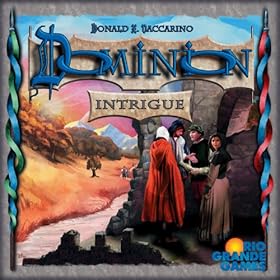
- Dominion: Intrige (Dominion: Intrigue)
Remember playing old
Monopoly
when you would sometimes pull a yellow card that would say
"Bank error in your favor"? This one is a game error in your
favor. As it adds new types of cards for
Dominion,
this ought to have been an expansion kit for that game,
playable only if one owned the original. Instead
the box contains not only those cards, but also all of the
money and victory point cards needed to play as a standalone
affair, which in fact is the only way this reviewer's several
playings have been done thus far. What this means is that
instead of everyone buying both boxes, in any gaming group,
one friend can buy the original, another this expansion and
then the two can mix them together sometimes or play just from
the single box at others. To what we owe this bounty is
unclear – perhaps the ongoing major economic crisis at the
time of this writing? In any case, it is Lucky Day for game
playing fans. As to the details of play, if choosing between the
original and this for the first experience of the system, most
should get the other one. The newer cards tend to be more
complicated in function and involve more interaction with
other cards. As a result turns tend to be longer, both in
terms of analysis needed and number of cards turned over.
There are also some cards which are quite useful in very
specific contexts, such as toward the end of the game, but not
so much at others. Unwary beginners could thus fall into a
crack. One of the more interesting developments are that there are
now cards which both have functions and provide victory
points as well. There are interesting developments in the
production too, which has maintained its high standard. Very
usefully, the insert contains printed labels so that it becomes very
easy to figure out where each type of card can be found or put
away. It's also fun that the many card artists are now
credited in small text right on the cards themselves. Overall,
depending on whether you own the original or not,
this is an excellent edition or addition. One note is necessary,
however, as it is now claimed that six players can be supported.
While the number of cards make this true, players should beware
that if the number of players exceed three, downtime doldrums will
dominate your Dominion.
[Frequently Played]
Donald X. Vaccarino; Hans-im-Glück/Rio Grande-2009; 2-6
[Buy it at Amazon]
HLMH8 (Strategy: High; Theme: Low; Tactics: Medium; Evaluation: High; Personal Rating: 9)
- Dominion: Prosperity (Dominion: Blütezeit)
-
Kingdom cards of particular interest in this large-sized
expansion include the
Bishop,
which lets you trash any card and receive half its value in victory
points chips (thus gaining points that do not clog the hand);
the
City,
which operates like a Village, but gets stronger as
the game goes on (triggering on pile depletions); the
Goons,
similar to the Militia, but giving 1 VP chip for each card
purchased which is great when having multiple buys; the
King's Court,
which is like a Throne Room that repeats an action three
times; the
Peddler,
whose cost of 8
is lessened for each action card played when it's acquired; and the
Trade Route,
which gives more buying power as the game goes on.
This last is a bit odd as each time a different type of victory
card is purchased a coin is added to the route. As with the
Pirate, when the Trade Route is played it adds that much buying
power. But using it requires trashing a card. The weird thing
is that you'd like to have this early in the game so that you
can trash some Estates and Coppers, but on the other hand it
isn't valuable until much later in the game. As a consequence
you may end up using it to trash something like Duchy (shudder)
in order to buy the new Colony (see below). Other new cards include the
Bank, Contraband, Counting House, Expand, Forge,
Grand Market, Hoard, Loan, Mint,
Monument, Mountebank, Quarry, Rabble, Royal Seal,
Talisman, Vault, Venture, Watchtower, and Worker's Village.
But probably the most noticeable additions
are a treasure card worth more than gold – Platinum
which costs 9 and is worth 5 copper – and a
pure victory points card worth more than a province
– the Colony which costs 11 and is worth 10 points.
Depletion of the Colony pile becomes a third way to end the game.
These two cards are not always in use unless only the
Prosperity set is being used. Otherwise, one of the ten
kingdom cards in use is drawn at random and only if it is from
the Prosperity set are they included.
The Platinum coin can change play in interesting ways. As just one
example, consider the Mine. It used to be preferable to use this
card to change a Copper to a Silver rather that to make Gold from
Silver because a doubling in value is superior to a 50% increase,
but now that there is such a big jump from Gold to Platinum it
might be better to try to make that happen as soon as possible.
Also included are 8 player mats, a trade route mat, 31 nice
metal victory point tokens denominated 1 and 5 which
unfortunately look far too similar to one another.
Players can rejoice that finally there are cards –
Bank, Expand, Forge, King's Court – costing exactly 7,
but will have to lament that 10 replaces it as a new limbo
number which is not the exact cost of anything. Some cards
like the Bank and Loan are so similar to the Coppersmith and Moneylender
that you probably wouldn't ever want both in the same game.
Perhaps someone should design card choosing software that prevents
such an occurence.
This "everything is bigger" addition to the series is certainly a
worthy one, but maybe not one for all players. Maybe it's due
to the extra ending condition or to complicated cards like the
Forge, Goons and King's Court or perhaps just all the extra
money involved, but games that use a lot of these cards just
tend to take longer to complete, perhaps to the point of ennui
for some. So this expansion is tending to be more for the
aficianado player who plays a great deal, is tired of the
existing card sets and hungry for something new. Fortunately
for these players the next expansion, Cornucopia has
also already appeared.
MMML9 (Strategy: Medium; Theme: Medium; Tactics: Medium; Evaluation: Low; Personal Rating: 9)
Donald X. Vaccarino; Hans-im-Glück-2010/Rio Grande-2010; 2-4
- Dominion: Seaside
The latest
Dominion
expansion kit really is just that. Unlike
Dominion: Intrigue
the coin and victory cards necessary to play are not included
(but there is space to hold them in the box).
These nautically-themed cards don't change play enough to
convert those left unconquered by the original, but
offer the increased interaction and extreme situations that
tend to appeal to fans of the Anglo-American school of design.
The most noteworthy new action card is probably the Pirate
Ship which causes undefended opponents to reveal and lose coin
cards. If even one such is revealed, the pirate receives a
special coin token on his pirate ship boardlet. These count
as coins for purchasing purposes. If no defenses
are in play, this card alone can lead to some crazy games in
which no player has any remaining coin and all need to
be able to make purchases solely using action cards (and the
pirate of course). The major new type are the orange
Duration cards, which affect both the current and
also the next turn. For example the Haven draws a card, permits
salting one away for next turn and provides another action while
the Merchant Ship adds two to buying power on both the current
and next turn. Among other cards, popular early buys are the
Smuggler which permits buying the same card as the previous player
so long as the cost is less than seven and the Island which
permits storing both it and another card outside the hand.
The Treasure Map is
sort of an overpriced, crazy gamble where one gets a huge
award, but only if multiple copies are located in the same hand.
But then this might be easier if using the Tactician which permits
dumping the hand in favor of drawing twice the usual number of
cards on the next round. It's a nice idea thematically in any case.
Others include the
Ambassador, Bazaar, Caravan, Cutpurse, Embargo, Explorer, Ghost Ship,
Lookout, Native Village, Navigator, Outpost, Pearl Diver, Salvager,
Sea Hag, Treasury, Warehouse and Wharf. Interestingly, there
is still no card costing either one or seven. Each player now
gets up to three small boards to be used with particular
action cards, a generous touch. The small metallic-looking
coins look cool also. This works with
either or both of the first two Dominion incarnations and for
better or worse is no doubt not the series' last. This game
can also be tested on
BrettSpielWelt,
though at present only five of the seaside cards are available.
[Pirate Games]
HLMH8 (Strategy: High; Theme: Low; Tactics: Medium; Evaluation: High; Personal Rating: 9)
Donald X. Vaccarino; Hans-im-Glück-2009/Rio Grande Games-2009; 2-4
[Buy it at Amazon]
- Dominoes
Essentially a card game not without strategy, but somewhat
dependent on luck of the draw. There are many, many variants,
for example
Mexican Train.
- Don
Michael Schacht-designed game, theoretically about 1930's Chicago
mobsters taking control of various districts. The connection
with theme is extremely thin – an auction card game is a better
description. Interesting features are tying the number of chips
one can bid to the cards held – it is not allowed to
make a bid that shares the last digit. Similarly, payments
are split up evenly as in Traumfabrik, except that if any players
have cards matching the last digit, they receive the payment
instead. Worth a few plays, although the yellow cards seem to
be the best of the unequal suits to collect. It might be more
interesting to create one's own deck randomly using, e.g. a Sticheln deck, and so
leave it unknown which the superior suit is. It is also important
to win one of the early auctions. Most players seem to be using
the official variant which allows the winning bidder to exchange a
card à la Tikal,
and if he does so, allowing everyone else to do same. This makes
matters more interesting, but does have a chance of becoming a
kingmaker effect by the end. When playing the variant, keep in
mind that there is no exchange on the ultimate round –
exchanges always occur at the start of a round. Really needs
stand-up shields to keep secret the nice quality plastic poker
chips.
Michael Schacht;
Spiele aus Timbuktu
- Don't Break the Ice
Dexterity game for children composed of a grid of plastic "ice"
blocks set in a frame. Players take turns one by one knocking
out a single block with a plastic hammer. A little figure sits
in the middle. Should the blocks lose their tension with the
frame causing him to fall, the player wielding the hammer at
the time loses. It was pretty fun, though it would always seem
to collapse too early and the fun would be over too soon. Then,
as with Skittles, it was too much work to set it all up again.
- Doppelkopf
German partnership trick-taking game using a Pinochle deck. The rules
are bid for and partnerships are often unknown, being based
on cards held. Unusual features are that often there are more
trumps in the deck than not
and that cards take on different statuses from hand to hand, but one gets
used to the latter over time.
Also interesting that it offers provisions for special handling of unusual
hands.
Players must decide when their hand is strong enough to reveal their identity
and when it is better to lie low. It can also be quite challenging to decide
whether a hand is strong enough to try a solo game.
Ultimately an interesting game which defies easy analysis and rewards
continued play to the point where one is actively using the prediction
rules to gain extra points.
Name means "double head" and refers to a special trick containing two
Aces and two Tens.
[summary]
[Two vs. Two Games]
- Dos Rios
"Two Rivers" by Franz-Benno
Delonge is the only game known set on two branches of the
amazing Amazon. Players farm three different crops on
the variable hex map. Essential for a harvest is the irrigation
that proximity to the river brings. Harvest events generate
the money to establish farms – make enough of them and you
win. But forests may also be farmed to generate dams which can
be placed to re-direct the river. The simple, workable rules by
which this operates are the true highlight of the game. What
doesn't necessarily follow from all of the above is that this
is also a game of campesinos who run about ousting one
another from their lands. It's also a game of different types
of harvest events which occur per draw of the tile. Although
there is a four-turn warning, it's fairly moot as one often
finds one's position mostly destroyed by the time the next turn
rolls around. Moreover, the harvest event tiles may be a bit
unbalanced as the forest harvests seem rather less useful than
cash crops. Although the gorgeous Kosmos physical treatment is
typical, this tactical back-and-forth nature of play is not. It
can even be deflating on those turns in which a player finds all
of his campesinos out of play, although matters are rarely as
black as they appear. One other quibble is that in common with
Raja, the game can be provably
won even before all necessary turns have been completed. Overall,
this is an elegant, yet highly tactical vehicle which gives a nod
to the Anglo-American games paradigm. Fans of theme should be
well-pleased, but master strategists may find themselves liking
the river/harvest system while wishing placement and events had
been handled differently. Finally: it's curious that even though
most of the Amazon flows through Portuguese-speaking Brazil,
the title is Spanish.
- Double
Card game of trick-taking and trick-prediction similar
to Oh Hell or Wizard.
Ten hands are played, one in which each player holds one card,
one for two, one for three, etc. all the way up to five and then
down to one again. There are two cards, the Jester and the Pope
which command all the rest. The unique feature here is that the
double 27-card deck is composed of bifurcated cards, one end of
which shows, for example the Ace of Spades while the other shows
something like the 8 of Diamonds. As players must follow suit when
able, this can cancel out some of the most powerful cards, including
the two specials. This interesting concept is not really permitted
to flower however as luck of the distribution seems to rule here,
especially with so few of the cards actually being in play.
Utterly wild guessing is really the best one can do in terms
of prediction. As a result, predictions of zero tricks are unduly
rewarded, which can make for desultory play.
- Doubles Wild
Abstract for up to four in which players attempt to
make as many three-in-a-rows as possible. Luck of the dice, which control
where pieces may be placed, seems to play an inordinately large role,
at least for serious players.
Enginuity Games
[Buy it at Amazon]
- Down Under
Günter Cornett tile placement game, a re-working of his
original Schlangennest ("Nest of Snakes"). The original
had trouble making its way in the world after an unbelievable
accident: the release at the same time of Blatz'
Die Schlangen von Delhi,
a game of similar type and theme. Now the theme has been
transported to the exploration of Australia, complete with
aboriginal-style art by
Ro Sato.
New subsystems have been added as well with various icons (the
kangaroo, emu, platypus, rabbit and dingo) appearing on the
tiles. Players want to collect sets of the first three on
their single, long route, but avoid the rabbits, unless they
can manage to also get a dog on the route. The trouble with
achieving all of these goals is that the icons never appear on
the main path by which the player is permitted to lay tiles,
but on the secondary, neutral path, also found on each tile.
This means that the player must somehow curve his path back to
reach these, and do so before opponents. Meanwhile, one can
try to litter rabbits along the way for opponents. But that's
not all. There is also the game of making as long a route as
possible, the need to make use of both straights and curves
and avoiding running out of space. A clever rule is that while
the size of the "board" is fixed, its location is not, so
players have large effects by adding to length or width. For
some, the reaction to this game will be that it's all too
simple. For others, it will seem too complex. Both are
wrong. What's true is that while there are few rules and
they are easy to learn, playing well is complex and hard to
achieve. The
inventor
has said that he could write an entire book on the topic and
of that I've little doubt (maybe he should). So far I can
advise only a little bit. Curving back on one's own path is
very important, but it's also important to use up the straight
paths, so it appears best to first travel away a tile or two
before returning to cross back over one's path. I believe
this game appeals most to those who go in for the shortness and
elegance of the pure abstract, but the beautiful X-ray style
artwork which shows not only the outer form, but also the inner,
and the large tiles will help to entice others as well.
The small package is a welcome relief to the game shelf too.
[Frequently Played]
Strategy: High; Theme: Low; Tactics: High; Evaluation: Low; Personal Rating: 7
Cleverly, the reverse of the tiles is used for an entirely
separate game, Sturt's Stony Desert. Match that,
Carcassonne!
The topic now is one Charles Sturt. In the early days of the
British experience in Australia they first found the land's
outlines by sea, leaving the more difficult inland exploration
for later. In fact the terrain looked so forbidding that they
could only hope that within lay a large lake to permit easier
traversal. The result must have been a curious spectacle: an
expedtion setting out for the desert carrying a large boat. In
the game both of the players are trying to complete an
expedition, at right angles to one another. The match is
played in two halves. First only tiles with relatively simple
curves are played, without the need to preserve path
continuity by the way, except insofar as one wants to do so.
Then, if no one has yet won, the second half begins when the
area is completely tiled. Now the more elaborate tiles –
curves on three corners – are placed as a second layer
above the existing. Here it's advisable to try for a sort of
fork so that even if one path is blocked, the other remains
viable. Despite the cute story, theme is not really in
evidence here, but this should appeal to fans of pure
abstracts like Twixt.
Ultimately it probably has more to think about than the title
game, actually.
Strategy: Medium; Theme: Low; Tactics: High; Evaluation: Low; Personal Rating: 5
Günter Cornett;
Bambus;
2007; 2-4 (2)
- Down with the King
Card game by the Rahmans, who are much better known for Divine
Right. But also, Alan Moon, had started working for Avalon
Hill at this time and was involved in its development. He
would later become well known for a lot of very popular games,
including the Ticket to Ride series. This one is set in
a fictional kingdom reminiscent of Britain. The setting seems
to be Georgian, particularly from the things characters can do on
the nifty activity tables with a wide range of flavorful results,
but the presentation is sort of vague, especially with respect
to the artwork. I suspect Avalon Hill did not spend very much
on the artwork, possibly just repurposing whatever they could
find already made. This might explain why there doesn't seem to
be much unity of period in the images. Also, fantasy had become
very popular at that time and so it would be natural to make the
cover look more like a fantasy game. There is a character in
the game called "the pretender". Bonny Prince Charlie, James'
descendant, and his descendants, were known as pretenders.
That's probably the most famous use of that term. In the
game, players try to attact neutrals so as to build up large
factions that have the side effect of reducing the strength
of the non-player ruler, who may then be overthrown in a coup
attempt. Should a player succeed without themselves being
overthrown for three turns, they win. So maybe the model is
more like James II, who was intransigent and lost the support of
most of the magnates, leading to the invitation of his relative,
Mary, and her husband William of Orange. There is an interesting
"advising the king" feature, but not as much is done with it as
might have been. Unfortunately some of the events are rather
too strong and a player can spend a lot of time doing nothing due
to no fault of their own. In addition, it can be very difficult
for anyone in the game to achieve even the means for the game's
main goal, overthrow of the king, making for a game that can
last hours and hours, and much longer than play of the game
would dictate. The game also suffers the death of a thousand
cuts as the number of exceptional rules and die modifiers
are a huge impossible mass of items practically impossible
to completely recall and always account for. These problems
are regrettable in that the basic system is actually quite
interesting from both gameplay and theme perspectives. A second
"cleanup" edition, perhaps this time including a board, would
be a welcome development. Post-publication articles in The
General add more activity tables which give the game more
variety without solving the above problems. Shares features with
Illuminati and Kremlin as players try to influence
neutrals. I think the developers missed a trick with respect to
Prestige Point (PP) tracking. What you normally need to know is
how much PP you have that's not spoken for. One can solve that by
placing PP markers equal to the characters on the cards. PP not
on the cards is what you have available. Once you realize that,
you realize that you don't need to put the PP on the cards, but
just assume it's there. Then all you have to do is remember to
get your PP change if you lose a character.
Strategy: Low; Theme: High; Tactics: High; Evaluation: Medium;
Personal Rating: 4
Glenn & Kenneth Rahman; Avalon-Hill-1981; 2-6; 12+
[6-player Games]
[summary]
[variant]
- D'r Af
Unusual auto racing game in which the goal is to drive off the edge of the table.
Unfortunately I didn't find much to recommend. For example, in our five-player
game, on turn one the first player, positioned on the end,
before even moving forward decided to slide sideways. This
bumped the car to his left, which bumped the car to its
left, and so on, and so on, until every car had already
taken substantial damage before any had even moved! Then,
players played so many Swap tiles that hardly anyone could
get anywhere, except one player who had used his "9" Cruise
Control, who promptly outran every other car to the extent
that the race was over by the end of turn one. I cannot
believe that this is the way the game was meant to be
played, or that anyone would consider this fun, but apparently
it's all allowed by the rules.
Roads and Boats
by the same publisher is of more interest.
Title is Dutch for "Off it".
[Splotter]
- Drachenfaust (Fist of Dragonstones)
Bruno Faidutti and Michael Schacht game of auctions in a
medieval fantasy setting. Bidding is blind and has the goal of
accumulating various sets of glass stones which are turned in for
victory points, constituting a race to the win. Players don't bid
on these dragonstones directly, but on randomly-revealed cards
which yield stones or in some way confer a special power. It's
a little like
Citadels,
but with auctions standing in for drafting, i.e. there is careful
balancing of the various powers. The biggest innovation here is
the use of three different currencies: one which when spent is
irrevocably lost, one which returns at round's end and one which
is only useful in tiebreaker auctions. In terms of downsides,
there are just two. The first is that there's a lot of fragility
in a blind bidding system when players have to rely on one another
just to play defense. Someone may forget, fail to notice or sell
out the rest in hopes of feathering his own nest. Unfortunately
this engenders a lot of table talk as well as the phenomenon
of victory by accident. The second concern is that bidding is
all one does and by the fourth round or so this can feel rather
monotonous. For this reason this system might someday work better
in a larger game, one having a theme that could make better sense
of the various currencies as well. (The current excuse for a
theme is that players are playing a game that used to be played
in the olden days.) As it is, there is little to interest
any but expert tacticians, and not all of them. By the way,
the bidding pieces are of wood, not the nice plastic bits of Citadels.
Strategy: Low; Theme: Low; Tactics: High; Evaluation: Medium
- Drachengold (Dragon's Gold)
-
Game by Bruno Faidutti about fantasy adventurers killing dragons
and squabbling over treasures. You have two knights, a wizard
and a thief. On your turn place one of them against one of
four dragons. When enough points have been accrued against
a particular dragon, then all the players involved have one
sand-timed minute to reach terms about dividing the treasure
(modulo special abilities of the wizard and thief). If agreement
cannot be achieved, you get nothing. Magic cards break the
rules in various ways, including a card which, similar to the
Filch of Cosmic Encounter,
legalizes theft of jewels as long as you don't get caught.
A set-collection mechanism (conducted secretly) determines the
final winner. Although at first glance appearing to be only a
negotiative party game, actually the negotiations are usually
not that difficult to conclude, especially since treasure is
plentiful, although one could envision an unscrupulous player
causing a lot of havoc. Choose opponents accordingly. The Black
Diamond can be a game winner if acquired early, because it is
worth a lot, because the owner is sure about what he wants to
collect and because no one wants to rob him. Rules are just
two pages. Overall should be popular with the RPG crowd and
negotiators with some crossover appeal for the general public.
The need to memorize what jewels have been taken and the relative
randomness of the treasures may lose others.
[6-player Games]
- Dracula
-
This two-player game in the Kosmos series by Michael Rieneck
(Around the World in 80 Days,
Die Säulen der Erde)
can be seen as a
distillation of the main elements of
Fury of Dracula,
but probably it's more usefully described on its own, for reasons both
of context and accuracy. Players have had some of their cards
distributed randomly onto a 3x4 grid. Some cards are in effect
land mines for
one player or the other while others are either coffins or victims,
the collection of which is the ultimate player goal. Movement and
combat are resolved using cards which each feature no fewer than four
functions, the other two being barrier placement and a special,
rule-bending action. The cards which permit fast movement tend also to
be the ones that offer the most strength, even if not needed, so there
are tradeoff considerations. Observation of the opponent gives scope
for bluff and deduction, but there is a lot of memory work as well.
Coupled with the original uncertainty of which card is where, I
suspect a lot of players will in the end just ignore all other
considerations and simply start exhaustively exploring all the cards.
The fact that the system is not very tight – one usually is not in
danger of losing the last life point or also can usually move quite
far – means that this can become a methodical processing contest with
the luckiest player winning. If you do play it's probably a good idea
to put out all of your strongest helpers from the start in order to
put your opponent under threat and duress. Plus there is a card that
lets you get one back so this might as well be the best available. The
treasures should probably be placed out slowly, generally away from
the opponent's current location and where he has just departed, unless
of course that is what's expected. Barriers can be used to hinder a
fast return to the area. Getting out as many of your cards as possible
is good as it both narrows down where the opponent's treasures can be
and trips him up as well. Theme is well served by the fog of
uncertainty, but the grid layout is quite boring and rather detracts.
Why didn't it show the great cities of Europe or at least depict more
interestingly the various locations? Tiles, though smaller and less
able to show a nice portrait, would have permitted more of the map to
show through as well. There are only a few different card types
anyway. Ah well, I suppose it depends on whether one loves cards or
maps. Overall the entire system is a good one – much faster than
Fury of Dracula
– but it would seem a system that deserved more tuning so as to
provide more strategic options and replay value. Still, it's not bad
as an occasional tactical contest.
Strategy: Low; Theme: Medium; Tactics: Medium; Evaluation: Low; Personal Rating: 6
- Dragon Delta
Unusual game combining bluff and pseudo-dexterity features.
Slightly reminiscent of Quoridor, in this multi-player
outing players attempt to build bridges across a chain of islands
and be the first to advance their pawns to the other side.
Building bridges requires placing wooden discs. Moving pawns
requires unoccupied bridges for them to walk on. All of these
things can only occur as a result of five pre-programmed cards
secretly chosen by the players in advance, à la
Roborally
In addition, bridges come in differing lengths and must fit to
be placeable – a player may not test one out beforehand.
The result is a fun-feeling although rather chaotic romp.
Some matters feel insufficiently developed such as the situation
when a player is on the last ramp to the goal and 99% unstoppable
and yet another turn must be played out. This is similarly the
case when one programs two bridges but only wishes to place one
– it is so ridiculously easy to plan a misplay that the
rule should have been amended to say that this card means that
one has the option of placing one or two bridges in the first
place. Arbitrary attacks, i.e. the card which prevents another
player from executing his action, thus harming both players in
comparison to the others, may be insufficiently limited as well.
[6-player Games]
- Dragonslayer
Not much strategy is available in this rather simple-playing
movie tie-in, and perhaps no one remembers the 1981 film anymore either,
even if it was of some fantasy cult-type interest. (Amazing to realize
that starring as the lead apparentice wizard was Peter MacNicol,
Ally McBeal's John Cage character.)
- Drahtseilakt (Relationship Tightrope)
Reiner Knizia game in which players bid either high or low
for cards with the eventual goal of balancing out the highs with lows
to achieve a zero. Somewhat reminiscent of
Zero
and also
Hornochsen,
the latter in the way that players often try to
play a card which is between two other values. Although it is possible
to do poorly due more to bad luck (of the draw) than poor play, the elegant system
is very pleasing and the analysis of what others will do quite challenging.
The "0" card mechanism is a piece of genius in what is already a good game.
Overall enjoyable if played in several hands and not too seriously.
Title about tightrope walking could be translated as "high wire act".
- Drake & Drake
Two player abstract with a very light
veneer of competing pirate bands played out on a grid. Players earn points for
occupying squares, some of which confer extra points, and earn
extra points for large connected groups according to a
schedule (reminiscent of
Texas).
Before play each player receives half the
sequentially numbered cards and allocates from a sub-deck
of eight each turn. These are simultaneously revealed and
resolved in numerical order. Although the purpose of most
cards is simply to place a piece, a few specials grant
greater powers, e.g. removing an opponent's piece, flipping
some as in Go, sliding a row to
knock an opponent off the edge or removing a group of
opponents surrounding one's own pieces. One of these cards,
Falsification of Orders, appears only once and is much more
powerful than any of the others as it not only cancels the
opponent's specials – which would already be too much –
but also permits the lucky recipient to direct the opponent's
placements for the round. The only drawback to the card
is that one might play it when there are no special cards
to nullify. But as it doesn't really make much sense to
play the specials on the first two rounds when there are
but few pieces on the board and since a player must always
specials in pairs, it is almost guaranteed to work on either
one of rounds 3 or 4. By round 5 the game may well be
over. Of course, other imbalances are quite possible and so the
instructions suggest a workaround: have the players swap hands
and play again, but given how much is now known, this gives the
second player of the more powerful hand quite an advantage, not to
mention removing the fun of surprise. The artwork is cute, but
the wording on the cards in the English version leaves something
to be desired, which can be overcome in time. That the pieces
completely obscure important board information is a major problem.
Disks in three different sizes would have worked much better.
Thematically the connection to the Caribbean pirates is almost
zero. If placements had to start in one corner and could only
expand from there it would have felt more real, but this must
have started life as a pure abstract that adopted a theme in an
attempt to improve sales. Kosmos' "Spiele für Zwei" (games
for two) series must be very successful as both Ravensburger
and Eurogames have started their own; in this one, "Games for 2"
even the card backs display the series name and logo, commerce
thus intruding somewhat distastefully into the play experience.
If Hera and Zeus was an attempt
to make a quick and tactical version of
Stratego
and
Tally Ho!
an attempt at doing the same for
Chess,
this could be considered the equivalent for Go, and
should appeal to the same audience, but somehow doesn't
have quite the fun of either of its counterparts.
[Pirate Games]
- Draughts (Aracaby, Checkers, Dama, Damenspiel, La Jeu de Dames)
-
Abstract whose roots stretch all the way back to ancient Egypt, when possibly
it was not quite so abstract. Today, versions vary and the
UK and USA seem content to play on a Chess board while
continental Europe prefers a ten by ten board. Other parts of
the world, such as southeast Asia, even use twelve by twelve.
Generally quite popular, although somehow lacking the exalted
reputation of Chess, to which it is often compared,
probably on the basis of the similar board even though this
is not really appropriate as the games are quite different.
In fact the game has federations, standard openings, "problems"
and endgame philosophies much as Chess does. The listed
titles are those used in British English, Polish, American
English, Italian/Spanish, German and French respectively.
[10 Most Famous Board Games]
- Dreizehnte Holzwurm, Der
-
Unusual Kramer-Kiesling card game whose title means "The
Thirteenth Woodworm." The title refers to the "-13" card
that one must take along with the last trick, but if there a
literary or other allusion beyond that I would be interested
to learn about it. Somewhat reminiscent of 6 Nimmt!
or Hornochsen, here the deck has been divided into five
suits and players take turns laying cards onto the correct
color. Gray cards are wild and may be placed on any pile. The
problem is that if the absolute value (some cards are positive
and some negative) of a card is less than the number of cards in
the pile, the player must take the pile in hand. The game ends
when the first player goes out, earning a thirty point bonus.
Others earn the value of points in hand. Thus there are at least
two strategies, one to try to be first out and one to maximize
points in hand. The first is most available to the first player,
but everyone's decision will depend first on what cards one has
and second on how the other players behave. It is often feasible
to switch strategies midstream. The distribution of the five
public cards as well as those in players' hands keep every game
quite new and different, unexpected developments being more the
norm than the unusual. There can also be dramatic tension near
the end as everyone expectantly waits to see who will be forced
to take a big trick. It is more strategic than its cousin,
6 Nimmt!,
and
more variable than its other relative,
Hornochsen.
Cards are amusingly illustrated and show various cartoonish worms biting
into things, including electrical cords.
[6-player Games]
- Drôles de Zèbres
The title of this game for two about directors competing
within a zoo translates to "Strange Zebras" and it's a bit of an
odd, or at least, surprising affair, given its external
presentation. A square board is
divided by a grid and also into five, irregularly-shaped areas
of differing sizes. Players take turns placing one of their
tiles on a vacant space in the row or column next to which a
figure at the outside edge is standing. Then he moves the figure one
to three spaces. Zebras are worth six points, gazelles only
two. A lion flips adjacent herbivores upside down. A crocodile
swaps location with a gazelle which is across one of the
rivers that criss-cross the zoo. The elephant ain't affected
by nobody, thank you very much. The goal is majority control
of the areas, for which at the end a player receives all of
the region's points. This is actually a pure abstract as there
is no luck involved, but dressed up weakly with theme. A lot
of playing well appears to be about grabbing the corner lots
and, of course, keeping the opponent out of particularly
critical spaces. There is some lookahead also since when rows
fill up there are fewer choices about where to place the
figure. Contrary to the jaunty, light zoo image,
this is a dry, think-y affair, but maybe a useful one as a
bridge between the abstract fan and others, though
Hey! That's My Fish!
is a likelier option for the purpose. At least there are no
language-dependent components other than the instructions.
Strategy: Medium; Theme: Low; Tactics: Medium; Evaluation: Medium; Personal Rating: 5
Bruno Cathala; 2004; Asmodée Editions; 2
- Drunter & Drüber
Klaus Teuber voting and logical deduction game about crazy
city planners. Players each have a secret type of existing
building on the board grid that they are attempting to preserve
so there is considerable bluff element. Player turns consist
of placing nicely-illustrated tiles in three different sizes. If
the tile overruns an outhouse, then this action is subject to a
secret ballot vote, but most vote cards are only usable once,
so there is considerable dilemma in their use. Some English
translations of the rules fail to completely cover the case of
ties. I suggest that if a tied vote occurs because all players
used their "undecided" vote cards, the building is built, whereas
if at least one real vote was cast, it is not. Amusing theme,
simplicity and attractiveness of presentation are all assets,
a slight tendency to more luck of the draw than one wants a
drawback. Title is an oft-used expression which can be loosely
translated as "under and over", but doesn't really capture the
full sense of its meaning of topsy-turvy or a long, silly process.
[Spiel des Jahres Winner]
Personal Rating: 6
Klaus Teuber; Hans-im-Glück; 1991; 2-4
- Dry Gulch
American game with an interesting theme about building up an
Old West town. The board is mostly incidental in what is at
heart merely a card game. Luck of the draw in cards is what
it mostly seems to be about – most of the player decisions are
rather obvious and the game runs too long for this kind of thing.
Alan D. Ernstein;
Hangman Games;
1999; 3-6
- Dry Gulch Junction
This additive second title after
Dry Gulch
prompts question of what the third will be. Let's hope
something better than "Dry Gulch Conjunction Junction". This
time around players are concerned with three matters: drafting
additional floors for buildings, placing buildings
advantageously and having funds sufficient to accomplish both.
Players each begin with a different deck of building cards and
it's fun that each set seems to have its own, unstated
personality. One seems to be in charge of the town's
entertainment – saloon, bordello, etc.; another is the
establishment – sheriff, city hall, and so on; and a third almost
feminine with the hatmaker, shoe shop, opera, ... Players add
their buildings to either side of main street, trying to
locate them next to the building types that the cards name to
get earn extra points. Between building rounds are two
drafting rounds which permit acquisition of second and third
stories. In addition these cards have a second purpose, to
generate income, either the same amount for all players or,
at the owning players' options', to provide income directly on
a listed building. Funding for a specific building is always
more lucrative, but is restricted to being used there (apart
from a kickbacks rule). The example of
Bang!
is folllowed in using hearts, clubs, spades and diamonds to
denote building compatibilities. The most clever innovation
is in the drafting. The first player to forego taking a
building improvement gets to choose the income card, but then
must live with the last choice of improvements. This is
probably the most challenging decision as that of which
building to add is fundamentally dependent on available funds.
In fact it sometimes develops into a no-win situation as
actions are too valuable to waste, but often one would prefer
not to build until an opponent does so, in order to place
a building next to one with an affinity for it. There is a
fair amount of randomness in the drafting process, but a
runaway leader seems unlikely. In fact resolution of one playing
required going to the third tiebreaker. The instructions can
be a bit confusing until one gets the point of what is going
on. Card artwork is cartoonish and bright and attractive.
Notation could have been made clearer by putting the story
points in a more visible location and labeling those having a
cost of two but a value of four as "2 (+2)" instead of "2*".
Duration is short and downtime kept to a minimum. On the other
hand, with some of its special rules (e.g. side streets), it's more
oriented toward experienced players than a general audience.
Some tips for your first game: (1) build next to your start
building, (2) build the Boarding House. The reasons are that extra
funding for these two situations are common.
Strategy: Low; Theme: Medium; Tactics: Medium; Evaluation: High; Personal Rating: 7
Alan D. Ernstein;
Hangman Games;
2008; 2-4
- Dschungel
Tile-style game, but with cards. The title translates to
"Jungle." Some filler games are meant to be openers, some
closers, and with some it doesn't matter. This one should be in
the opener category as it is a maddening memory game in which
one must three times cross a jungle of cards in which half the
cards are hidden and changeable by other players when it is
not your turn. Tactically, here are a couple tips, even if your
memory is as bad as mine. Get the path cards which go in all
four directions in your line of direction
as much as possible. This helps to make up a lot for bad
path planning. The other is that even though it may seem
wasteful, just going ahead and trying to see if you can
shoot through can be quite valuable in terms of making
clear in your head what you need to fix in your path. The
downside is that it gives the opposition free information,
but hey, you just might get through the jungle that way.
Anyway, this game is an opener because it cruelly tests
and sharpens the memory so that you will be glad to play
something less taxing afterward. Playing it as a closer
just leaves you feeling helpless. I think the game makes
an impressive statement about just what an effect art can
have on a game. In this one, all of the jungle paths look so
similar to one another, and the card backs so similar to
the card fronts (in fact, it is often tricky to find out
which cards one needs to flip back over), that one really
does begin to get that oppressive feeling of being trapped
in the jungle where every leaf, flower and path looks the
same and from which you will never escape.
- Dschunke
German doesn't have any single letter to represent the English "j" sound,
so "dsch" is used instead. This title is a cognate with English "junks", referring
to the old Asian trading ships, the word originating with the Javanese jon.
Essentially this is an auction game with a few extra wrinkles.
Best and most innovative of them is the mechanism of layering three part strips
representing crates. These are placed in groups of three with each succeeding
layer being laid crosswise. Each player's influence on the containing junk
depends on the number of crates he has showing. So interesting is this unique
mechanism that one comes to regret that it does not play a larger role. Instead,
playing the starring role is the dreaded "blind auction with possibility of
no return". In other words, bids are sealed, simultaneously revealed and all must
pay, even if coming in second place and receiving nothing. What will it take to
make this mechanism disappear from games forever? It really does nothing but
defeat skillful play. Can it be consigned to games for children, please?
Another unwelcome element is that of memory as players must dive into one
of five decks of special cards à la
The Settlers of Catan Card Game.
The game slowdown that occurs while this happens is not as bad here, but
there is enough card text that it may cause problems for non-German readers.
The other main activity is choosing to execute special functions with the
three different merchants on the five different junks, an interesting
process which requires considerable lookahead and defense against the
activities of others, especially the player to the left.
Thematically, the economic model is a very strange one, suggesting that products
such as spice, rice and fish are more fungible than money as the market
presents a fixed price and the player who bids the most product is the only
one who gets paid. Actually, money is never spent, only being employed as
a scoring mechanism. A good idea makes holdings public at two strategic
points of the game. The design does not feel "tight" – in fact,
the phases in a round could probably be re-sequenced in any order without
substantially affecting play – whether this is a failing or sheer brilliance
I can't quite make out. The overall result is something of a mishmash of good
and not so good features. Designer Michael Schacht has succeeded better with
previous outings
Web of Power
and
Kontor
than in this, his first large game published by Queen.
It will probably be less to the taste of sophisticated players, but
may be appreciated by those less demanding, if the language issues
can be surmounted.
Strategically, keep in mind the 25-point bonus available for presence on all
five crates. As the final winning score will be about 75,
this is quite a significant component.
Michael Schacht;
Spiele aus Timbuktu
- DTM-Hockenheimring (Das Motorsportspiel)
Auto racing game with real time elements makes for a reasonable
experience. Each player turn is time, beginning with the roll of
three six-sided dice. The player then chooses which to use, including
possibly using more than one. Only results that have a diagonal
element, i.e. 2, 3 or 5, permit lane changes.
Timing turns at about twenty seconds or less seems
necessary if the crash rules are ever to get used. This will
greatly benefit experienced players so handicaps for newer players
may be a good idea. Board casts quite a large footprint and is
best with at least six racers. Although pleasant, auto race game
bashers will not find any special relief here, especially since
once one falls behind, it can be quite difficult to catch up.
[6-player Games]
[Professional Motor Sports Spiele]
- Durch die Wüste (Through the Desert)
Players take turns placing two camels on the board to form
caravans. Each player has four or five caravans of distinct
colors. You get points for placing your camels on waterholes or
adjacent to oases or for surrounding territory. Additionally, the
longest caravan of each color gets a bonus. The title in English
is Through the Desert. There is really nothing here to do
with camels, deserts, trade or adventure. The camels, deserts
and oases are merely a very thin veneer for a Go-like
game of surrounding territory.
- Dutch Blitz (Ligretto)
Multi-player frenzied action game of being first to get rid
of cards. Pretty clearly this has been inspired by the endgame
portion of Double Klondike. Players begin with a few
out cards, a stack of ten and a deck. The goal is to play any
visible cards into the center, piling onto any stack in order. The
round ends when any player has exhausted his stack of ten. The
out cards may be replaced from the stack to help. The deck is
only revealed three cards at a time. There may be a little bit
of strategy in the order that you consult your card sources
and some tactics in examining the current stacks of others,
but mostly it's speed and recognition. Also published as a game
for children: Ligretto Junior.
- Dvonn
Fourth in Kris Burm's Gipf series following the
flagship game, Tamsk, and Zèrtz. Like the rest,
a pure abstract made with quite nice pieces, here hefty rings
in black, white and red which form solid stacks. This abstract
almost seems to tell the story of two tribes who first populate a
valley and then enter into a war of enslavement. The two ideas
are to isolate and destroy by removing pieces from connection
with one of the three red pieces and to be on the top of the
largest stacks. A deep game with rapidly telescoping options,
the latter idea appears to be the more important one, at least
for beginning players. The initial population of the board
ensures that every playing is different, but in itself seems
a bit boring. Perhaps this part improves with repeated play.
Fans of the previous outings should continue to be pleased as
although it doesn't have the innate excitement of Tamsk
or quite the subtlety of Zèrtz, the gap is quite
small. And it may be that much more accessible to those who
have found the others too deep. Can be used to generate a
potential in the original Gipf, though I've never heard
of anyone playing it this way. [Holiday List 2002]
- Dynasties
Two-player game of Chinese dynastic competition. In the basic game
players begin with identical sets of cards which they re-use over
the course of nine turns, allocating them among five provinces of
China. Cards are then revealed and the player with the larger
number places cubes equal to the amount of the difference into the
province or removes an equal number of the opponent from there if
some are already present. A scoring of all provinces occurs every
third turn using randomly determined values chosen at the start of
the game. The system is cleverly arranged so that a province which
is worth a lot one round is of only minimal value the next, and
vice-versa. After each round a player also draws two special cards
at random, keeping one of them. These are either very strong or
offer special effects. In this area I found that while I would not
have minded the opponent knowing what card I kept, it would have made
my game much more interesting to know his. Thus I would suggest a
variant in which these cards are revealed when chosen, which should
make planning in this
Rock-Paper-Scissors-like system more rather than less
interesting. Despite the simple system, there are several
strategic paths available. One can concentrate on just a few areas
or try to dominate everywhere. The game ends early if one gets too
far ahead, so it's possible to try for a knockout. Another possibility
is offered by the fact that cubes are limited: getting the opponent
to over-commit in a couple provinces denies him sufficient options
for acting in others. The game package is nicely small, but
unfortunately the
board tends to warp. The scoring pawn is not comfortably situated
on it either and is easily disrupted. Artistically it is a little
drab and the communication design could use some work too, by
making the card placement areas more closely correspond to the
province locations and scoring values. But this is a nice, fast
game for two provided they enjoy a game of outguessing. Additional
cards offer several variants, including ones the players can easily
devise for themselves.
[Jolly Roger Games]
Strategy: High; Theme: Medium; Tactics: High; Evaluation: Low; Personal Rating: 7
On to E
- Main
Please forward any comments and additions for this site to
Rick Heli.