Spotlight on Games
>
1001 Nights of Gaming
- U -
- Ulysses
Game in which the bored Olympian gods direct the path of the
hapless Homeric hero hither and thither across the Mediterranean
Sea. As in Expedition,
a player holds secret destination cards and tries to get the
ship to visit each of the corresponding ports. Success depends
on a combination of bluff and card management. The current player
proposes the next destination and then any wishing to dispute it
may play objection cards to propose a new one. Then begins a game
of "chicken" in which players must continue to play objection
cards or drop to determine the ship's eventual next port. But
this is not all. On a turn a player may use cards to build more
and more of the nicely-made wooden temples. Each of these expands
the number of cards drawn in a new turn, but also makes other
activities, such as curing plagues or swapping in new goal cards,
more expensive. There seem to be multiple approaches, whether
it be a quick win attempt, a huge temple buildup or some sort
of control of the plague locations. The best advice is probably
"know thy opponent" as what works with some is not guaranteed to
work with others. The Italian sense of style is evident in the
beautifully made board and cards although it's surprising to find
a vase rather than a box on the Pandora cards. On the other hand,
would they have had boxes in Ancient Greece? Players who enjoy
the bluffing of a Heimlich &
Co. and the card duels of a Taj
Mahal ought to enjoy this one also. One caveat: although
permitted by the instructions, do not attempt with more than four
players as then the objections can be piled so high that no one
can get anywhere and the endgame becomes a long and frustrating
experience. [summary]
- Um Krone und Kragen (To Court the King)
Dice game set in a royal court in days of yore. Players begin
rolling just three dice, attempting to achieve one of the
combinations found on a largish number of cards in the central
pool. Achieving a combination, which is generally not
difficult, grants a special capability, permanently either
adding a die to the player's supply or giving some special
ability to manipulate dice results. There are certain
difficulties, the main one being that the publisher has not
supported the design with much gusto. Not only the cards, but
also the player aids are too small. Consequently the icons
and text are too small, making figuring out what one has and
can do rather difficult at a glance. But some of the modes of
play can be confusing too, at least at first, especially those
which provide a pre-set result that can later be re-rolled.
Such systems may exclude some of the usual dice game audience.
On the other hand, the decisionmaking is mostly mechanical rather
than strategic. Programming a competent computer opponent
would not be difficult. This game is another in a long line of
attempts to improve on
Yahtzee
(of which
Easy Come, Easy Go,
because it can move fast enough to hold the excitement
is probably still the best). Alternatively, you could see it
as a version of
Outpost,
stripped way, way down. Marrying together mechanisms that were
not meant for one another can be intriguing, but combining
dice and a technology tree has not yielded an exceptional
result this time. Best to keep the number of players to three or
less to avoid a rather long game.
Strategy: Low; Theme: Medium; Tactics: Low; Evaluation: Low; Personal Rating: 5
Thomas Lehmann; Amigo/Rio Grande; 2006; 2-5
- Uncle Happy's Train Game
The Empire Builder system
is here simplified almost to the point of unrecognizability.
The board is a map of the United States. Each player get three
state cards and spins the spinner trying to connect states with
crayon lines. Connecting two states for which you have cards
gets a new card. Connecting five
states gets the win. Not much of a game except for having
something to play with small children.
[Italian Rails]
[Crayon Rails series]
[Traveling Merchant Games]
- Uncle Wiggily
Pleasant game for children has wonderful atmosphere and is full of fun
words like rheumatism, Skeezix and Pipsiwah, but typically not
much skill and a lot of luck. However, not bad for the game technology of the year
it was invented, 1916. The game board was changed in 1923, 1949 and 1955.
It remained in the Milton Bradley catalog until 1966 when
the franchise passed to Parker Brothers.
The object in this one is to be the first to reach Dr. Possum's office.
Based on the character of Uncle Wiggily Longears who first appeared 1910 in
Uncle Wiggily's Story Book
by Howard Roger Garis (1872-1961).
- ... und Tschüss!
Card game in which players bid for points on the table using
dealt starting cards. The lowest bidder is eliminated each round,
which is a bit of drag for players no longer in play, but the
game usually goes fairly quickly so this is not serious. There is
strategy and bluff in choosing to drop out early with low cards.
Rule which gives the overall winner of each round the ability to
improve his hand by discarding feels backward. A bit subject to
luck of the draw, but worth a try or three as a very quick filler.
Martin Wallace
- Union Pacific
The re-issue of
Airlines
adapted to railroads.
Nicer components, better handling of the deck, the use of cash
rather than a scorecard, better graphics and more play options
are all great additions to the system. Unfortunately, the idea
of flipping tokens to sabotage a route has been lost and the
board largely become useless because one can almost always
expand any line. Moreover, the Union Pacific stock adopts
an undue degree of importance. Post-publication rule changes
also introduce problems because not all players will have heard
of them, requiring a pre-game discussion session. Better to
backport the new ideas from this game and play Airlines.
[6-player Games]
[variant]
Alan R. Moon
- Uno
Simple card game of the climbing family has some strategic
elements. Essentially the same as Crazy Eights
except that the Wild cards are not ranked and some of them
force the next player to draw four cards. In addition,
there are cards to reverse and skip the current player order.
Uno Attack!
represents another salvo in Mattel's campaign to entice every man, woman
and child on earth to play some form of Uno. I can see the staff
meeting now... (dissolve to flashback)
Marketing Dweeb 1:
"Can you believe it? Some people think card games are insufferably boring!"
Game Design Weenie 1:
"You don't say."
Marketing Dweeb 2:
"Whatever can we do?"
Game Design Weenie 2:
"How about we put the cards in a shoe -"
Game Design Weenie 1:
"yeah, and make them come shooting out!"
Marketing Dweeb 1:
"Can they fly into your soup, your face and all over the floor?"
Game Design Weenie 1:
"Sure, but check with Legal ..."
I have to admit it can be rather funny, in the schadenfreude sort of way,
when someone is down to just a few cards, or even one, and
then he pushes the "draw" button and suddenly a dozen more are
spewed at him. To make up for this large number, by the way,
sometimes no cards are emitted at all. There are also now wild
cards which force all opponents to draw, cards which let you
dump all cards of that color and cards which let you swap hands
with another's. These latter don't seem well thought out as it's
rather unfair to play it and then take a larger hand if it's one
of your last cards. There is also a problem with the shooter
itself as cards don't emit unless stored upside down. So your
new cards come out with everybody able to see them. (Experienced
players learn to position their open hand right in front of the
chute.) The target group for this game will never read this,
but if you are considering it as a gift for such a person, this
might not be bad as a gateway as long as you can avoid getting
stuck too long in the gate. Otherwise, this is even more random
than the already random basic game.
- Urland
A Doris & Frank successor to Ursuppe in theme only, probably one
of the greatest successes from Essen 2001. Perhaps in response
to complaints that every Ursuppe turn was more or less the
same, now one has at least three or four different types of turns.
There is the turn in which one chooses the island of competition,
after that the turn one spends only planning, after that the turn
in which one goes last and has a very good chance of knowing what
the land of competition will be and finally the neutral turn.
As in the predecessor there are still gene cards which permit
players to "break" the normal rules, but now the game is one
of regional dominance rather than of feeding. In addition, in
deciding to breed more fish (which will later walk onto land),
one usually helps other players as well as oneself. There seem
to be curiously few gene cards, but there is already precedent
for an expansion kit. What many players may not realize and what
designers will most admire is just how clean all the rules have
been kept, how just by details like the clever ordering of the
phases, the handling of the scoring track, etc., many extra and
niggly rules, e.g. what to do about ties, have been very neatly
avoided. Recommended for all strategists.
[What's the best evolution game?]
Frank Nestel & Doris Matthäus;
Doris&Frank; 2001; 3-5
- Ursuppe (Primordial Soup)
Amoeba feed, excrete and evolve, somewhat abstractly.
Very pliable game system with large number of strategic paths.
Can suffer from kingmaker problems, particularly with
respect to the "Struggle for Survival" card.
Is also often the case that one crucial decision in the game
makes all of the difference.
[What's the best evolution game?]
[variant]
Frank Nestel & Doris Matthäus;
Doris&Frank; 1997; 3-4
- Ursuppe Erweiterungssatz: Frisch abgeschmeckt (Primordial Soup: Freshly Spiced)
The kit which expands Ursuppe from four to six players also
adds a large number of new gene cards, some quite interesting, others
a bit frivolous. As you expected, the resulting game is a bit wilder
and longer, but players should have fun for a long time trying out
various gene combinations.
[6-player Games]
Frank Nestel & Doris Matthäus;
Doris&Frank; 1995; 3-6
- Uruk: Wiege der Zivilisation
"Cradle of Civilization", ostensibly set in the ancient Sumerian city
Uruk
connects to it tenuously at best. Really this card game is about
collecting invention cards, using cards to generate the resources
to play them and to build towns/cities. A player begins with
just one face up level I card containing three cubes and that's it.
When those are gone there will need to be other cube producers
operating. A turn consists of three actions which can include
(1) drafting one of three face up cards (which have been shuffled
into the deck in increasing levels of sophistication and power),
(2) discarding cards matching inventions others have played to
get matching color cubes,
(3) building a village or city by spending the cubes required by the
current epoch card,
(4) taking resources produced by an invention card or
executing its special function, or
(5) discarding a number of
identical cards equal to their level in order to play one of
them as an invention. The third is quite difficult to do at
level III and above so any pair of same color cards can also
act as as a wild card. Players may only have five inventions
going at a time and each new one can only exceed the previous
highest level by one. Salted into the deck are also gods and
disaster cards, the former giving a benefit to the most
deserving player and the latter dealing trouble to the least.
The nice thing is that only every other card has the effect,
meaning that players get some warning before they happen,
usually. Who's deserving? It depends on the card. Some are
auctions, others a catchup mechanism as they favor the player
with the smallest population. Some auctions are card auctions;
others feature blind bidding of cubes, but it's not too bad as the
losers get their bids back and often player holdings are inequal
enough that the result is a foregone conclusion anyway.
The ancient invention cards are grouped into different colors.
Blue – cistern, water wheel, ship, well, canal, pipe, aqueduct
– has an aquatic theme while red is architectural. Others,
like yellow, are puzzling to pin down: earthenware, kiln, axe,
lighthouse, lyre, coinage and cog wheel. Strategic options
mainly revolve around cards at the third (of four) levels.
The Water Clock permits an extra invention.
The Scale awards points for cards that others won't see.
The Lyre permits playing an extra invention after play ends.
The Pipe gets extra cubes whenever the leading player gets them.
The ending usually appears startlingly quickly, but the good
news is that this is the rare game about civilization that
doesn't last as long as one. It's fun trying to manage the
bottlenecks; evaluation is important, but so is recognizing
and seizing opportunities. There's not a great deal players can
do to one another, no declarations of war for example, but in
the auctions and drafting there is enough to have a definite
influence. The artwork is sort of grade school
history book, but it works with the theme. Only interpreting
the icons may sometimes be cause for vexation.
Also available is a limited edition expansion (untried) which supports
to six players, but it only provides extra pieces; a second copy
of the original is also needed.
MMHH7 (Strategy: Medium; Theme: Medium; Tactics: High; Evaluation: High; Personal Rating: 7)
Hanno & Wilfried Kuhn; DDD Verlag-2008; 2-4
[Shop]
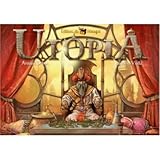
- Utopia
Germans are too smart to get hung up on it, but Americans are wont to
argue whether games should be designed starting with theme or
starting with mechanism. But are these two approaches the only
ones? Have you ever considered a game designed first from
aesthetics? This just might be what we have here. Perhaps someone
said, let us create a really cool-looking game with
several colorful islands onto which players build some very
nice plastic monuments and wonders derived from five civilizations
(Chinese, Egyptian, Persian, Greek and Mayan). You may be laughing,
but this is just the feeling conveyed. One factor in its
support is the ostensible theme: the ruler of mythical Utopia
has invited ambassadors from of all of these places and the
players represent officials welcoming them in and encouraging
them in constructions according to the styles of their native
lands. What actually happens is that a number of tokens
representing foreign princes are drawn from a bag. These are
doubly-coded, once for the island on which they must go and
once for their nationality. Players take turns replacing one
of these with a token of their own having the same nationality
and placing it on the appropriate island. After this they receive
cards which they use to perform various actions with their
tokens of matching nationalities. Having a token of each
nationality on an island permits creation of its wonder. The
owner receives some points every time a player builds a
monument on the same island, something achieved by having
three tokens of the same nationality in the same location.
Points are also awarded for causing tokens to enter or leave a
building of their nationality. Finally, points are given at
the end of each round according to a schedule, five for each
monument of one of the nationalities, four for another, three for a
third, and so on, all the way down to one. This is very nice
for those players who managed to pick up tokens of and build
the buildings of the highly-valued nationality and it's
possible to open up a big lead. It is possible to change the
schedule and make the top scoring type score only one, but it
requires one trailing player to "take one for the team" and
burn up resources to do it for the benefit of all of them.
It's not really good to do it, but not doing it is even worse.
The real problem is that a two-player game mechanism has
been fitted into a multi-player game. Having failed to
diagnose this, the inventors (who also invented
Khronos),
at least realized that some catch-up mechanisms
were needed; three are provided. First, turn order is
based on the number of points (though possibly this should be
reversed). Second, a player unhappy with
the choice of princes may instead pull one from the bag and as
a side effect also give a free placement to another player,
presumably another trailing one. Third, when it comes to
cards, the leading player must discard two, the last place
player none and those in the middle just one. While good ideas,
if the board has become too full and the prince or card draws
are insufficiently cooperative, all of these valiant efforts
may not be enough. But just look at those beautiful bits.
There are forty monument pieces, four wonders and five nicely
sculpted officials in different colors. The board, tokens and
pieces are very attractively illustrated as well. On the other
hand, all of this artistry does somewhat work against the
communication design. There's no easy way to associate the
prince types with their monument types. This can be solved by
taking one example of each and placing them together in plain
view, but it's unfortunate that color or some other method
wasn't employed to make this clearer. The cards are not
always so easy to match up with tokens or buildings either.
And once the buildings start populating the board, it becomes
difficult to see the counters which hide behind them.
This mostly opportunistic affair with a high price tag should
appeal mainly to tacticians as well as parakeets/collectors.
It probably also works better as a two-player affair than many
multi-player vehicles.
Strategy: Low; Theme: Medium; Tactics: High; Evaluation: Medium; Personal Rating: 5
Ludovic Vialla & Arnaud Urbon;
Matagot/Rio Grande;
2007; 2-5
[Buy it at Amazon]
On to V
- Main
Please forward any comments and additions for this site to
Rick Heli.