Spotlight on Games
>
1001 Nights of Gaming
- L -
- Laborigines
-
In a circular path are placed seventeen double-sided tiles, randomly.
Using clay, each player sculpts a pawn, representing a creature
mysteriously created in a lab, and takes a number of energy tokens
(cubes) in their color. A five inch high clay head
called the Moa is also placed. On a turn a player rolls two
dice, one of which he chooses to move the Moa clockwise, the
other being used to move his pawn in either direction. Players
who get landed upon must give up energy. A pawn that lands on
another moves the same amount again until a free tile is
reached (could this become an infinite loop?), at which
point the tile is flipped over and its effects applied. These
include diseases, lightning strikes, acid baths, explosions
and an immunity flag; all but the last involve token loss.
Half of the tokens are left in the pawn's starting and ending
spaces, ready to be picked up by whoever can land there.
While the round tiles are large and well-made, the Moa
impressive and the pawns as good as the players care to make
them, there is too much of a memory element and too little
real decisionmaking for this to appeal. Player elimination
gives a negative flavor as well, though most of the eliminated
will find themselves happy to be no longer playing. Moreover,
the instructions are somewhat confusing, leaving vague questions
like what the immunity flag does and does not protect from
and where tokens lost by inactive players go. Even for
children this is doubtful as besides elimination it's a slow
war of attrition that can last a couple hours and requires
great patience. Plays with six only in partnership mode.
[6-player Games]
Strategy: Low; Theme: Low; Tactics: Medium; Evaluation: Low; Personal Rating: 3
Tomas & Jakub Uhlir; CzechBoardGames; 2007; 2-6
- Labyrinth Das Kartenspiel
The card game version of Master
Labyrinth is another development in an ongoing and
somewhat disturbing trend of board games morphing into card
games, usually to the detriment of play. Earlier examples
include Die Siedler
Kartenspiel and Café
International. This one starts out promisingly with
about twenty-five different iconic treasure items which are a
pleasure to discover and a "board" which, speaking of morphing,
re-arranges itself constantly in nearly kaleidoscopic ways.
However, while there is a little strategy, for the most part plays
are obvious as there does not appear to be enough connectivity on
the cards to make for truly interesting plays. It becomes more
of a puzzle, but not one which is really in the player's control.
Strangely, the deck contains only fifty cards – it would seem
more fair for there to be sixty in a game which is designed for
two to six players.
- Ladybohn: Manche mögen's heiss!
This is one of the strangest publishing situations ever.
Originally there was Ladybohn published by Lookout.
Then there was this game "Ladybohn: Some Like It Hot"
published by Amigo. So far all is normal, except that not only
did the game completely change somewhere along the way, but it
appears to have actually gotten more boring. Well, the last
part should be qualified as it's based not on actual play, but
only on perusal of the rules, but it certainly looks to be so.
And as to the degree of change, it is not possible to play
either game with the other's components. Now to focus on only
this game. It's a standalone that has the usual beans, but
changes some of them to female versions with new artwork and,
more importantly, better beanometers. If at harvest time a
female version is the last one planted, the harvest rate is
likely better. There are also baby beans which are planted
just like all the rest. However, they do not permit any
harvest proceeds at all. They do have the side effect though
of moving one lady bean in the row two places nearer the top.
Apart from these alterations this is
Bohnanza
as usual. As such, it's not a particularly interesting variant
since there is little different to do. Mostly one plays as
usual and just deals with the new features as they are forced
upon one. There is extra fiddliness in having to pull the lady
beans out of the stack and move them. It appears a shame that Amigo
did not stick with the original version, which was
unfortunately printed in a single rather limited edition.
Uwe Rosenberg;
Amigo Spiele; 2007; 3-5
Strategy: Low; Theme: Low; Tactics: Medium; Evaluation: High; Personal Rating: 5
- Lamarckian Poker
James Ernest-designed card game in which players try to evolve the
best poker hand. The reference is to early naturalist LaMarck's
incorrect theory of evolution which held that if, for example, a
giraffe stretched its neck the progeny would have a longer neck.
Awful luck is possible, but usually works out pretty well
as long as there are four players or less. Players should be
careful about trying to be too fine in the early game. First
try to acquire several extra cards before trying to get the
perfect hand. Easy to play and interesting to try to master,
as well as to observe how much the hand has evolved since the
beginning of the game.
[rules]
- Lancashire Railways
Railroad game set in the UK involving bidding to be the one to build
track and then gaining income based on deliveries made over it.
I prefer New England Railways
which uses exactly the same system as it does not feature this
one's long north-south, spinal track. In addition, the demands are
grouped much more homogeneously location-wise. While this is all
probably realistic, the result seems to be that the central spine
tracks are all important. They pay a great deal and other players
cannot help using them as well. Whoever can own these tracks seems
destined to win so there appear to be fewer strategic options
here. This can be unfair as these tracks might appear when one
happens to be low on funds and inspite of the "inflation" rules
meant to hamper the leader, it can still be that the rich get
richer. There can also be kingmaker situations towards the end.
We play by drawing tracks on the board with dry erase markers
instead of using chits and found it about 100% better in terms
of deciphering the board. I am still wondering whether the
game would be improved by a variant which prohibits a supply of
something appearing at a city where it is demanded. By the way,
while I generally like little wooden blocks in games, in this one
I thought it might have been nicer to have the commodity chips
that one uses in a game like Empire
Builder. Otherwise, one never pays any attention at
all to the type of what one is hauling. Probably a long way
of saying the story element is not as strong as it could be.
[6-player Games]
Martin Wallace;
Winsome; 1998
- Landslide
A presidential election game which offers some possibilities
for fun, but is ultimately disappointing. Players must bid for
states unseen so except for the player who draws it, a state from
the East could be New York's 41 electoral votes or Delaware's 3.
This does not exactly reward strategy. Moreover there is plenty
of luck depending on which space a player rolls to land on.
The same goes for drawing vote cards from the hands of other
players. Then there are political cards which allow breaking the
rules in some way, but these cards are so ambiguous that play may
break down entirely. Finally of course, if one is to play today,
the electoral vote totals are in serious need of updating.
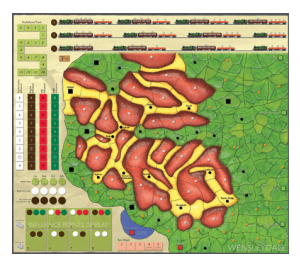
- Last Train to Wensleydale
Those old enough to know the
Monty Python Cheese Shop sketch
need not fear: there's no cheese here, except in the theme of
course. The other question is, since creating
Age of Steam
which has spawned myriad imitators (many of them published by
erstwhile partner Winsome Games), has the original inventor
forsaken the rails? No indeed; he's back, and on an entirely
new track. Borrowing an idea from
Tinners Trail
(as firmly set in Cornwall as this one is in the English
north), each playing differs by virtue of the random starting
placement of tokens. These represent the aforementioned cheese,
ore, passengers headed in one of two directions and finally
landowners opposed to track being built on their lands.
It's the players' task to use influence tokens to overcome
the last named in order to build track and ship out the first
four. Much of it dominated by impassable hills (where the
ore is found), the map is rather irregularly divided into dozens of
areas. Not necessarily a knock since learning new
skills is often fun, discerning connectivity is not always easy
and it's possible for first time players to miss seeing
valuable openings. For of course only one player can build
track in each area and cutting off the paths of others is
often a useful tactic. On the other hand, there is plenty of
built-in connectivity and there shouldn't usually be any
question of anyone falling dramatically out of the running.
Questions of turn order and resource allocation are once again
handled masterfully, the hallmark of most Wallace games.
Influence is not a generalized quantity as with most games,
but more realistically comes in four types: government (which
helps with both turn order and those squatters), local
engine yards (which helps with shipping) and with the two
trunk lines in the region. These items exist as discs that are
semi-randomly distributed into eight lots each turn. Players
bid on these using their investment cubes which are fixed at
fifteen. It's a
multi-multi
system with responses delayed until the player's next bidding
round . The need to bid high to get the best lots fights with
the need to save cubes for track construction. Routing has the
challenging restriction that each turn must be built as a single
end-to-end segment with no branches. It also requires the
aforementioned influence to connect to the trunk lines.
Once all have built, the local influence determines the order
of securing trains of varying types and sizes. These
activities are interleaved with shipping which gets tricky
as sometimes more than one player can ship a particular item.
Then players add up their shipments and deduct their number
of train links to adjust their profitability status for the
turn, which affects player order. Finally, players decide
which of their track to sell to trunk lines, facing the
dilemma of their continued cost vs. the opportunities that are
thus opened up for opponents who may now link to the
accessible lines. This has the side effect of radically
re-making the board each turn and players must keep on their
toes to spot opportunities. The fact that there are two trunk
lines sometimes leads to dilemmas over which one will get the
track which can have surprising consequences. Game length is
a fixed number of turns, which is somewhat annoying to track;
it's regrettable that a better way could not be found. Victory
is calculated, somewhat athematically, by a combination of set
collection of pieces delivered plus profitability minus
remaining owned track. This lasts about two hours, which feels
right for the situation, and is not overly difficult. There is
a positive feeling as usually the decisions are between multiple
beneficial choices rather than, as in some games, between
relative negatives.
[multi-multi auction games]
Martin Wallace;
Treefrog-2009; 3-4
[Shop]
Update: First Train to Nuremberg
In this new edition the map is double-sided, one again showing
Wensleydale – this time with a more palatable color
scheme – the other the Nuremberg area. Note that
there are
map errors on the Wensleydale side
and
a problematic border on the other.
On the topic of flaws, there are also about three significant
ambiguities in the rules. On the other hand, the summary sheet
is excellent and this is almost playable from it alone.
There is also now a two-sided sub-board for the auctions and
statuses; alas the space allocated to four tracks is too small
(a lot is wasted on the little-used profit/losss track)
for the disks that rest on it so mistakes are easy to make.
Other differences in this edition include support for two
players including a rules version for tighter play with two
players (basically changing the number of available options
and some valuations) which can also be used for three. As this
is played more and more, the fiddliness of the setup has begun
to irritte. It takes considerable time as probably a hundred
items are drawn out of the bag and placed in various
board locations, from which about half are removed. It's a
bit tricky and error prone and often if messed it's
generally necessary to completely start over. That's time
that would be better spent just playing. Another realization
that comes from more playings is just how unfair the
Wensleydale map can be; if it happens that items on the right
half are sparse, someone starting
at the bottom left can wall off most of the board and just run away
with things. The Nuremberg map is more open which would seem
to indicate that the problem would be less likely, but
actually it's still possible to wall off a big part of the map,
which seems to be the main tactic in the game. But this has
several unfortunate consequences. For one, the player who does
this becomes almost impossible to beat. But that's not all.
Now this player's main concern is not to make too much money too soon,
but delay it until the last turn so as to maximize end of game
points. How much sense does that make in real life terms?
This last turn becomes a time-wasting exercise as well
since there is no chance for anyone else to possibly win.
A final concern is that the closely-interlocked mechanisms of
this game lead to a constant feeling that one has just
completed the wrong move. You might have been thinking about
how far to extend in order to get more pickups, but forgot all
about ending at a station, which is what's needed to sell
track to the state. Or you should have built one track
past a station in order to ensure that after you sell
back you are the only one to take advantage of the new
position on the next turn. Or you might discover that you
don't have enough points to sell off as much as you intended
and so you actually built too much. And there are more. On the
marketing front: considering the trials held there afer World
War II, it's curious that the publisher didn't think this
title would put players off.
Martin Wallace;
Argentum Verlag-2010/Z-Man Games-2010; 2-4; 120
[Shop]
MMHH5 (Strategy: Medium; Theme: Medium; Tactics: High; Evaluation: High; Personal Rating: 5)
- Leader 1
Compared to
Bolide,
this publisher's last racing effort, this is much more of a
game and less a simulation. But is this a compromise which
will please anyone, and if so, whom? One of the clever ideas
here is the concept of the main group (peloton) to which all
racers belong at the start. Until a racer tries to escape it,
it moves three to five spaces (via die roll) and all
racers in it consume the same amount of energy. Racers
generally expend extra energy to move past it and hope not to
be caught. Cyclists come in three types: those effective on the
flats, those who excel in the mountains and those who are good
all around. These are represented by their base speeds in
various terrains to which energy points may be added; thus
dice are not involved in individual racer movements. But there
are other issues. On a track having only three lanes, there is
plenty of blocking as only one racer is permitted per space.
There are also issues of handling the curves, which are
treated quite seamlessly by lengthening and shortening
spaces depending on whether the curve is being followed
in the optimal lane or not. Drafting is handled by giving a
one space movement bonus for having directly followed
another bike on the previous turn. Disasters can crop up in
the form of punctures which turn up on the die once or
twice per game. Even then, it's just a requirement that every
rider pass a puncture dice check, which by far most will do. The
effects are not major either, as it only changes the turn order
– often not important, save for the last turn. The
other variable is that each turn there is a round leader who
individually gets to decide if the peloton is trying to push
things and if so, it moves an extra space. The abstracted
peloton appears to be the major obstacle from a simulation
point of view. Staying in it, one hardly uses energy at all,
yet the peloton often manages to stay right with the riders
for a long time. This is rather unfair to those who have
broken away and who may even be caught and thus suffer a net
loss in energy. It seems like if the peloton is going to work
this way, then maybe its die rolls should be replaced by card
draws so that there is a fixed total or tendency it can have.
From the entertainment point of view, it seems often the best
thing to do is stay with the peloton which is boring as can
be. But if many riders break out of it, then turns become quite
long and the waiting time while each player painstakingly
counts out his move and updates his energy supply can become
unendurable. Also because of the nature of the sport, it can
well be that there is little excitement until the last turn or
two. So ultimately this game may not completely satisfy
anyone, but if it does, it is still mostly in the simulation
camp and of most interest to those who are well steeped in
cycling lore (which for better or worse is not most
Americans). 'Tis a pity as the large hexagonal track tiles
are as hefty and gorgeous as we might expect from an Italian
production while the rider pieces, though a little fragile,
are rather evocative as well. But except for the hard core
audience, probably the only way to come close to enjoying this is as a
three-player game with three team members each. By the way, do
you have any idea how many cycle racing games have been published?
What would you guess? 20? 30? 50? All are wrong. There are actually
over 150 cycling games
at present, and those are only the published titles.
[Cycle Racing Games]
[6-player Games]
Christophe Leclercq & Alain Ollier; Ghenos/Rio Grande; 2008; 2-10
Strategy: Low; Theme: High; Tactics: Medium; Evaluation: Medium; Personal Rating: 5
[Buy it at Amazon]
- Leftovers
Small press Rummy-style
card game for 2 to 6 about building meals using remains of previous
dishes in five categories. A meal consists of a card in each
category and one may make one for any player who doesn't already
have one melded. There is a substantial points reward for doing
so – which declines on each new meal – to which card points
are added (or subtracted since many cards are negative) at the
end. A player's turn then consists of only one of the following
possibilities: (1) make a meal, for anyone; (2) use hand cards
to replace some of one player's, including own, meal cards; (3)
"eat" one of one's own cards preventing its future replacement;
(4) pass. The amount of time required to figure out these
decisions, especially because two entirely new cards are drawn
at the start of the turn, causes exponential downtime problems
at more than four players. Not only are there more players
to wait for, but they have more other player meals to examine
before making their choices. Something similar can also crop
up in something like
History's Mysteries,
but is less likely as the information gathering
and decisionmaking is much less. Drawing the cards at the end
of the turn rather than the start would have helped, but to
avoid one's own discards getting in the way, this would really
require five discard piles à la
Lost Cities,
which might make meal creation far too easy. The
point awards for creating meals might be too high as well since
a player can't really sacrifice anything to acquire the necessary
cards. This bonus simply goes to the player lucky enough to draw
the right cards earliest, statistically the earliest players
in the hand. Since these points can never be taken away, it
seems too perfect a strategy to always play a meal as soon as
possible, no matter what its quality. If played on oneself,
there will probably still be time to fix it later. Moreover,
toward the end players are too nervous to hold many cards,
which if in hand accrue as penalty points, so are not likely to
have much ammunition for sabotaging another's meal in any case.
Packaging is a cleverly-related takeout food box. Card art is in
color on business-sized cards, but disappointingly in the form of
clip art. Still, it is some of the better clip art I have seen.
Perhaps a future deluxe edition could employ more personal and
thematically unified original artwork. Overall this is sort
of a Cheapass-style game, but less satirical, in color and for
less strategy-minded players. Up to four can reasonably enjoy
the tactical possibilities and tension
over the uncertain ending in this innovatively-themed effort.
Strategy: Medium; Theme: High; Tactics: High; Evaluation: Medium; Personal Rating: 5
Candy Weber; Weber Games-2004; 2-6; 30; 5+
- Lego Creator
Roll-and-move game for children whose spaces instruct which
and how many building pieces to take from the common supply.
The goal is to be the first to complete the assembly on one's
unique card. Decisionmaking is entirely absent apart from
choosing first items which others will not wish to steal, but
there are times when players have no pieces in common. Perhaps a
bit of educational value in construction from a plan is there,
but otherwise this is just another vehicle for selling Lego
pieces. Setting up all of the pieces beforehand is lengthy and
boring as well.
- Leinen Los!
Dexterity game of racing boats around an obstacle course.
Each small wooden craft's "engine" is a wooden dumbbell
standing vertically in a notch at the back. With the words
"Cut the painter!" a player presses down on the engine with
just one finger, attempting to direct the boat along
the turn-filled course. The problem is that unless moving
slowly and absolutely straight the engine tends to slip out
and with it any possibility of advancing. And if the task
weren't difficult enough, the course doubles back on itself so
that opposing boats may be in the path with almost no ability
to dislodge them. By the way, this activity is also timed, via
a unique method: another player wraps a rope between two
mounted pegs until its length is ended. There are pretty good
rules here for exceptional situations – often missing in
such games – as well as two different courses. A variant
employing a book to create a slope in the board is also
provided to increase play value. This is probably mostly of
interest to children, but can hold a line for adults as well.
The German title means "Loose the line!", but surprisingly as
the instructions state, the
English title would be "Cut the painter!" Probably only folks
with an interest in matters nautical would realize this has the
same meaning, i.e. untie the rope connecting the boat to
whatever is holding it fast, or more generally, to set out or
depart. Why "painter"? It seems to relate to the words
"depend" and "pending", coming from Late Middle English
"paynter" which came from Old French "pentour" which
ultimately derives from Latin "pendere", meaning "to hang".
So the painter is the line that the boat is hanging on. The
Norman French conquered England via boat and controlled naval
operations. The strength of tradition in naval circles is probably
why "painter" has triumphed over the Anglo-Saxon "line".
Alex Randolph;
Haba; 1996; 2-4; 6+
LHLL6 (Strategy: Low; Theme: High; Tactics: Low; Evaluation: Low; Personal Rating: 6)
- Letters from Whitechapel
-
Besides this, Gabriele Mari has two published games: Mister X
which is
Scotland Yard
on the continent and Garibaldi, in which the Garibaldi
player tries to hide from and escape the Austrian police. Can
we guess what must be this inventor's favorite game in the
whole wide world? So while we may be thinking, who needs
another Scotland Yard, we should keep in mind that
someone else must have been thinking, "How can we make
Scotland Yard even better?". Even though the
protagonist was called Mister X, the setting London and
the police sort of bumbling, Scotland Yard players
have always had lurking in the backs of their minds Jack
the Ripper. Well, now he lurks no more, but is out there front
and center with all the gore and mayhem one would expect. Each
night the Jack the Ripper player whom the rest team up to
catch, must commit at least one murder and then run back to his
lair, where he becomes safe. The tone becomes much darker
anytime there are simulated blood spatterings on the board.
The intrusion of reality becomes all the more with the highly
detailed, period style map of London, the fancy cards providing
historical information and the figures resembling bobbies and
lady victims. Strangely, however, the usual Scotland Yard
visor meant to hide the villain's eyes is not provided. The
voluminous instructions are not the easiest to comprehend
either, but they're better than the confusing flow chart shown
on the player aide cards. Despite a fair number of special
rules thrown in for flavor this is Scotland Yard on a
mild steroid, its extra wrinkles not really worth all of the extra
time – three hours in all – it requires. Unless
one is an absolute fanatic about the original, this is basically
the same stuff: secret movement by one with the rest figuring out
where he's gone and covering the likeliest possibilities. Sure
it can finish in ninety minutes like the box says if he's
caught on the first night, but it can take much longer.
Considering that in the early days most Jacks are going to be
played by the more experienced player, likely the owner
of the game who knows the map best, he will have the advantage
and most likely the game will go on for the duration. Better
to get the same degree of fun from the original and also
be able to play something else as well in the same amount of time
because let's face it, this is never going to be as fun for
the detectives as it is for the Jack player.
[6-player Games]
LHML6 (Strategy: Low; Theme: High; Tactics: Medium; Evaluation: Low; Personal Rating: 6)
Gabriele Mari & Gianluca Santopietro; Nexus-2011; 2-6; 180
[Shop]
- Letzte Paradies, Das
Reiner Knizia board game about the development or preservation
of a pristine tropical island. Short game of sixteen auctions
seems to mostly be about blind bidding to the wall. Generally
nice components are not without problems as it really needs a
screen to hide unspent coins, especially as the wooden coins
are so large that they cannot be easily hidden with one's hand.
The artwork of the board does not match the promise of the
attractive boxcover. Such elaborate wooden pieces and large board
seem incongruous in such a short and simple game. Title means
"The Last Paradise".
[Tourist Games]
- Liar's Dice (Bluff, Call My Bluff, Perudo)
Another one of the traditional games which has also been published
commercially. Players all make a secret roll of five dice and
then start making claims about the results, or deny the last
claim made. Each time a person is caught in a lie or wrong
denial, the wrongdoer loses a die. Many play with the rule that
aces are wild unless the very first claim involves aces. The
game has plenty of interest, but can sometimes be decided by
lucky rolls, i.e. high rolls of many matching dice.
[Spiel des Jahres Winner]
[6-player Games]
- Lift Off [Queen]
Card game about planetary occupation and mining. Has real-time
aspects reminiscent of Brawl
as players try to pile up cards as quickly as possible.
Seems rather too subject to luck of the deal, even if the real-time
aspects are agreeable, although in general such are not compatible
with strategizing.
Marcel-André Casasola-Merkle;
- Lift Off! [Task Force]
Game by Task Force about the space race of the 1960's. Players
represent the space programs of the USA, USSR, PRC and European
Union trying to be the first to land and successfully return a
man from the moon. Features a rather satisfying level of detail
about various delivery vehicles and payloads. Development of
systems is reflected via paying for dice whose totals are added
to the system's safety and reliability percentage. Different
systems thus have different research costs. They also have
different maxima, meaning that for certain kinds of systems
you can never reach 100% reliability by R&D alone.
Further improvements can be made by
successful use of the systems. Players are engaged in the
full gamut of launch activities including mere earth orbits,
lunar satellites, satellites to Mars and Venus, spacewalks,
etc. With each success, space programs are given more funds
with which to prepare further missions. It is even possible to
develop the space shuttle. Serving as a brake are event cards,
most of which tend to trim the sails of the current leader.
Tricky is the need to plan missions one year in advance,
i.e. without knowing how the current year's mission will turn
out. Tricky because if a system fails, reliability numbers go
back to the stone age which can be a big problem if you were
planning to use that system in the next launch. There is an
amazing amount of very realistic detail in the mission failures
. one could write a legitimate-sounding history with the results.
Overall, plenty of stategic and interesting decisionmaking which
should keep players interested for many repeats.
Also later released as a computer game.
- Linie 1 (San Francisco Linja 1, Streetcar)
Game of the "pipe connection" type in which players must construct
track between their two stations, visiting certain stops on the
way, finishing up the game by "proving" the efficiency of their
route by actually running a streetcar over it. German rules move
the streetcar via die roll which is luck prone while American
rules (preferred) use movement based on previous player's speed
which occasionally provides a kingmaker opportunity. One of the
great fascinations of this game are the tradeoffs it offers and
the difficult decisions that the player must make in response.
The route which is strictly speaking the shortest may contain
stops, which tend to impede velocity. Do you want to use them
and hope that you don't get major movement penalties or do you
want to route around them? Do you want to spend time making sure
that stops for stations not of interest don't get in the way?
In fact, the game has been called "broken" because of what has
been termed its "conflicting goals." I guess that is another way
of saying that there is no clear indication of exactly what steps
are needed to obtain victory. Complainants will state that the
three main goals in the game are incompatible with one another:
(1) minimize the number of stops on your route, (2) minimize your
route length, (3) minimize the amount of time to complete your
route. But on the other hand this is what makes the game so
fascinating. Empirical study seems to indicate that the above
order should be the guide to priorities. Tactically, try to
establish as late as possible the tracks which reveal your entry
and exit locations. Published in English as Streetcar
with a New Orleans setting and in Sweden as San Francisco
Linja 1. The smaller packaging of the English edition
may make it the best, even if somewhat drab. The Swedish
edition is so busy that it can actually be confusing to play.
It also has a few simple curve pieces which have trees on them,
meaning they cannot be replaced. This would be a bad good idea
as possibly someone could be prevented from ever reaching their
station, but according to game reviewer and bona fide Swede
Carl-Gustaf
Samuelsson, this version adds the rule "you may not play a
tile which totally prevents a 'rail termination' from reaching
completion". It seems to me much simpler to ignore the tree on
these tiles. Update: Over time, found that if playing with
friends this is okay, but with people you don't know, there is too
much scope for being very nasty, possibly for the sake of nastiness.
It's frustrating that the game rewards negative play instead of
encouraging everyone to pursue their own goals. When others stop
focusing on their own progress and only interfere with yours,
it undermines the sense of fair competition. It also feels like
your efforts are wasted, especially if your strategy was sound
and efficient. This creates a spiteful atmosphere instead of a
strategic challenge, which is not what board games should be about.
MMHL7 (Strategy: Medium; Theme: Medium; Tactics: Medium; Evaluation: Low; Personal Rating: 7)
Stefan Dorra; Goldsieber/Mayfair-1995; 3-5; 60
[Two vs. Two Games]
[Frequently Played]
Stefan Dorra;
- Linq
-
Imagine two people, identities unknown, who try to communicate
with one another over a difficult connection while others
listen and use what little they say to identify them.
You could imagine ships eavesdropping on submarines, two
spies whose messages are intercepted or even
outer space aliens listening to earth communications, but it's
the situation not the setting that matters
in this party game. Using cards two players are randomly, and
secretly, allocated the communicator (spies) jobs. Their
cards contain a numbered list of 10 words, one of which is
chosen for them to use. In round 1 each player takes a
turn saying any word, other than the actual word. In round 2
they say their previous word and then add a second word.
The spies try to use words that help their partner to know
that they know what the actual word is while other players
try to fool the spies by guessing what the word might be and
trying to sound like the spy. The biggest surprise might be
that this can be easier than one would think; voila, another
talent you didn't know you had. All of the words are written
down on an erasable board so that everyone can see them. Then
on the count of three every player uses both hands to point
to their top two suspects. Spies are quickly identified: they
are the ones with one hand pointing at themselves. It's vital
that the spies cooperate since they score best if both of them
identify one another, but it's just as important that they
not be too obvious otherwise they must give points away to
any non-spies who identified both of them. So here's a
challenge for the spies – how to make their word clear
and yet also fit in with the rest of the words being uttered.
There is a clever tactic for non-spies that can be
used against other non-spies: they can try
to pretend there is a code word between themselves and in
that way throw others off the trail. Finally, any non-spy who
guessed both spies can get extra points by successfully
divining what the actual word was. This is a language game
that greatly benefits from English's dual heritage of German
and Latin. Most English concepts have at least two synonyms,
which means that even though this is designed by Germans, it
probably shines best in English. The presentation is well
done, including dry erase markers and two score sheets, an
indication of a sincere attempt to prevent cheating, intentional
or otherwise. There is some worry about using up all of the
words on the fifty-five cards too quickly so let's hope this
is a big success that generates many expansion kits. Meanwhile
players can have a lot of fun outguessing one another in this
quiet and thoughtful form of a party game which is probably
best with six or more. Also included are three variants, the
most intriguing of which features two teams of spies.
[Party Games]
MMML7 (Strategy: Medium; Theme: Medium; Tactics: Medium; Evaluation: Low; Personal Rating: 7)
Andrea Meyer & Erik Nielsen; Bewitched-2004/Endless Games; 4-8; 45
- Livingstone
David Livingstone (b. 1813) was a British missionary and
explorer to Africa. Becoming ill there, he lost contact with
the outside world until being found by the Welsh journalist
Henry Morton Stanley. This first game by Benjamin Liersch is
not about that story. Instead, we find a take off from the
ideas of
Yspahan,
combining it with a majority control mechanism and other features.
The board is essentially a grid, though artistically designed
by Michael Menzel so as to make that inobvious. Along the
bottom moves a steamer piece. Stretching above it are zones
numbered one through six onto which players may place tents by
using a corresponding die roll. These are derived from the
roll of all of the dice by the current player, each one in
turn being able to draft a die, so long as it is higher than
that of the previous dice one has drafted in the turn. At the
end of each turn scoring occurs for placement in the column,
the higher the placement the higher the score. At the end of
the game, there is scoring for having the majority in each
row, the highest value for the lowest row and decreasing as
one goes up. But placing tents is not the only use for dice.
Another is the ability to draw largish, irregular plastic rock
pieces from a cloth bag. Here one wants to get the valuable
jewels, which are almost always turned in for the cash needed
to play tents (a cost which goes up as the game goes on), and
avoid both rocks and the reset rock which causes one to lose
everything and returns discarded rocks to the bag. The number
of rocks one can draw depends on the number of dice pips used.
The last and best use of a die, however, is to draw an event
card. These cards offer so much power that it should almost
always be the choice one makes, provided one has a bit of
money perhaps. But the cards even provide this. They can
provide tent placement as well. They can even turn back time,
by forcing the last column to be played again. One final
dimension is that just as in the recent
Hab & Gut,
players make secret donations, in this case to the queen.
The player who has donated the least automatically loses.
(This is also similar to Knizia's
High Society.)
The game has been magnificently produced with cardboard boxes
to hold the donations, unique wooden tent pieces, a wooden
steamboat, a clear and yet attractive board as well as the
aforementioned jewels in five colors. Yet what the thematic
connection to the title, or anything is, remains a mystery.
So ill-fitting is it that suspicion is strong that the original
design had a completely different theme and this African one
was picked by the publisher. But no matter: this is far too
long for the degree of luck involved and a dry, trite mechanism,
event card draws, has been permitted to dominate play.
Benjamin Liersch; Schmidt/Playroom; 2009; 2-5; 8+
[Buy it at Amazon]
MLMM5 (Strategy: Medium; Theme: Low; Tactics: Medium; Evaluation: Medium; Personal Rating: 5)
- Logistico
Not every inventor can make every sort of game, but
in recent years Corné van Moorsel has fielded
many different horses, e.g. linking, dominance and
sports, in Morisi, Zoosim and Streetsoccer
respectively. Now he has one of yet another color: a traveling
merchant game of planes, ships and trucks. It's a contracts game
and they are all fully public: first come and first served apply
on either end. One's first playing is lived in stages. First
experienced is Bewilderment at all the colors and delivery
possibilities. Second, there is Doubt as it becomes apparent
how expensive it is to move more than an iota at a time.
Players concentrate on low-hanging fruit, i.e. the fortuitous
short deliveries. A motherly rule prohibiting movement without
profit helps protect players from serious mistakes. Then, Dismay
registers over the difficulty of re-positioning the short haul
vehicles to complete long run deliveries. Scores may go negative
for a while. Are we really playing the game as she was intended?
Finally comes Enlightenment as with patience things can get
done and all will be right again. It's a contest of close
planning, divining the opponent intentions and (a few) hidden
objectives. One of the best ideas here are the variously-abled
vehicles and getting them to work together. Eventually it
crystallizes that the slower ones must get materials to the
nearest airport where they can be jetted to another airport for
the other vehicle to complete delivery. The other very nice
wrinkle is that payoffs depend not on the distance traveled
and the like, but, surprisingly, on what turn it is –
payoffs increase as turns pass.
In most games of this type, calculating payoffs is a tricky,
messy business and the realization that the longer it takes
to do something the more it is worth is a very clean solution
which works because it is a system of pure competition with
high costs to both storage and moving quickly. So the prima
facie audience would seem to be train game fans, but they
may prefer a little less luck than that given by the random
starting locations and secret goals. In addition, they may
dislike the thematic liberties taken as it seems difficult to
explain why no new materials or contracts every appear or why
the secret deliveries make sense in a real world. Probably this
is more for would-be train game fans who find them overly long,
repetitive and absent chances to catch the leader. For this
group this should work fairly well although some doubts remain
about whether there isn't bias in the turn order despite the
inventor's public comments to the contrary. But perhaps more
playings will prove him right. Certainly, rotating the turn
order as in Puerto Rico
could result in a lot of analytical headaches, and down
time. A better solution might be to bid for turn order if
it becomes necessary. The O
Zoo le Mio money must be helping Cwali games to
look better than ever as the usual tube has given way to
a box. To be found within are a puzzle board, glossy cards,
glossy instructions in multiple languages and plenty of wooden
discs and cubes. [Cwali] [Traveling Merchant Games]
- Lokomotive Werks
Board game featuring the gradual introduction of train technology and
receipt of its attendant benefits which
delves into problems of production, sales and
most importantly, obsolescence.
[more]
MMMH7 (Strategy: Medium; Theme: Medium; Tactics: Medium; Evaluation:
High; Personal Rating: 7)
Dieter Danziger; Winsome Games-2002; 3-5
- London
-
This is the history of the city since the
1666 Great Fire
to about the year 1900. Apparently it originally also
covered the period before the fire, but since everything was
going to burn down, there seemed little point to the first
part of the game and it was removed. Other games would have
tried to fudge this so full credit to Mr. Wallace for
embracing the theme. Perhaps one day we'll see a
Londinium for an earlier period? After so many games
eschewing cards, the inventor has gone crazy with them this time,
offering a double deck of 110 with a large variety of technologies,
businesses and cultural developments spread over three
programmed sub-decks. Initially players are mostly drafting
new cards, but under control of a hand limit, eventually forcing
return of hand cards to the board for others to pick up.
Finally the hand is as ideal as it's going to get and so
it's time to start playing cards. These go to one's personal display
and now it begins to be tricky. It would be good to play lots
of cards so as to acquire lots of capabilities and, in
particular, ways to generate cash and/or victory points, but
maybe you should think about that a little. Each card is a
little engine or transformer, consuming coins or cards or
something, maybe nothing. Thus the third option in a turn is
to run one's portion of London, activating one or more cards
and having them produce. This is great, but afterwards comes
the catch: each card showing (they can be stacked) and each
card still in hand generates a poverty point. Getting too many
of these can be pretty bad because at the end of play the
player with the fewest discards all of his. The rest
discard the same number and then consult a fairly steep
schedule to see how many victory points each loses. Leftover cards in
hand also count as poverty points by the way. Thus, acquiring
those cards which help dissipate poverty is very useful.
Another way is to buy land, in the form of boroughs, in
a special phase. Decisionmaking here is good since each
borough is a different set of cost plus number of cards and
victory points provided. Importantly, poverty point
earnings are reduced by the number of boroughs owned.
It's thematically satisfying that new boroughs must expand out
from an existing one and across the Thames River only via a
bridge. With so many different cards there's a lot of artwork
here and it looks quite good. Cards are all named, e.g.
Bank of England, Huguenots, Nelson's Column, Streetlights,
the Underground, and have thematically-appropriate effects.
The map looks to be historically accurate as well. Cards
feature iconography for their functioning parts and for the
most part it works. A supplement to the rules explains some of
the more complicated ones. Some may be bothered that there is
a fair degree of randomness here, but for the most part, the
curious truism that players don't mind luck when it stems from
cards coming out of a deck applies; e.g. it's entirely possible to never
see even one of the valuable Underground cards. This might be
okay if it's possible to make use of the others, but when one
has been building up toward certain cards it can feel rather
unfair. But as there are usually ways to at least accomplish
some goals, this is usually not a problem here. This is also
one in which familiarity with the cards will give experienced
players a greater than usual edge. Four player is probably not
the best configuration as there may be too much waiting
between turns. The real
challenge, as well as the fun is how to play well. What's the
ideal number of card piles to work with and under what
conditions does that change. As that's so much at the center
of the fun, besides the history, no discussion of it will be
found here. Go out and get this and try it for yourself.
Includes instructions in English, French and German.
HHMM7 (Strategy: High; Theme: High; Tactics: Medium; Evaluation: Medium; Personal Rating: 7)
Martin Wallace; Treefrog-2010/Mayfair-2010; 2-4; 90
[Amazon.com]
- London Game, The
Set in the London Underground, players roll the die and move along
subway stops trying to be the first to visit all of the stations
dealt to them at the outset. Wrinkles are that the player cannot
change lines without stopping, that every lane change requires
draw of a hazard card (conferring either good or bad), and that
via the cards stations become unavailable from time to time.
While there is some challenge in optimally choosing the initial
station and planning the most efficient route, the randomness
of the die and hazard cards removes most of the interest. The
magnetic traveling version is a very appealing plastic package
in which the game opens up to become the board, under
which are drawers neatly containing all the components. Probably a nice way
for city first timers to learn the main station locations.
- Loopin' Louie
Game for children 5 and up featuring a very nicely made mechanism.
A plane flies in a circle and if it flies low enough, will hit the
coins of the four players, knocking them out of their slots and
eventually out of the game. However, with their paddles players may
be able to affect the flight of the plane, and if very skilled, even
cause it to strike another player's coins in a virtually unstoppable
way. Cheerful, light fun but not really strategically satisfying.
Succeeded by the similar Barn Buzzin' Goofy (not described here).
- Lord of the Fries (Herr der Fritten)
Set in the same fast food world as
Give Me the Brain,
essentially a card game of the climbing type
in which players attempt to create
particular card combinations (food orders).
Although luck-prone, not without strategy and, along with
Parts Unknown,
one of the better offerings from this publisher.
- Lord of the Fries De-Lux
The fancy version of the above offers a larger variety of cards,
now bearing color illustrations, and a wide variety of menues from
different sorts of restaurants, including the Christmas menu.
The deck is customized for each type of menu.
Certainly it is a presentation improvement, but whether play is enhanced is
an open question as card counting players now have a more difficult time calculating
the possibilities with a deck whose contents may not be entirely clear.
- Lost Cities (Les Cités Perdues)
Reiner Knizia card game ostensibly about exploration of lost
civilizations, but a primitive form could be played with
an ordinary card deck. Here each card is very attractively
illustrated with the clever idea that each successive card
shows more about the civilization being explored. As in Gin Rummy, players contend not only
with the activities of the opponent, but also with the vagaries
of the ordering of the deck. This gives the appealing feeling
of the chaos of a multi-player game which is not very common
in two-player setups. More than one different play style is
possible and players who feel they have the game figured out will
sometimes have their convictions shaken by a new opponent. In
particular, there seem to be two schools of thought. One holds
that the only way to play is as aggressively as possible and any
unfortunate results should be ascribed to bad luck. Holders of
this view tend to dismiss the game as too chaotic. Others try
to play the hand and the other
player adaptively as both reveal their natures and tend to
find the game quite satisfying. Overall, a very appealing
experience with a large "one more time" factor – large
crossover appeal for non-gamers as well.
Web-published
four-player partnership rules
with card passing also make for a very challenging experience,
layering communication issues on top of those of hand management.
[Tourist Games]
[Ancient Egypt games]
[Two vs. Two Games]
[Holiday List 2002]
[Buy it at Amazon]
- Lost Cities: The Board Game
-
As well as the multi-player board game version of
Lost Cities
card game, this is the English-language version of
Keltis.
But why was Keltis changed to Lost Cities
you may ask. Actually, it seems that was not the case at all.
Despite Keltis' having appeared first, from the
inventor's perspective the original game was Lost Cities,
its theme having been changed by Kosmos to better fit in with its
other titles. Evidently Kosmos knew what they were doing as
that incarnation went on to win the vaunted
Spiel des Jahres award.
What have we here then? Well, a very similar game which can be
used to play according to the Keltis rules if one
wishes, but which makes some changes such as requiring three
rounds rather than one to complete and goes back to cards
being playable only in ascending order. Scoring occurs both at
the end of each round with monuments being scored at the end
of all rounds. Thus the most significant differences are in
theme and presentation. Instead of the Celtic sculpted
cylinders, this one features wooden Indiana Jones-style figures that
resemble cowboys. Board paths no longer travel upward
like spines of a fan; now paths in five colors spiral out from the
center in all directions. A regret here is that the artist is
not the same as for the card game original and the enticing
look of that game is not preserved here. The new look seems
more garish and cartoonish and is unthematic as well, making
it appear that all of these locations are quite close to one
another. The card artwork has been altered to correspond
to the new look as well. In the end it's probably a matter of
personal taste whether one prefers the quiet mysteries of the
Celts or the more colorful and adventurous world of exploration.
[Tourist Games]
MLMM6 (Strategy: Medium; Theme: Low; Tactics: Medium; Evaluation: Medium; Personal Rating: 6)
Reiner Knizia; Rio Grande-2008; 2-4; 60
[Amazon.com]
- Lost Valley
Game of exploration and gold excavation
in the frozen wastes of North America. The
"house that Jack built" concept from
Roads and Boats
inspires part of it. (For example, to mine gold you must spend timber. To
get timber you must chop wood in a forest. To actually extract
gold you need food so you must fish or hunt an animal. Etc.)
But added thereunto is a single moving protagonist and a
more concrete theme, which is strongly reminiscent of Source of the Nile. Unlike that
game, however, turns are kept very short, a player taking only a
single action each (usually). One fishes, hunts, pans for gold,
digs a mine, etc. Never do they directly affect one another except
by getting in the way or taking an unowned item first. The board
is free-form, consisting of the rhombus-shaped tiles beloved by
this independent publisher. What's nice is that whatever one
discovers, usually the player can make use of it, somehow.
On top of that there are interesting purchase decisions to be
made at the trading post that give a strategic flavor. One can
only afford a one or two major items and the one chosen will
have a big effect on the type of game you play. Canoe owners
tend to stay on the river while horse owners stray away from
it. Rifle owners tend toward placer gold while someone with
a case of dynamite heads for the hills. Artwork and physical
components are of high quality. Instructions are brief enough
to cause a few minor problems, but nothing insurmountable.
English materials are included. But best of all, the creators
are interested in the theme! This can be seen by the variety
of terrains, of tools and the glacier ending condition,
among others. The only complaint would be the misleading
title – more likely this valley has never been visited by
anyone rather than lost. A title like "Lost in the Klondike" or The
Gold Rush would have been much better – in fact it might
be fun to have the classic Chaplin film on in the background
during play. Intended for 3-4 players, it's likely that fewer and
more would also work. This should appeal especially to logistical
experts and those interested in theme – most game players will
find it fun. The detailed treatment may be a little overwhelming
for casual players initially, but only for a while. Strategically, try
to get both dynamite and a cart, or at least don't let anyone else
have same. Now if only we could more easily force the appearance of those triangular
tiles ...
[variant]
[Frequently Played]
[Holiday List 2004]
[Kronberger Spiele]
- Lotus
Simple racing abstract for up to four features stacked checkers
which travel a number of spaces equal to the height at which
they are stacked. The Lotus space adds the twist of being a
space where no checker may stop, but must instead trampoline
forward a number of spaces equal to those already moved.
Although sometimes it seems a good game for a computer to play
to perfection, features a very accessible system and plenty of
scope for tactical and strategic planning. The two-player game
appears quite balanced while with more than that it is perhaps
better to be the last player than the first. There can also be
"kingmaker" problems in this version. An interesting sidelight
is that each space features a different Chinese character which
translated from end to start mean "Army", "Middle", "Light",
"No", "Go", "Agile", "Lotus", "Car", "Go", "Big Tool", "House".
From here, if one regards the board with "House" toward the
bottom, the spaces on the left are "Truth", "Sky" and "Straight"
while those on the right are "First", "Move" and "Black".
Perhaps someone will design a variant where each of these spaces has a special
game effect.
In Ravensburger's Chinese edition, the title means something like
"Chain Reaction Flying Dragon".
Shares with the later
Igel Ärgern
the idea that only the top checker of any stack may move.
- Löwendynastie
"Lion Dynasty" is a card game of the climbing family. Players
each start with a level 1 lion card. At the end of the hand,
each trick taken adds a level and so he turns in the "1" card
and fishes out the one of his new level. Attaining 10 makes the
player the king of beasts, triggering an immediate contest, for
if anyone else can attain 10 in the same hand, the old king is
out of the game and a new one reigns. The last king standing
wins. The deck has up to six suits (depending on number of
players) with lions numbered 1-10 in each suit and play consists
of playing a higher card in the same suit or passing with the
ability to come back in later. There are also three net cards
which can be used to scoop up any lion and which in turn may
only be defeated by a "1" (essentially a re-start). Finally
there are three wild cards (mouse jesters) which can represent
anything, and thus beat anything. In addition, if a net wins
a trick the round is over – the lions have all been bagged
without any new lines springing up elsewhere. This early ending
may actually be a good thing to allow if one has a lousy hand.
Inventor Hartmut Witt is also responsible for the marriage game
Sumera and the rite features
here as well. Each suit has a gender and when atop the stack,
the 7-8-9 cards are eligible to get married with another card
of the same rank and opposite sex. This starts a second trick
going simultaneous with the first and each player can play on
one or the other. This is a weird idea, as is play in general,
but it is difficult to say whether this is good or bad. Perhaps
with extended play certain understandings would come to light
that could make this a masterful exercise, but more likely it's
ruled by luck of the draw, particularly with respect to nets,
jokers and high cards. An important tactic is one seen in
games like MarraCash and
Kill Dr. Lucky, which I call
"blackmail" – players should usually not waste special cards
trying to win the trick unless the player to their immediate
left will otherwise take it. Much better to force your left hand
opponent to give up his valuable cards first. (Blackmailing
is much less common with more players.) Delay on the last hand
is also a good idea. Let others become king of beasts first,
only then take tricks to knock them out. Having a good feel
for when it is safe to delay and when to act is really the key
to it all. For a German game there is a surprising amount of
memory required, not just the usual one of which cards have
fallen, but of banal information such as who is winning each
of the two ongoing tricks, who has won the main marriage trick
and whether this trick has been married before or not. You
might want to raid another game for some cubes to help keep
track of it all. The variant which slightly weakens the
all-powerful wild cards appears to reduce chaos. A final bit
of weirdness: while the text description may make this sound
like a fairly good thematic match to lion life (childhood,
mating, capture, kinghood), this is totally betrayed by the
card artwork which depicts the cutest collection of soft
toy (stuffed animal) lions you ever saw in your life! The
inventor has indicated to me that he had actually imagined a
different sort of artwork, more satirical than cute. Perhaps
we will see a re-issue one day. Actually, the theme comes from "The
Lion and the Mouse" by Aesop. Folks who have tried every
climbing card game should give this one a clamber as well.
- Louis XIV
If a game's appeal can be divided into 4 principal factors and
if one's most important factor is absent, can it be saved by
factors 2 and 3 being well executed? These are the questions
inspired by play of Louis Quatorze, for while Theme and
especially Tactics are well-handled, Strategy is virtually
absent. (Evaluation is mostly absent too, but for me that is only
job 4.) Actually, inventor Rüdiger Dorn has made a game like this
before: the light and fun
Emerald.
That one works because whatever its deficits, it remained short
and accessible. But now under the Alea label, the same level of
randomness is presented in a package which is rather longer and
more difficult, even if not egregiously so. The game arrives in
Alea's new midsize package, smaller than
Puerto Rico,
larger than
San Juan
(and as a boon to all who missed earlier collecting lines,
the box is numbered "1"). This affords a "board" made up of
12 separate square tiles, which must be arranged in checkerboard
fashion. This is novel and it's a wonder more wasn't done with
the negative spaces. On the other hand, placing cubes on the tiles
along the diagonals is also fairly novel. Each tile depicts an
important personality in Louis' orbit and on them are fought majority
battles, the outcomes depending on the type of the tile. "Money tiles"
provide their rewards to all willing to pay with first place riding
free while "presence tiles" give their reward to all who have at
least two markers present. But probably the most crucial are those
I term "who's your daddy?" tiles because here only first place receives
a reward. This situation tends to make placing last crucial, but
there is something to be said for going first and showing a strong
interest in a tile as a deterrent. The variety of rewards includes
coins, special cards, shield points and most critically, mission chips.
Spending pairs of these last permit satisfying one's private mission
cards, the chief source of victory points in the game. Each of these
cards also provides a benefit which will continue for the rest of play
so it is wise to buy them as quickly as possible (a rule against
hoarding helps players avoid this mistake). The cards and their costs
feel balanced, but there can still be inequities in those
random draws, depending on how the new cards match up with existing
ones and also with one's existing context. A player with a lot of
coins already probably doesn't need more of the same whereas two
players who need the same things fruitlessly butt heads while others
sail through. There's even more randomness in the shields system,
whereby chips are taken at random and the player having the most of
each type at the end receives extra points. Usually the player with
the most shields should win most of these majorities, but he will
feel unjustly treated when it comes out otherwise. It's too bad that
shield collection couldn't be a valid strategy in its own right,
instead being relegated to a supplemental role, but at least now
you've been warned not to make this mistake in your first playing.
A high school obsession with the
novels of Alexandre Dumas
brought recognition of many of the personalities in the game.
Mlle. de la Vallière
was Louis' first mistress and was tied in
to the
Three Musketeers
tale by being the first love of the son of Athos'. Another mistress,
Mlle. Maintenon helps the player with her good friend, another of
Louis' mistresses, Mme. Montespan. Cardinal Mazarin,
successor to Richelieu, was said to be intimate with the king's
mother, Queen Anne, and was the actual ruler of the kingdom. Here his
character provides a powerful intrigue card. Colbert, the king's
finance minister, gives coins. And so on. These thematic touches are
quite admirable if one cares to look and this could have been a
great game indeed had it been either less random or less involved.
Strategy: Low; Theme: Medium; Tactics: High; Evaluation: Low
- Löwenherz (Domaine)
Nicely produced Klaus Teuber design includes both territorial
expansion on a grid, bluff and controlled negotiation for
ownership of revealed cards. For unknown reasons does not
seem to gain the attention that it deserves. Perhaps it it is
slightly combative nature of the proceedings? (Although actual
combat is completely absent of course.) As in the designer's
The Settlers of Catan,
there are multiple strategies – money, walls, knights, victory
point cards – and all are fairly well-balanced, but it is
hard to imagine anyone winning without completing all of their
kingdoms. Now if only it were easier
to figure out just how large a kingdom should be ...
Theme is around a medieval European setting; the title
translates to "Lionheart" which confusingly is the title
of a completely unrelated game.
Update June 2003:
Several of my favorite games of the past year – Abenteuer Menschheit;
Edel, Stein und Reich; Carcassonne: Hunters and Gatherers
and Dr. Jekyll & Mr. Hyde
– have been re-makes. This onslaught of re-issues probably
has more to do with the soft economy than anything else,
it not being a great time to take a chance on a high cost,
unproven design. Fortunately the independent small companies
are still around to bring us true originals which comprise
the rest of my best: Fische Fluppen
Frikadellen, Trias,
Eketorp and Mogul. But when it comes to
Domaine, the Löwenherz re-issue which retains
the original name in Germany, one gets the feeling something
else is afoot. In fact Kosmos have been bringing back Klaus
Teuber's earlier designs for a few years now, including Die Neuen Entdecker
and Barbarossa. More
than likely, demand for these has never truly gone away and
in these cases a publisher routinely prints another edition
of the exact same thing. But we are lucky that Teuber, like
an expert craftsman, has taken the time to re-visit his work
with the benefit of hindsight and present us with another
realization. Domaine is substantially the same game. True,
it now has rather fancy plastic castles, horsemen and walls. It
has more complex and yet more satisfying territory valuation
and it has removed entirely the simultaneous bid with possible
negotiation mechanism (and replaced it with the option of
pay-to-play a card or sell it for money letting others pick
it up). Yet the basic ideas and strategies are all still
there. It almost seems to reveal something of Teuber's design
process, as if this was a possible way the game might have been
designed from the start, but that was rejected in favor of a more
original approach. In terms of play, this version is probably
faster and less complex. On the other hand, the hardcore player
may find it less fair as it's now possible to become the victim
of bad luck of the draw. This is probably the overriding factor
in deciding which version to get – a very pointed question
as both are available new in our local store. By the way, the
new version retains the slightly uneasy feeling one gets as
players deliver rather palpable hits on one another. It never
overwhelms, but it is always there, right on the edge. A new,
clever yet unobtrusive bit of design is in the revenue system.
No doubt in early playings there was a problem of players accruing
enough money. Instead of designing in a whole new subsystem,
a single high revenue card was inserted. This card tends never to
be played, but is always passed from player to player, each time
being claimed for cash, in the process generating interesting
timing issues with respect to funding. It's amazing how many
problems were solved and interesting situations created with just
a single card. A few more comments on the physical production
seem appropriate as Kosmos have now inaugurated their plastic
pieces era. The whimsical castles remind of those tiny European
countries like Liechtenstein and San Marino, no larger than a
mountainside, and this can happen in the game too as a kingdom
gets shrinkwrapped down to a single space. It's a very tiny
quibble, but the castles are the same size and basic shape as the
knights; in future it's expected that a bit more distinctiveness
will be incorporated for quick decipherment of the board position.
- Lucca Città (Lucca Citta)
Multi-player card game of tower and wall building, ostensibly set
in the north Italian city of 1628. Having visited I can attest that
a very fine, wide wall still exists there, and gets a lot of use,
by wallters and runners, but the connection with the game is
minimal. Anyway, the primary mechanism is drafting, players taking
a group of randomly-dealt cards at a time. Cards also sport unique
numbers which help to break varous ties, but strategically
this seems best relegated to secondary consideration. There
are multiple ways of scoring which are somewhat complicated and
unfortunately not particularly elegant. The card artwork does
incorporate an Italian sense of style, but is more stylized than
sumptuous. While there is nothing very wrong here, there is not
much which is particularly innovative either. It suffers a bit
from the appearance in the same year of the similar
Palazzo,
which is more elegant with more interesting considerations, even if
its running time is a bit longer. Not to be confused with the
one page game, Lucca, also by daVinci Games.
Strategy: Medium; Theme: Low; Tactics: Medium; Evaluation: Medium
- Lucky Loop
Multi-player dice game very loosely-themed around old style
barnstorming aircraft. Players make a series of dice rolls
trying to exceed, or even better, equal, the amounts printed on
cards which have been chosen by the players. Failures give
credits which can be exchanged for extra rolls on future turns.
Players also have hand cards which can be used to create new
challenges or replace existing cards. Of course luck of the dice
plays an enormous role. There is a place for such games –
probably amid beer and buddies – a buds and suds game if you
will. In that context this works better than
Fill or Bust
or
Knights,
but on the other hand is not
Exxtra
or
Can't Stop.
- Luna
-
From the title you might think this is the first game since
Lunar Rails to be set on the moon. You would be wrong.
Instead this is about a priestess of the moon
called Luna and her satellites, presumably called
lunatics. In fact, very reminiscent of Royal Palace,
this is a game of modular locations, represented as
fantastic islands around a central temple board,
each island affording a different type of action. Players have
workers on said islands and for each one can execute its
island's action. Some of the functions are infrastructural,
like getting more workers, moving or relocating them, while others are
more directly involved in point production such as temple
construction and changing the game state such as the locations
of certain non-player markers, which can have both beneficial
and harmful effects. There are several ways of gaining points,
not least of them acquiring spaces on the central temple
board. Being able to plan as well as look ahead to what others
are likely to do is astronomically important. Unfortunately,
there doesn't seem to be anything particularly new or different
here; rather it feels more like several systems put together in a
hurry, sometimes being layered on as with the books in the
temple. Thematic feeling is mostly absent. Perhaps
worst of all, due to enemy action a player can get into a
degenerate state in which all of one's workers are displaced
and given the nature of a system that takes workers to make
or restore workers, there is nothing much that can be done to recover
from it. Larger publishers with whom this inventor has worked before
appear to have turned this one down; perhaps one of them might
have been able to develop this in a more satisfying way. As it
stands, even the fact that the islands can be arranged
differently each time won't redeem its problems.
LLMM5 (Strategy: Low; Theme: Low; Tactics: Medium; Evaluation: Medium; Personal Rating: 5)
Stefan Feld; Hall Games-2010/Z-Man Games-2010; 1-4; 90
- Lungarno
Although it may sound like another of those Italian city name
games, such as
Roma,
Venezia,
Siena
or
Palermo,
this title actually belongs to a prestigious district along
the Arno River in
Pisa.
But when it comes to actual play, look not to Italy, but
France, for it's another tile-layer reminiscent of
Carcassonne.
But not so similar as to permit description only by analogy.
One difference is that the playing area is very much
restricted, being divided by water into six two by six areas.
There is a short term scoring each time an area is completed
as well as end of play scoring. Tiles which participate in the
first are divided into two different shields, the player being
able to place a pawn on either half so long as no other player
has claimed that shield type in that area. When an area is
complete players score points for each shield of their type
in it, plus the value of the random extra points tile which is
hidden except for players who have committed to the district
(reminiscent of
Chang Cheng).
Unlike
Carcassonne,
there are also modifier tiles, some of which enhance, and some of
which detract from, the values of adjacent tiles. There are
also swap tiles which can be placed in order to bring into
hand an already-placed one. Speaking of the hand, it is built
up by also giving players the option to draft from three face
up tiles, the oldest of which is free and then each one more
expensive as they get younger (reminiscent of
Vinci).
Players pay one more as well when they wish to take more than
one action, a nice idea. Final scoring is for tiles bearing
only one shield
and, depending on the tile, counts tiles in either its long or
short row. Tiles are attractive and to go with them are some
unique plastic merchant pieces showing wide coats; the
communication design would have been improved by making
circles for the pawns to stand in. Without them players tend
to place on the shields which is most inconvenient for others.
The indicator icons on the long-term tiles should have been made
larger as well.
This is a fairly simple affair which does not take
overlong. It is probably at its best with fewer than five
so that the tile queue can operate meaningfully.
The negative scoring tiles are too powerful and easy to be
used arbitrarily, leading to petty diplomacy issues,
especially as it's often the case that the leading player may
not have pieces in play and thus cannot even be hit. They're
also a poor match to a system designed for ages as low as 8. Overall,
this has combined a few good ideas, but would have benefited from
more subtlety of design. Later expanded by Lungarno - Luminara.
LLHL5 (Strategy: Medium; Theme: Medium; Tactics: High; Evaluation: High; Personal Rating: 5)
Michele Mura; Mario Truant-2008/Elfinwerks-2008; 2-5; 8+
[Amazon]
On to M
- Main
Please forward any comments and additions for this site to
Rick Heli.