Spotlight on Games
>
1001 Nights of Military Gaming
- B -
- Bang!
Card game set in the Wid West is of the "take that!" family.
Its brilliant idea is to borrow from
Cosmic Encounter
the idea of each player having a unique power and to combine
with it the secret roles from games like
Inkognito.
Sheriff, deputy, outlaw and renegade are the roles that up to
seven players can portray, the sheriff being the only one whose
identity is public. The roles are meaningful as well because
the lawmen win by eliminating all but themselves while for the
outlaws it is the opposite. Only the renegade wins alone, probably
a difficult job in a seven-player outing.
The best thing is that your actions depend on your ability to suss
out who the other players are. This is also the worst thing.
If you are playing with even one person who is no good at
this, you end up getting attacked by the wrong people and knocked out
early, your entire experience ruined. But everything is quite
difficult as there is plenty of chaos in card draws. Unfortunately,
it is not ameliorated by the hand size, which is always four or
less. Were it larger a player could try a strategy of building
up a strong hand. But this is really a bluff and tactics game
and must be played as such, quickly and with gusto, or it will
not be enjoyable, not least because players do get eliminated
before it is over. There also seems considerable advantage in
sitting immediately right of the Sheriff because of the ability
to gather data on opponents' behavior before having to act.
Perhaps someone can come up with some extra rules to address
this issue. There should be considerable replay value because
the variable characters, roles and combinations keep matters
fresh. Thematically, it's a little bit weird that deputies should
be secret (in the second edition it is explained that they have
just arrived in town), but pardonable in the first outing for a
fresh idea which would appear to have plenty of room to expand
to other themes as well. The artwork is fairly attractive –
why does the mistress (in the second edition called
Cat Balou [sic])
look like a schoolmarm? –
and the traditional card markings remind of saloon
Poker.
The English-Italian production goes halfway towards
internationalizing the cards by use of iconic symbols, but sort
of admits their ambiguity by also printing separate legend cards
in English. By the way, the inventor appears to have been partly
inspired by
Wyatt Earp
in the rules around "draw the top card" to see if an action
succeeds or fails. We tend to play with the following variant:
at the start deal each player two characters. Each gets to decide
which one to play and which one to use as the scoring card.
[Take That! Card Games]
Strategy: Medium; Theme: High; Tactics: High; Evaluation: Low; Personal Rating: 6
Emiliano Sciarra; daVinci/Abacus; 2002; 4-7
- Barbarian, Kingdom & Empire
Multi-player war game set in ancient Roman and post-Roman periods.
Fascinating idea has players begin as barbarians, reach critical mass,
transition to a whole new set of rules and units as a kingdom, then
transition again into an empire with another new set of rules and units,
then when this becomes decadent, re-cycle into a new barbarian horde.
Players can go all day long and see who has done the best during a
single cycle.
There are also more structured scenarios which depict more historical
situations.
Map employs area movement and includes cities and income. Roads confer
a movement bonus.
Very satisfying overall.
Later re-done independently as
Rise and Fall.
[analysis]
[scenario chart]
- Barbarian Kings
Diplomacy,
set in a mythical fantasy island continent,
i.e. a negotiation war game with simultaneous written orders.
The system has been jazzed up with multiple unit types
(Orcs, Elves, Whales, etc.) and variable purchase and maintenance costs.
Includes rules permitting buying counters out from under someone.
Leaders who specialize in either combat or magic are also included.
There is too much negotiation and backstabbing in this style of
game for my taste,
but otherwise the "world" and systems are nicely realized. Sequential
public rather than simultaneous secret turns might have saved it for me.
The need to write out orders may also be a turn-off for some.
[summary]
[chart]
[errata]
- Barbarians [Keith Poulter]
War game with a huge set of maps and a
series of scenarios on various Roman campaigns against their
neighbors and invasions of the Empire. Quite similar to
Eagles.
Some scenarios are better than others, both in terms of balance and
rules clarity. Grognards criticize the game a bit for not having enough
detail, but the maps look wonderful regardless of possible inaccuracy
and it is a good introduction to the topic.
[summary]
- Battle for Germany
Very simplified war game about the US and USSR advances to Berlin
at the close of World War II. Germany is divided longitudinally
and the German forces west of the line are played by the Russian
player to slow down the US forces while the German forces east of
the line work at stopping the Russian forces. The US may have a slight
advantage due to its speedier trucks. The three-player version with
one person playing all German forces should be avoided in most cases
because this player by shifting forces over the line and playing better
or worse for one side can become a kingmaker.
- Bin'Fa (Hexagony)
Abstract for up to six players about moving around on a board
of triangles and surrounding enemy checkers to remove them from
play. There are some interesting concepts – especially stacking
up armies which lets more move faster, but puts them more at risk
– but much strategic planning seems defeated by the vagaries
of the dice – a turn can end at any time with an unfortunate
roll of the dice. Early player elimination is another problem.
Better-developed rules for the placement of mountains and
vortexes would also help. The rules on stacking also seem
unfinished and there does not appear to be any reason to ever
reduce a stack to just one chip. Some special rules to balance
matters for five players would seem to be a good idea. However,
movement on a board composed of triangles has more challenges
than one might think. Hexagony is the earlier, slighly
different form by by Avalon Hill, the main difference being
that that version did not permit stacking higher than three.
Roll-up board and wooden pieces are nicely made.
- Bismarck
Two-player World War II war game depicting the short career of
the German battleship. There are several scenarios which permit
various combinations of German ships and submarines. Players
each have their own secret map in this double-blind situation
and call out search locations to the other in order to meet in
battle on a hexagonal battle board. Ship combat is very elegantly
and satisfyingly rendered and I have spent hours simply engaged
in that activity totally out of context of the rest of the game,
which can be a bit too detail- and logistics-oriented at times.
In particular avoid the advanced weather systems which although
they look interesting, take a lot of time and care to mess with
and give the German player an altogether too great an ability to
predict and therefore hide out in bad weather. Otherwise a fairly
balanced and interesting system. Possibly even better if it is
possible to recruit a third party to act as referee. At least some
editions also include a completely different miniatures-style
game using the same counters which I have not tried. [combat restrictions]
[convoy chart]
[land search summary]
[movement chart]
[surprise attack summary]
[tactical start position]
- Bitin' Off Hedz
A simple race game that lets you use your own plastic
dinosaurs for pieces. Dinosaurs can throw rocks at each
other to knock the other guy back to Start, and they can
accomplish the same thing by "Bitin' Off Hedz" (landing on
the other fellow's square). You win by being the first one
to get to the volcano and throw yourself in! It's a very
simple game, which is usually short, but it can become
interminable if too many players get on-board.
- Black Hole
Tactical science fiction
war game (microgame) for two depicting warfare on an asteroid shaped
like a torus (doughnut). This crazy map arrangement allows missiles to exit
one side of the board and come on to the other. Features several different
types of units which is reminiscent of
Ogre a slow-powerful unit,
moderate units and light, fast units. All fire either lasers or missiles.
Victory seems to go to the player who can figure out the strange
map and strike the enemy first.
- Blackbeard (Barbe Noire)
Piracy on the high seas, not just of the Caribbean, but also in
the Gold Coast and Indian Ocean. Pirates may even relocate between
oceans in this war game of great atmosphere which sometimes irks
players because the turn order is random and they feel they have to
wait too long in between. I have studied this empirically however
and it turns out that the number of turns each player gets is almost
identical. If possible, buy or make a second deck of cards so that
when it comes time to re-shuffle, you will already have another deck
ready to go. Beware first edition board (which lacked line of
demarcation between Atlantic and Caribbean) and rules (later improved).
Includes solitaire rules which are supposed to permit the player to
operate two dummy pirates. Unfortunately the player is left rather at sea
by rules which fail to indicate in which direction the pirate should sail
to search for new merchants. More irksome are the many delays that really
make matters take much longer than necessary such as vagaries of the dice,
restrictions on how much can be done in a turn, limitations on being able
to search right out of port, tiny prize ships, etc. etc. etc. There can
also be a lot of irritation if one does not have decent luck in card draws
or dice. Compensations are the difficult tactical and strategic decisions
one is frequently forced to make in terms of positioning, which nations to
enrage, how much risk to take and when to move one's pirate vs. moving a
King's Commissioner to threaten an opposing pirate. This is a good reminder
that a game need not be fair to have good decisionmaking. Play this if you
love the topic and atmosphere and have several idle hours. "Barbe Noire"
refers to the title of the French edition.
[summary]
[Pirate Games]
- Blood Royale
Multi-player medieval war game is very nicely-made with interesting
concepts, but a bit long and logistically challenging.
Features trade, combat, negotiation, marriage and genealogy.
A computer aide which handled all of the genealogy would be a great help.
More detail in the resource production subsystem might make trade more
interesting. Event cards do not seem to work well and were
added over the apparent objections of the designer. The
quality plastic coins are quite useful for other games and
prototypes.
[more]
[analysis]
[names]
[errata]
[famine chart]
[notes]
- Blue Moon
Reiner Knizia's take on the two-player collectible card game
isn't really a CCG in that it avoids the collectibility
aspect, but it is played in the mode of these games. The
base game includes a board laid out between the players and
two 31-card decks. Cards come in four types: basic combat, booster,
support and leadership. A player begins a conflict playing
just a single card after which the opponent responds with up
to three in three types. The original player then responds
likewise, covering over his previously played combat and booster
cards, but not leadership or supports. The hand is continuously
replenished. A game consists of a series of such combats
until the decks run out. Winning a combat earns one of the
three plastic dragon figures or moves one from the opponent
back to the board. The ultimate winner is the one with the
most dragons on his side at the end. One deck is themed around
fire with easy-to-pronounce card names, the other themed
around earth with names that are much more difficult.
Non-linguists should try to play the fiery side. Combat thus
occurs in either one theme or the other, each card being rated
for its strength in both earth and fire, the type being set
at the start by the initiator. The basic game using a random
deck is of middling value at best, with most decisions on the
obvious side. The real interest is in pre-programming the deck,
trying to constantly have the advantage and plan for all
contingencies. This is a good alternative to the economic downsides of
the CCG world – the player who buys the most cards wins,
though it's too bad the cards don't tie in to any existing novel
or mythos. The artwork by the estimable Franz Vohwinkel who never
disappoints is once again first rate, certainly up to the level
of other CCGs. Has since been followed by nine different expansion
kits including new decks, one of them themed around water.
Blue Moon City
is a board game based on the same fantasy setting.
Strategy: Medium; Theme: High; Tactics: High; Evaluation: Medium; Personal Rating: 6
Reiner Knizia; Kosmos/Fantasy Flight Games; 2004; 2
[Buy it at Amazon]
- Book of Medieval Wargames, The
Oversized 1984
book
by Nicholas Slope contains board and pieces for four different
medieval war games. Fifty-five pages detail history
of the medieval knights while the remaining eight comprise rules
for four games: joust, tourney, mêlée and battle.
Rules are simple, but sometimes presented in an unbelievably complicated fashion.
No special mechanisms here and luck with the dice won't hurt, but interesting
because of the nicely illustrated jousting green complete with grandstand and
stand up figures.
[chart]
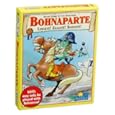
- Bohnaparte
There's a certain danger for both players and publishers in a
long string of expansion kits. Each appearance of a new one is
a kind of statement on the entire game series. Is it still
working, still going strong, or is it out of gas? Such was the
case with games in the
Bohnanza
series when there appeared
Bohnanza La Isla Bohnità,
which was so disappointing that many just gave up on the
entire series. But for those who did, it turns out that that was
too bad since subsequent efforts have improved considerably.
This particular entry is rather surprising, being a mild conquest game.
Added to the existing base set of cards are a set of place
cards which are laid out like brickwork to form a sort of map.
Each player begins in his own corner with a pawn denoting
ownership of that card. The game is played as normal with the
addition of a conquest phase at the end of each player's turn.
Initially and for quite a while players are mostly conquering
unowned territories. These combats are resolved by comparing
bean cards, the player's coming from his stock of cashed in
beans, the neutral's from the top card of the deck.
Significantly it's the higher-numbered card which wins, giving
more value to the usually less valuable cards. Players who
take over a particular land can purchase a munitions dump into
which they can store any type of card. Other lands confer
other advantages, including one which gives a cannon that can
be used to break ties. Inter-player combat isn't a big portion
of the game, but it certainly occurs in the final third. But
it is limited enough that petty diplomacy problems usually are
not much in evidence. Thematically it's a bit odd to have a war
driven by bean farming, but it all works and in the right
amount of time to have an enjoyable outing. So if once upon a
time you bailed out on this series, it's time to let
Agricola
be your signal to come back to the bean. By the way, next time
the bean masters make a game like this, I hope they set it in
ancient Rome. One of the most famous Roman families were the
Fabians, as in Fabius Maximus. Their name is derived from the
Latin word faba for the broad bean, an important food
crop in Roman times, something the Fabians apparently grew
when they were not conquering.
Uwe Rosenberg
& Hanno Girke; Lookout Games/Rio Grande/Amigo; 2003; 3-6
Strategy: Medium; Theme: Medium; Tactics: Medium; Evaluation: Medium; Personal Rating: 7
[Buy it at Amazon]
- Borderlands
War game by the same team that created
Dune
and
Cosmic Encounter
is set in a barbaric dystopia
and is something of a predecessor to
The Settlers of Catan
in that the setup is always random and areas always produce the same
type of good. Collecting goods in combination permits purchase of something
more valuable. Combat is similar to that of
Diplomacy
with enhancements to make situations more volatile. As in
Risk,
it is usually possible to take at least one territory as the
advantage is with the attacker. Unfortunately can be rather
subject to kingmaking as there is a major dependence on other
players to sacrifice their chances in order to play defense.
Really only balanced with four players. Two expansion kits don't
seem to be too necessary, the first added remote islands (which
no one wants) to support up to six players while the second is
rather over-the-top, including temples, universities, and blimps.
- Bounty Hunter
Two-player gunfighting booklet game after the style of
Ace of Aces
and
Lost Worlds.
Concept is intriguing, but probably the least successful of all
of the games of this type as the lawman and outlaw skulk around
the small town trying to find one another. Eventually someone
gets bored and crashes through a window or door tipping off the other.
From there it is mostly a matter of luck who gets the drop on whom
and who is lucky at shooting. Various codes at the edges of the town
indicate several expansions were planned but to date have never been
published.
- Brawl
War game with cards in which players compete by playing cards from one of
several special
decks in real time. Ostensible theme is personal combat between two cartoon
characters. Real-time element destroys virtually all possibility for strategy.
- Britannia
Light war game set in the British isles from the Romans to the Normans.
One of the first and best games of this type, this is a game which really
rewards several replayings as players can develop their strategies and counter-strategies
to determine the best approaches. But even then nothing is certain as the dice
can always be rather cruel. Either way, it's an epic sweep that's quite enjoyable for
for the history fan. Requires four players and about as many hours.
[playback]
[summary]
[Britannia-style Games]
- Broadside
Set in the War of 1812.
Board depicts a bay with bisecting island containing two forts.
The map is a grid which is traveled on its intersections.
Both sides have ten ship hulls but the British have five more masts than
the rebel Americans, who also have four immovable merchants; six
buoys, half of which are mined; and four forts sporting cannon.
Players alternate moving one ship at a time in a straight line.
Encountering another ship permits firing a broadside which removes a mast.
"Crossing the T" of another ship is ideal as no return fire is permitted.
A de-masted ship goes to Davey Jones' locker.
Game of position and lookahead has little to do with combat as it was
actually fought, or any actual battle for that matter, but works fairly
well as a positional system à la
Nine Men's Morris.
Likely the best of the American Heritage series of the 1960's, the others being
Civil War (later re-titled Battle Cry which is not be confused with the
Battle Cry released by Hasbro in 2000), Dogfight, Hit the Beach and
Skirmish.
Features a dramatically-illustrated board and attractive plastic ships,
though the masts are a bit fragile.
Interesting historical background booklet accompanies.
- Brotherhood, The
John "Squad Leader" Hill design from the war game publisher
GDW in the early '80's (first edition previously by Conflict
appeared in 1972), apart from the violence, looked
forward to the German-style game renaissance. Here godfathers
of criminal families try to make as much money as they can
by trying to control various neighborhoods. Features nice
strategy dilemmas between diversification and concentration and
how much one wants to try for the more lucrative but more targeted
areas. Plenty of flavor is included, such as thugs, hit men,
political influence, police, grand jury investigations and even gunplay.
Game mechanisms include secret allocations and negotiation.
- Byzantium
Martin Wallace game for up to four chronicles the struggles against
the Arabs with Bulgars thrown in to generate interest on the other
end of the map. As in a previous effort,
Liberte,
the player's sentiments are intriguingly ambiguous as each controls
forces on both sides. Also leveraged is
Princes of the Renaissance
with its ability to choose various enhancements. The combination is
presented in a game in which players seek to maximize combined
scores for efforts on behalf of both sides. Points come from
claiming and holding citadels – represented by stacked cylinders
– and by taking them from the enemy. A player has a single force
in each army which on his display is represented by cubes in three
boxes: main army, elites, movement ability. Movement cubes are
expended to advance one city on the point-to-point map. The others
indicate the number of dice to be rolled in combat, each hitting
50% of the time and are also taken as losses. Actually army-to-army
combat is uncommon. It's usually wiser to attack where the army
isn't, but also wiser for the defender to run away, there being
little for a defender to gain and the castles being fairly strong in
their own right. A defensive strategy is probably a good idea
in general since holding citadels provides not only points,
but valuable income. A player can enhance his defense by adding
cubes to his levy area which strengthens all his citadels, but
the cubes are un-thematically reduced when just a single one of
them is attacked. So there are some strategic possibilities amid
this mostly tactical milieu. One could go all out for attack or
invest heavily in defense. The ploy of weighting everything in
favor of the Arabs, or against them, is more problematic however
because of the special rule negating one of your scores if it
is less than half that of your other. You're given 10 points for
each side at the start and it seems wise to keep all of them. A
sort of funny sideshow aspect is the early ending afforded by
the ability of the non-player Bulgars to conquer the capital
at Constantinopolis. Although not easily done – it has
perhaps a 1 in 3 chance – it addounds to the benefit of the
player having the most Arabic points – the capture itself
providing a substantial 5 of them. When it happens this kind of
victory feels rather unfair to those players unable to affect
it. Theme is well-served by a beautifully-illustrated board (by
Peter Dennis) and lots of wood. The towers are appropriately
purple for Byzantium (purple was the color exclusively reserved
for the Imperial family) and white for the desert clothing of
the Arabs, making an attractive if somewhat fragile display. As
our British friends might say, there are a few too many "rolly
bits". But theme is not served by the fact that there are so
many independent commands and that they never return home for
the winter. The crusades or the Russian civil war might have
been better choices. There is rather more ambiguity in the
rules writing than desireable – getting to be a Warfrog
habit, unfortunately – and not enough effort in the
communication design as players at first need to keep checking
the rules to explain icons and for costs. In this regard, it
might have been wiser to make coins worth 3 rather than 5 as
the former valuation is so frequently employed. The overall
feel of the game is of scarcity as both cubes and money are
insufficient for all one wishes to do. Turns tend to end when
all armies have run down to nothing. Duration is two hours or
more, depending on player desire to play out the turns. As in
Princes of the Renaissance, the use of the dice
is objectionable, being both too influential and too little
used to permit the law of averages to take effect, though
some players are willing to give this up for the drama of the
rolling. This is more meant to be played with beer in hand than
as a calm study, like, Euphrat &
Tigris to pick another example from the same part of
the world. For many duration will be too long for such a game,
however. The two-player version has a serious problem and is
not recommended.
Strategy: Medium; Theme: Medium; Tactics: High; Evaluation: Low; Personal Rating: 6
Martin Wallace;
2005; Warfrog; 2-4
On to C - Main
Please
forward any comments and additions for this site to Rick Heli.