Spotlight on Games
>
1001 Nights of Gaming
- P -
- Pachisi (Ludo, Parcheesi)
Traditional game of India invented over 1200 years ago
is a race powered by dice with the ability to
send players back to start by landing on them. Some may not realize that
the original four-handed partnership game requires a good deal of skill,
at least as much as
Backgammon
at any rate. As for the more modern realizations such as the European
Ludo (1896 title from the Latin word for game) or the American
Parcheesi: The India Game little remains apart from
some minor strategic and tactical appeal, perhaps a good
vehicle for introduction of strategic concepts.
Introduced to the United States under the Parcheesi title
by Selchow & Righter c. 1867 and trademarked in 1874, one of the very
first trademarks in US gaming history.
Has been published under many other titles including
Home, India, Pollyanna and others,
including many in other languages.
[Two vs. Two Games]
A
- Pacific Northwest Rails
Very enjoyable strategic railroading game is neither in the
Empire Builder nor the 18XX series. Set in Washington,
Oregon and Idaho.
[Italian Rails]
[Traveling Merchant Games]
[6-player Games]
[more]
[errata]
- Palais Royale (Royal Palace)
After
King's Breakfast
and
Louis XIV
this is at least the third game to place the French King Louis XIV at
its center. This is more like the latter though, a massively
logistical affair which one could imagine being published by
Alea as well. Aptly named, the palace board is the center of
the action here. Actually it's not a board at all, but nine
modules representing palace rooms randomly placed in a three by
three arrangement. Players have over dozen wooden pieces shaped
like a head and shoulders – courtiers – which they
place into these rooms, each of which provides a different effect.
In the beginning they only have two in the room which permits
bringing in new courtiers (the parade ground) and two in the one
which permits moving courtiers (the stairway). Thus on the
first turn two pieces are brought on and up to two
(orthogonal) movements may be made. Other room functions
include the place where new courtiers enter, gaining money,
gaining the king's favor, gaining the favor of the king's
mistress, buying cards, recruiting noblemen and winning
tiebreakers. The latter becomes important because for many of
the rooms if a player has the majority of coutiers there, an
extra benefit is gained and if there is a tie, the player
having more in the tiebreaker room wins it. The eventual
point of all this activity is to be found on the other board,
on which a couple dozen or more noble tiles have been randomly
placed (omitting seven to keep things different from playing
to playing). These generally have four costs, three of which
require removing courtiers from rooms – king's favor,
mistress' favor, recruiting room – plus coins. This
monetary cost keeps changing during play, being decremented
each time a neighboring tile is removed. The benefit of these
tiles is mainly victory points, but some also provide extra
benefits such as an extra favor per turn, extra cash,
extra moves, extra recruitment,
diagonal movement or being able to pull courtiers out of the
reserve pool. There is a sub-game in collecting tiles as well.
When a player takes a tile lying at one of the four edges, the
player replaces it with a courtier. At the end of play six
points are given to the player having the most courtiers at
each edge, two for second place. These points are fairly
minor, but could make the difference when the score is close.
A more important feature are the special ability cards which
can be quite powerful, for example giving a dozen extra moves,
for just the cost of a courtier and whatever it took to get it
into the cards room. Thus the cards are some of the best
deals available and it will be difficult to win without
partaking in them. On the other hand, the balance of the deck
is quite variable, some cards being a waste of time. It's true
that to ameliorate this it's not necessary to buy a card if
it's not good enough, but on the other hand, drawing too
many poor cards is in effect just as bad as it wastes time and
resources. This degree of randomness is a little out of place
in such a serious system affair, but probably difficult to
avoid because the value of each attribute will vary a lot
depending on the palace setup. If, say, money happens to be
right next to the board entrance all players will have plenty
of it all the time and money cards will be practically
worthless. Probably the solution should have been to find a
way to get the cards – which are important for
throwing a monkey wrench into plans and making things a little
less predictable – into player hands by a different
method than random draw. This might also have helped with
another problem with the cards, that the first time player
doesn't know what's in the deck and thus must decide
whether a drawn card is worth keeping without having any idea
of what the other possibilities are. As it is, owners of the
game ought to print out a list of all the cards and present a copy to
each player. There are other practical difficulties.
Buying a tile usually means counting up the non-obvious
monetary cost and spending in the four areas plus
puting a pawn replacing the tile with a courtier if it
was on an edge. These are really too many things going on at
once and frequently one or more will be forgotten. Inventors
really ought to keep the number of simultaneous activities down
to three. Imagine in this one how tricky it becomes if
buying two or even three tiles at once, especially since the
previously purchased tiles likely affect the costs of the
subsequent ones. A terribly confusing artwork problem is that
while each board edge counts for points, the way the numbers
are shown it looks like only the top and bottom edges do.
It's also tricky that play ends when the number of tiles is
down to twelve or less, something very easy not to notice.
Probably an equivalent, but easier to track method could have
been found. Because there are so many moving pieces, and costs,
turn take backs seem frequent in this one and it can be be slow
waiting for others' turns. For this reason it's probably best
with three or less. Thematically there's not that much there,
though it's fun that the king's mistress has so much say over
things. Overall, this has a feeling which was later done
better by
Hansa Teutonica.
Its Belgian inventor has since gone on to do Carson City as
well as help with
Troyes
and
Tournay.
MLHH5 (Strategy: Medium; Theme: Low; Tactics: High; Evaluation: High; Personal Rating: 5)
Xavier Georges; Hans-im-Glück-2008/Rio Grande-2008; 2-4; 60
Amazon
- Palastgeflüster
This card game by Michael Rieneck
(Around the World in 80 Days,
Cuba
and, with Stefan Stadler,
Pillars of the Earth)
has an intriguing title meaning "palace buzz" or "palace
whisperings", suggesting various intrigues. Unfortunately no
such feeling emerges during play where one will only ever hold
six cards, some of them in hand, some in personal display.
There are no restrictions on the hand contents, but each card
in the display must be unique. If it is ever a player's turn
and he is unable to play a differing card, the hand is over
and all others score a point. As there are only seven card
types, this is the most likely ending to a hand, though it can
also end with a sole victory if a player manages to get six
different card types out (this should maybe end the game
immediately). But there are two other features working. One is
that many cards are colored – playing such hands the
turn to the player whose color it is; otherwise it goes to the
player with the fewest cards showing. The other is that most
cards have special powers, including abilities like picking up
a card, exchanging one or more with an opponent, showing one's
hand (not exactly a power in this case) or even suppressing a
particular type of power. There is also the Jester who, unlike in
Princes of Florence,
does nothing at all. There's not a great deal of strategy
here, nor is there much thematic connection with the card
powers. Mostly one tries to avoid getting caught in an illegal
situation by keeping the hand diversified and not so far out
in the lead as to become a target. It is sometimes possible to
try to go out on one's own, but it's dangerous and rare. There
are plenty of tactical possibilities such as forcing another
player to play and then giving him a hand of nothing but cards
he has already played. If you have enough such cards for his
whole hand, it's game over right there. The artwork is
cartoonish and a bit uneven, as if worked on by more than one
hand. Iconic language is used to describe each card's powers,
but it's not so easy to pick up. Most players seem to rely on
the tiny script font of the player aide cards. The real
problem is that the game is both too long and too short. An
individual hand goes too quickly for the situation to really
develop, but unlike a trick-taking game where every hand must
be diagnosed and played accordingly, here every hand is pretty
much alike, and very subject to change. Thus, the game's
requirement to repeat six hands or more is far too many. The
other problem is that not having a regular turn order means a
player can have a long, uncertain wait.
Strategy: Medium; Theme: Low; Tactics: High; Evaluation: Low; Personal Rating: 5
Michael Rieneck; Adlung; 2007; 3-5
[Buy it at Adlung]
- Palazzo
Multi-player Reiner Knizia auction game of skyscraper building,
Renaissance Italy-style. I believe this is the latest in what
I think of as his "bid on odd lots" series and for me, the most
successful. This is fundamentally because, compared with
Medici,
RA
and
Traumfabrik,
the player feels more in control of his own fate. The storeys
one hopes to add to his towers are not all acutioned, but can
often be purchased outright. And even when there are auctions,
players can readily discern what future auctions will be and
where new tiles will appear. It's similar with the distribution
of funds. If you need more, just reveal funds cards and draft
a pair for yourself. The rest are taken by other players.
Scoring is very intuitive as one just wants to build a lot
of high towers that are also aesthetically pleasing. Extra
height and matching building styles have the same importance,
but accomplishing both is best of course. This boosts theme as
well, although the idea of bidding for building additions makes
little sense under scrutiny. Play moves right along, keeping
everyone involved. The small package presentation is attractive,
including small boards which are not strictly necessary. The
artwork leaves some doors and windows – crucial to scoring –
somewhat ambiguous, but this may be intentional, considering the
ways that in the past Knizia has tried to discourage analysis
paralysis, e.g. the screens in
Tigris & Euphrates
and
Samurai.
Fans of theme may not be excited, but just about everyone should
be able to appreciate this at some level, for some probably
topping their list of what to play for quite a while.
Games of the Italian Renaissance]
Strategy: Medium; Theme: Low; Tactics: Medium; Evaluation: High
- Palermo
In 1992, three years before
Streetcar,
Piatnik had already published a game in which the board was
built in the first half so that pawns could navigate it in the
second. In this one, the topic is the mafia protection racket,
but the goal is essentially the same: visit all of your locations,
and visit them the most quickly, or so I think, but more about
that anon. In this one, players needn't worry about luck of
the draw as they may use any of the available tiles. The six
different offerings depict various roof arrangements, important
because roofs (structures) block movement and because each new
tile's roof must touch an existing roof. Anyone who leaves
no free roofs gives his left hand neighbor a free choice. In
the second half, players race around according to a fixed
schedule, gaining more movement points with each success. This
activity generates victory points too, equal to the number of
movement points not used on that turn. This is where
the instructions show the lack of a strong editor as there are
significant ambiguities. In particular, it's not clear whether
and to what extent players can deliberately noodle around in
order to maximize their points. Can they toggle ten times between
the same two spaces for example? If so, what is the point of the
police pieces that players use to delay others? Then there are the
lesser ambiguities. How are the polizia supposed to work on
the fast autostradi that encircle the board? And may they
be placed in the starting plaza while player pawns are yet to
start there? But the delaying tactics are the main problem. Are
players really supposed to procrastinate as much as possible?
If so, why do the police exist? And why do players who complete
the cource receive only an insufficient three points per turn
while waiting for others to finish? Only its inventor can tell us
for sure, but I rather suspect Walter Ziser intended that players
always follow the shortest route and there's no rule to enforce
it because the one-time inventor never dreamed anyone would do
otherwise! The end result is a lovely mess: great innovation with
lousy execution – this no doubt accrued to Streetcar's
benefit three years down the road. But apart from some doubts
about the abuses the polices enable, this one could probably be
just as excellent with a bit of tinkering.
- Palmyra
Knizia game depicting a Silk Road bazaar subject to
the whims of sudden news and the tax man, it actually has
the feeling of a modern stock market. Prices go up and up
and up until someone decides that their price point has
been reached and then watch them fall like a stone with
everyone in a headlong rush to sell off their inventory
while it's still worth something. The tracking mechanism
is reminiscent of that employed by
McMulti.
Players sometimes complain of too little control, but
this may be the point. To be fair, some have also
complained that the game too much resembles an accounting
exercise, and perhaps this is true as the game winds down,
but the tension and decision of reaching that climactic
decision point in the game, which can occur a bit too early,
will be more than worth it for many players. Strategically,
consider that the cards one knows cannot be played are at
least as important as those which can be.
Cover displays Reiner Knizia's middle initial which with some
displeasure he noted to this site the publisher was not supposed to do.
The Silk Road Foundation offers a fascinating
article on Palmyra's history.
This game was later re-published as Buy Low Sell High.
- Paparazzo
Small game by Friedemann Friese and Wolfgang Panning seems to catch the
paint drippings of Knizia's
Modern Art
from the previous year. Instead of art dealers, players represent
middlemen buying celebrity photos from those pesky paparazzi
and re-selling them to magazines. Once again players have
hands of cards (photos) that they put up for auction, always
trying to figure out how many other cards in the same series
are in play. They get some help in this as before play everyone
gets to see the hand of the player to the right. This is just
one of the unusual rules in play as the auction treatment is
also rather unorthodox. They are conducted in two rounds, the
first to set the price and the second to decide who will buy.
Moreover, not just the starting price, but also the minimum
bid increment increases as more photos in the series appear and
become more valuable. The rotating auctioneer, who chooses what
to sell not from his hand but from three cards placed by previous
auction winners, gets paid only half the auction price and so
it's usually necessary to eke out additional funds by selling a
photo or two to Stunk (logo similar to the famous German
Stern), which pays immediately instead of only at the
end. Success, besides depending on gathering information based
on the way others play, seems to require the particular trick
of winning the auction just before one is to be auctioneer and
thus being able to auction a valuable card on one's own turn. In
terms of information, there seems to be a problem shared with
Vernissage
that if a player receives cards that no one else has (only a
few from the large deck are dealt), he operates at a distinct
disadvantage. Although the more limited nature of the bidding
permits escape from the fragility of Modern Art, there
is something a bit rote about the decisionmaking and the best
part of the experience may be the hilarious satirical photos
which expose their unnamed celebrity targets – politicians,
tennis stars, fashion plates, opera divas, wives of soccer stars
et al. – in all sorts of scandalous positions.
- Paris Paris
Michael Schacht invention about the busing of tour groups
in the French capital. Employing the popular drafting
mechanism, players each take turns choosing from a random
set of stops. Cleverly, the one not chosen is the one
scored, or if no one there, its closest neighbor. But each
stop also comprises one or more routes. If stops on a route
have not been chosen twice, then the route is actually run
and everyone with stops on it receives points, getting more
if they have additional stops adjoining them. This means
there are a number of ways to look at the strategy:
connectivity vs. ubiquity, short term vs. long term, and,
since it's possible to remove other's pieces, offensively
or defensively. Since the details are simple, it can also
be played either lightly or intensely. The map appears to
be a fairly accurate rendition of the city and a unique
cardboard bus piece facilitates making the run. Apart from
the rules writing which at least in their English form can be
maddeningly imprecise, it's
difficult to say much against this one, unless it's
that there is a fair dose of luck around the order in which
items are drawn from the bag and one's place in the turn
order when each happens, but as length is only about thirty
minutes, there is not much cause for complaint. Recommended
for anyone who likes a short dose of thoughtful fun, but ultimately
not fair enough for master strategists, even in the generally
more tolerable two-player version.
[Tourist Games]
[Holiday List 2003]
Michael Schacht; Abacus/Rio Grande; 2003; 2-4; 8+
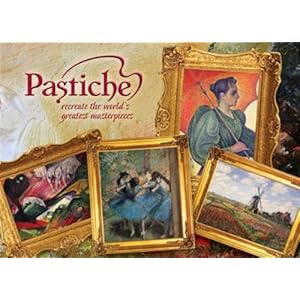
- Pastiche
Colors are fun. That seems to be the premise here. Perhaps you
can yet remember when you first learned that mixing blue and yellow
make green. And perhaps later were surprised to learn in a
physics or computer graphics course that optically red and
green combine to make yellow. This knowledge you gained in the
first instance will help here. But there's
another angle too, that of famous paintings, many of which are
accurately represented here. You collect paints in various
colors in order to paint one of the famous masterpieces in your
hand, each of which requires a specific combination of colors.
All's good so far, but does it stay on the easel. Collecting
paint is a matter of each turn playing a single hexagonal tile to the
growing central area. Tiles feature only the primary colors,
one per corner. After the tile is played, corners where the
tile meets other tiles yield paint cards for the player.
A red and a red yield another red, a red and a yellow an
orange and something more difficult like blue-yellow-yellow
yet another color. There's a strong element here of not
leaving a good position for the next player, i.e. one where
it's possible to touch more than two tiles as these are
virtually always better than other locations. Otherwise, only
three colors being available, this
phase is fairly rote. From there you are also permitted to make
swaps, not only with other players, but also with the game
according to the rules displayed on the big board, which also
permits mixings. Some are
non-intuitive such as requiring three primaries of the same
color to achieve black or white. Ironically the most difficult
color of all, requiring six cards, is real life's simple gray.
Eventually one has enough paint in hand to turn them in to
claim a painting, each of which has some value based on
difficulty. Play ends when someone achieves 35 points or more.
Here is one problem as it seems unfair in such a system that
not everyone have the same number of turns. We are left with
a dilemma in this area as the printed rules don't stipulate
that, but an on-line post by the designer states just that.
On the other hand, this might be just as problematic as the new
strategy would probably be to reach only 34 points and then go over
the line by as big a margin as possible, probably adding 15-20
minutes of playing time.
It's great that so many actual paintings
are included, though sticklers should be warned that the
listed paints for each correspond only loosely. There is also
a rule giving bonus points for having more than one painting by the
same artist. This is almost totally a matter of luck, probably put
in to get the players paying attention to the artist names and also
to prevent results from all being close to ties, but seeming
rather gratuitous and unfair otherwise. But there's the bigger
problem that in general the pace
seems too slow, both in the sense of downtime with four players and
also in the number of milestones reached. Even though overall
playing is three-quarters of an hour or so, it would have been better if
players finished more paintings more quickly to get more of a sense
of progress and accomplishment.
Maybe what we see here is a game
whose bits were ripe before all of its systems were.
All of the bits are well made,
but the lack of a tile rack is regrettable since
players need to hold both several cards, three tiles
and at least one of the paintings
all at once when planning a turn. It's good that the
publisher has announced that a new edition will include at least an
easel to hold the painting.
While they're at it they should at least re-design the paint
combinations board to group colors more logically and speed
finding what one needs. It would also be a good idea to
re-name "bisque" to something more likely to have been used in the
Renaissance. Can anyone really see Leonardo ordering up a supply
of bisque anywhere but at a trattoria? By the way, other artists
include Botticelli, El Greco, Raphael, Velazquez, Rembrandt, Manet,
Monet, Bazille, Degas, Cezanne, Gauguin, van Gogh and Marc, to
name the most famous.
MMLM5 (Strategy: Medium; Theme: Medium; Tactics: Low; Evaluation: Medium; Personal Rating: 5)
Sean D. MacDonald; Gryphon Games-2011/Pegasus-2011; 2-4
- Parthenon: Rise of the Aegean
Merchant travel and trade for up to six from the Z-Man.
Some things in this ancient Greek setting – production, trade
– are done as they are in
Catan,
but there is nothing here that is not Zeus (and his whims).
After trade and before production players may also sail to
non-player destinations and perform further swaps. Virtually
all phases are simultaneous, including construction of the
various advantage-conferring building and two named "wonders"
which are the pinnacle of their efforts. Wonders confer more
advantages, as do philosophy cards, the fruits of the all-important
academy, which, however, is deceptively labeled as just another
building. One could even neglect its erection in favor of something
else and thereby lose the chance and lose out too on the fourth
tiebreaker to victory. Tiebreakers are critical because often
several players progress at the same rate and will otherwise finish
at the same time. Those who have fallen out of the race often have
no reason to blame themselves, however, as most likely their
holdings have been wiped out by one or more of the vicious hazard
cards drawn every sailing phase. Although the cards affect all
players and some like pirates can eventually be defended against or
negated – note: only by a player who is already doing well –
others such as storm can cause loss of an entire ship holding up to
six cards, which could represent anywhere from half to all of the
player's production. Card victims can probably forget any building
for the turn. Thematically such events are correct, of course, but
the system does not seem to sufficiently compensate in terms of
game. One attempt at this is the archon power, voted by the
players, which, depending on the events drawn, may sometimes
be useful. Another is that construction of some wonders requires
giving wares to any other player, who ought to be the last placed
one. Even so these measures are often not enough, especially
considering that a trailing player cannot afford extra ships and is
likely to put all in one, greatly tempting a repeat disaster. Even
so, all of this would not be so bad were the game to conclude its
business in a timely fashion, but instead it lingers on for two,
sometimes three hours, forcing unfortunates to go through the
motions without the slightest chance of winning. This is
despite the fact that all but two trading phases are
basically meaningless as no one wants to trade. A shorter scenario
is available, but it has a balance problem since event and harbor
cards are designed for particular factions and not all of them are
used in this case. Other caveats include the large, messy table
print created by such a huge number of cards – every single
thing a player builds or acquires must be laid out as a full-sized
card. There's a small, basically unnecessary board too, which takes
up more space than the mere six card decks which would really be
required. There's a certain inelegance of design as well,
especially in all the different ways that the normal rules become
altered. The four event cards per year apply not just in their own
season, but in every season. Then each minor building confers some
minor effect which must be remembered. Add to these the effects of
the wonders, the philosophies and the harbor cards and you get a
sprawling jumble of effects that are beyond anyone to master, or
even want to try. This really feels like overdevelopment under
horror of a vacuum – at the very least it is neither clean nor
spare. Its best features are probably its bows to theme and
use of simultaneous phases and if anyone can enjoy this, it will be
deep-thinking tactical artistes who will appreciate the extent to
which theme is addressed and look for clever ways to exploit the
many card combinations. But most others will turn away, and
eventually even they. By the way, on our last try we used clear
plastic chips to mark player holdings and this made some issues
considerably easier, though sacrificing the illustrations of
Stephen Walsh, who also worked on the American edition of
Tigris & Euphrates.
[6-player Games]
Strategy: Low; Theme: Medium; Tactics: High; Evaluation: Medium
- Pass the Pigs
Variant on a dice-rolling game in which instead of generating
pips on dice, the landing position of rolled rubber pig figures
is considered. Of not much strategy and limited replay value.
- Password
Word game of synonyms rewards a large vocabulary. Ingenious
printing of clue cards makes them illegible until inserted
into a special sleeve with a colored window. Light amusement
for those who love words, though not much strategy. Published
by Milton Bradley and based on the television game show in the
United States in the 1960's. A "magical" feature of the game
for children was that the clue cards were printed such that they
only became visible when viewed through the film window of the
plastic sleeves. [Two
vs. Two Games] [Party Games]
- Past
Lives
Mostly random game of advancing on a board via dice collecting
treasures. The conceit of the game is that each player is
trying to advance to a higher state in the sense of the Indian
theologies. The look of the game is nice, but play doesn't
leave much to the imagination. Most interesting feature is for
students of histories who may enjoy perusing the biographies and
considering whether or not the relative rankings are appropriate.
- Patrizier
(Patrician)
This tower-building game attempts to evoke the construction
competitions of Renaissance Tuscany, but the strong association
is Manhattan. Just as in
that game one plays a card and then places one or two pieces
atop a multi-player tower, the goal being to have the most
pieces in it and, if tied, be above the competition. The board
is divided into ten named cities, each of which offers two tower
locations. Each card indicates in which city a tower must be
placed. After placement one draws the randomly-drawn face-up
card that is in that city. Thus success is a matter of finding
in a hand of three cards a play-and-draw combination in which
both are worthwhile. In addition, each card has a secondary
symbol. Some are just figureheads which form part of a set
collection game that only applies at the end of play. Others
can be more valuable as they confer an immediate extra power,
the best of which is to relocate one tower piece in a different
city. Physically, the board and cards are well designed: clear,
practical and attractive. The wooden tower pieces are unique;
they resemble wrinkles, stack quite satisfyingly and there are
a generous 149 of them. Turns tend to go quickly and a playing
could complete in as few as twenty minutes if all play fast. This
idea of the thing done affecting the future action has been done
quite a bit before, by Knizia, by Schacht and also in
Kupferkessel Co.
The same goes for the majority control and stacking
mechanisms. But that was the past. Today one needs to ask,
what else is on offer? Inventor Michael Schacht has delivered
the "what else" before and then some, so indications are that
it must be the publisher who here either trimmed out parts of
the design or encouraged blanding it out. While that's
probably fine for those new to the hobby, if anyone at Amigo
ever wonders why the cognoscenti prefer Alea and
Hans-im-Glück, they need look no further than efforts
like this. Moreover, any success it has again demonstrates the
truth that players are more willing to accept randomness from
a deck of cards than a roll of the dice, even though either can
be equally cruel.
Games of the Italian Renaissance]
Strategy: Low; Theme: Low; Tactics: High; Evaluation: High; Personal Rating: 5
Michael Schacht; Amigo/Mayfair; 2007; 2-5
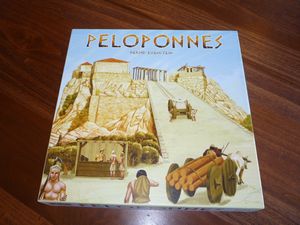
- Peloponnes
As inventors seek new gaming concepts, they have inevitably
turned to more complex mechanisms, often with the downside of
creating longer and more tedious games. Frequently such affairs require
players to manage a series of bottlenecks and balance a variety
of conflicting demands. Situated in ancient Greece and the Aegean,
this is a civilization-builder that wants to reduce all of that toil
and trouble and yet still present some juicy dilemmas. A nice
start is that each player begins with a variable power in the
form of a named city-state tile, e.g. Argos, Arkadia, Pylos.
Each has unique starting materials and forms of income. On either side
of this players will each turn build on with newly-revealed building
and landscape tiles which are auctioned off. These provide
things like wheat, wood, stone, money, settlers
(which leads to more income), victory points and sometimes
a special ability. Tiles carry minimum costs to
ensure nobody lucks into a windfall. Players unable to bid
or who are knocked out of the auction earn money instead.
Adding lands carries the restriction that a new land must
have at least one resource in common with the last one.
Buildings have thematic names and lands definite characters
such as forests, fields, etc., evinced from the illustrations.
There are a series of disasters like earthquake, drought,
plague, etc., each of which will trigger once per game. The
imminence of each is discerned by the two diaster chips drawn
each turn; three of a particular type triggers the event.
Similarly there are also tiles requiring players to feed
their people or lose those who go unfed. Victory requires a
balancing act between gaining people and valuable tiles; one's
lower total between the two provides the final score. Play
proceeds for about eight turns without necessity to count
them; the game simply runs out of tiles. In the event of fewer
than five players, instead of reducing the number of tiles on
auction each turn, the system cleverly adds supplementary
tiles which can be acquired sans auction at a higher fixed
cost. This independently-produced, visually-appealing, short
and generally balanced affair should appeal to a wide audience.
At the time of this writing there is also an expansion,
Peloponnes Erweiterung, which enables a sixth player as
well as provides other tiles, including those depicting the sea
and which permit fishing to gain more food.
Update:
The 2011 edition features revised rules and adjusted earthquake tiles,
no gold coins, larger format rules and a slightly larger box.
[multi-multi auction games]
MMLH7 (Strategy: Medium; Theme: Medium; Tactics: Low; Evaluation: High; Personal Rating: 7)
Bernd Eisenstein;
Irongames-2009; 1-5
Amazon
- People's Choice, The
Blind bid auction game on the US presidency. Included are 43
president cards, from first to worst. Each has a party affiliation
and several other attributes such as family, personal, legacy,
etc., each of which is also color coded in red, white or
blue. Other cards are then revealed which show the colors the
voters seek in the current election. Players then each secretly
choose one of their politicians to run, possibly committing one of
their starting coins to help. Players add the coin to the number
of ways their candidate matches the popular taste to determine the
election winner. Three wins takes the game. Not only is there not
much technique to play – possibly keeping a good variety
of candidates being an exception – but players must also
perform an annoying amount of confusing pattern matching. So
there is little to recommend here as a game, but I'm reminded
of a book of the presidents that I had as a child, a book which
inspired me to learn a lot about the presidents. Even today I
can still recite their exact order by heart. It occurs to me that
these cards can serve exactly the same purpose, being orderable
and dealable, perhaps even more so. I have little doubt that
all the facts on the cards will help to do this. Another little
side benefit are the player screens, illustrated to look like
the White House. These must the largest and most elaborate
screens seen to date and would be very nice to appropriate
for other games like Keydom where they are too flimsy.
Strategy: Low; Theme: Low; Tactics: Low; Evaluation: Medium
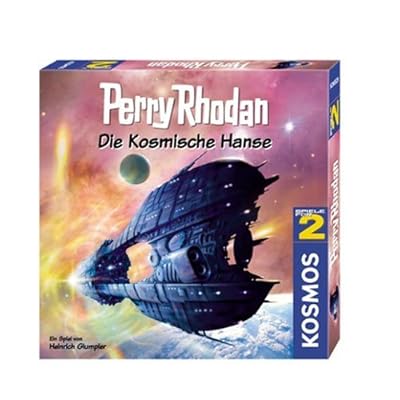
- Perry Rhodan: Die Kosmische Hanse
This pickup-and-deliver game based on the long running series
of science fiction books is a new entry in Kosmos two-player
series, now re-vivified after not having much to recommend for
a few years. There is no board
per se, but a solar system display consisting of a large sun
platter and six smaller, distinct planets (the back story of
each is described in the rules book). Over these the players
pilot their ships, represented by illustrated cardboard in
plastic stands. Solar gravity is simulated by letting ships
count each planet as a movement point when traveling toward the
sun, but on the way out forcing them to also count the spaces
between the planets. Speed is determined by roll of the die,
but a result of one means that the die is rolled again and the
new result added on. Arrayed at each planet are cards showing
other planets. By dropping down to the planet a ship loads one
type into its hold. When they are delivered to the planet
showing the player receives points on the spiral track shown on
the sun disk and the cards are flipped over. If their reverse
sides are the same, they are removed from play. Otherwise they
represent new cards to be shipped. By this elegant mechanism cards
gradually disappear until eventually passenger cards from the hand
become a surer means of income. Other hand cards in the player's
individual deck are of the one-time use variety, two of which can
be played per turn. Still others are permanent, offering various
advantages such as extra holds, the ability to load without
landing, an increased re-draw rate, special movement abilities,
etc. These begin cheap, but later cost points equal to the number
of such cards already purchased. Choosing which ones are the
most useful is a challenging dilemma made more challenging by
the fact that the card one wants may take a while to appear.
The number of such cards played is also the re-draw rate. The
physical production is attractive, but the passenger cards
show their planets too low on the card and the victory point
markers are slightly too large for the track. But the amount
of time to play is right. Interaction is not major, but
players do compete over the same loads and may also play cards
to cancel the opponent's cards. Overall this should appeal to
just about anyone as long as reading a lot of cards is not
minded. For this reason it's helpful to have a version in a
language one understands and very disappointing that there will
apparently be no English edition. Perhaps the owners of the book
rights require an additional fee that proved an obstacle and no
help in America where Rhodan is less know, but then, the title
could always have been changed to Flash Gordon or similar.
It's disappointing too that it seems there will be no
expansion that could create a planetary geography more
interesting than a simple line, an
Auf Achse
in space if you will.
Updated of January 2009: The first bit of good
news is that there is now a three-player variant from the inventor
and it works quite well. The only issue might be there the can be
a bit of kingmaking, mainly in the use of cards.
The more important good news is that
an English edition will be coming after all, from Z-Man Games.
Let's hope that it includes the three-player variant and
changes the icons at the corners of the planet cards to show
the planet icons rather than pictures of the passengers.
[variants]
[Frequently Played]
Strategy: High; Theme: High; Tactics: Medium; Evaluation: Medium; Personal Rating: 7
Heinrich Glumpler; Kosmos; 2007; 2
- Pez
Mike Fitzgerald invention that ties in to the popular (originally
German) PfEfferminZ (peppermint) candy. Although a play mat is
provided to organize matters, this is a card game, basically
of the "take that!" variety. In their two-action turns players
draft candy dispenser cards which specify a diverse list of candy
cards required to fill them. Once filled, the dispenser is kept
for points in the race to twenty-five. Players may interfere with
one another by playing candy cards to match the top showing cards
of opponents and thus remove them. A completely-cleared dispenser
discards it. Thus the dilemmas are what size dispenser to claim,
where to play candy cards among one's own dispensers and when
to instead keep someone else from winning. Which works better,
a few big point dispensers or many small ones? Eventually it
becomes impossible to stop everyone and victory occurs, almost
as if by accident. The card illustrations are delicious and
make one hunger for the candy. Nor do matters last longer than
appropriate for theme and mechanics. But this is certainly no
meaty endeavor and those who need a hearty meal will not be happy
with mere peppermint candy. Rare dispenser cards which provide
special powers are only available in random booster packs which
is the largest objection to the product. In contradistinction
to other collectible card games, at least these cards provide
no special benefit to their owner, but are part of the common
milieu. If you want this, it doesn't turn up in game stores,
but check your local candy store. It's surprising that there
isn't a stronger product tie-in such as selling cards with
dispensers or finding a coupon for buying a dispenser in the game.
PEZ fans may enjoy this book on the product's long history:
Collector's Guide to Pez. (2003)
- Pfeffersäcke (Medieval Merchant)
Game for up to six set in medieval Europe, mostly Germany.
Apparently originally about trains, it seems like the best thematic
fit would actually be an expanding airline.
In any case, the theme is not particularly important as it plays
mostly like an abstract. There is almost no luck apart from the initial
deal of start cities and even this means little in comparison to the
large effect on play of other player actions. Key is a keen
understanding of the mysterious long-term plans by the midpoint.
By time matters are three-quarters finished, these
plans are obvious, but it is too late to do anything about it. Turns are
short with only a couple actions being allowed, so usually moves
along fairly well. Distinct strategies are also possible.
Should a player work hardest to be in all the provinces or work
harder to be first in the
most cities? A monetary stategy may also be a possibility.
The German title means "pepper sacks" and is a somewhat derogatory term
for the wealthy medieval spice merchants.
Designer Christwart Conrad earlier created
Vino, featuring similar complexity,
which ended up being published later.
[6-player Games]
- P.I.
Noble attempt to update Clue that doesn't quite work, I think
because it gives positive results. Most deduction games give only
negative results and you arrive at the positive by elimination of
all the alternatives. But here, you can luck into the right answer
on your first stab and that can give you the game. I would have
played around with the idea of always placing at most a cube
(never a disk), even if the answer is right, that is, changing
what the cube means. Games would be longer, but that's okay since
it's mostly three mini games in one right now. Thematically,
asking the questions Who, What, Where don't work for me. After a
crime happens you pretty much know the What and the Where. Would
have preferred Who, How and Why. Needs at least three players;
otherwise the draft pool does not change quickly enough. Three is
probably the ideal though.
- Picknick Panik (Picknick Panik Deluxe)
The onslaught of bugs inevitable to any picnic form the backdrop
of this card game. Inventive packaging – an illustrated
cloth bag – and attractive artwork grace this entry
in the Yun Games line.
The theme is not particularly strong as players represent both
the spiders, ants and flies as well as the humans trying to
do them in via boots, swatters and spray. While there are some
intriguing mechanics, particularly the chance to divert a bug
attack by matching the card, there is much that is automatic.
Morever, replenishment changes the hand so frequently that
there is really no long-term planning. Tactical ploys are mostly
limited to decisions of how many cards to play at a time which
offers a degree of interest, but bad luck in drawing can prove
devastating. The deluxe version subsitutes wooden pieces for
the cards.
[translation]
[Holiday List 2003]
- Pictionary
Enjoyable party game for large groups. One player must draw
a picture of the word given to him while the rest of the team
guesses the word in a limited timespan.
Good drawing
skills are definitely rewarded as well as players who
know one another well. Objects are easy, but some words, e.g.
"wide", can prove quite challenging and stimulating to creativity.
[Two vs. Two Games]
[6-player Games]
[Party Games]
[10 Most Famous Board Games]
[amazon.com]
- Pingvinas (Packeis am Pol; Hey! That's My Fish!)
Near abstract for two to four is ostensibly about penguins
("pingvinas" in Lithuanian) collecting fish on the pack ice about
the pole. It wasn't designed that way, but this could be considered
a version of
Nanuuk
with fewer rules. The "board" is a play area formed by an arbitrary
grouping of hexagons, each of which shows a varying number of fish.
A player moves one of his penguins to claim a tile, but the trick
is that the tile is not claimed upon arrival, but on departure.
This simple alteration from the usual approach makes a world of
difference as it permits opponents to have some say in the
consequences of the move. In particular, by blocking and/or
removing adjacent tiles, penguins can strand others on tiny islands
where they are unable to score any more fish. Playing well is far
trickier than it looks and it appears that everyone's second game
is far better than their first. Perhaps most interesting is the
challenge of figuring out which area might be large by the end –
keeping one's options open – and which tiny. There is a special
edition using wooden hexagons, but even the ordinary version is
quite handsome with stand-up, inscribed wooden penguins that remind
a little of the old Tennessee Tuxedo cartoon character. As the
rules are so simply explained, the duration so short and the play
decisions so inobvious, it's very difficult to say "no" to the
game. Lack of thematic feeling and a sometimes feeling of fleeting
nastiness would be the only possible quibbles. The ability to look
ahead, as in most abstracts, is the chief necessary talent to win.
Strategically, I have come to favor a "keep options open" approach.
This means that initial placements and later movements all follow
the idea that the next move has several different possibilities.
This not only keeps the opponents guessing, but permits rapid
response to more developments. In choose these positions, I also
look for a locations that on the next move can provide effective
blocks to the opposition in at least two locations.
Co-inventor/publisher Günter Cornett discusses the game in an
interview
on this site. Also available at
Brettspielwelt
(as Packeis am Pol).
Strategy: Medium; Theme: Low; Tactics: High; Evaluation: Low
Alvydas Jakeliunas/Günter Cornett;
Bambus;; 2005; 2-4
- Pinochle
Trick-taking card game played in many variations. In Double
Pinochle, before the trick-taking game, players score points for
any melds that they can show. This tends to enhance the role of
luck of the draw.
- Piraten
Poker
Michael Schacht-designed card game is a rather simple matter
of players making three consecutive secret bids over three
treasures before replenishing their hands. Ideally a player
would like to win all three bids, but as this is almost always
impossible, it becomes mostly a matter of luck of the draw.
[Pirate Games]
[Periodic Table of Board Games]
- Piratenbillard (Cannonball Capture)
Action game for up to four played on a raised linen platform
overlaid with a wooden grid. Players use wooden mallets strike
under painted balls, attempting to reach the opposite edge –
which scores a point – or into the space of another –
thereby capturing it. Strategy is hard to find, so dominant is
the skill factor. Compared to other action games, this one offers
great subtlety and patience which decay as the game goes on, but
in the attractive mallet offers a fun tool for all artistes to
master. While generally credited to Reinhold Wittig and Abacus,
an American company is selling it under the title Cannonball
Capture. It's unclear whether there is prior art in this
regard or whether Wittig and Abacus are being shamelessly knocked
off. [Pirate Games]
- Pisa
Trick-taking game akin to Njet!
and Tzuris in which the cards
used and the very rules of the game are "negotiated" among the
players before play begins. A nice idea, but flawed in that
high cards are more useful than low for bidding. Would have
been preferable if the cards which are numbered 1-13 were
instead numbered -6 to 6 and the absolute values used for
bidding purposes. Also, there is a lot of
tiring preparation just to play an 8-card hand
(five-player version).
Games of the Italian Renaissance]
- Pit
Raucous trading game invented in 1903 by George S. Parker (founder
of Parker Bros.) probably comes closest to the feel of being a
traditional stock trader, an occupation being quickly replaced
by computers. Lots of nonstop and quick fun for a large group.
[6-player Games]
- Pitstop
Auto racing game for up to six. This is also the number of gears
to choose from, cars being able to shift up by two or down by
three each turn. Each additional gear allows rolling another
six-sided die. The dice are special, having 50 kph on five sides
with a blank on the sixth. Players may also choose to do what
we call "turbo", allowing addition of 50 or 100 kph depending
on gear. The number of 50's achieved is the number of spaces the
car moves with tire penalties for exceeding the ratings of the
curves. One side of the die has the 50 circled which causes use
of a fuel point unless the player finishes on a curve. Separable
cardboard track segments in a wide variety of curves and straights
are assembled in puzzle fashion to replicate various famous tracks
around the world. The detail with which this is done reflects a
characteristic Italian sense of style and attention to artistic
detail. Cars are small, nicely-made plastic. The dashboard
displays are well-made from thick cardboard; plastic pawns are
used to note statuses. Overall, deceptively simple, but actually
quite a worthy entry in an overpopulated field. It does make a
difference how one comes in and out of the turns. Moreover, there
are multiple valid driving styles. Players who take the turns
too fast may well get in the lead, but will be forced to make a
pitstop to repair tires while others may attempt to complete three
laps avoiding the pit altogether. The speed and fuel variabilities
introduced by the dice are not dramatic, but just enough to upset
a too-careful plan. On top of all this, it is easy for players
to design their own tracks. One problem is that the English
rules are not the best, in the case of the drafting rules an
entire paragraph is missing, but various support on the web (B)
is available. Overall, recommended for racing fans and
particularly for those who've found most auto racing games a
bit too divorced from reality.
- Poker
Traditional gambling card game has endless variations.
Unfairly discriminated against because of the gambling
element, played with minimal and equal starting stakes it
can serve as simply a challenging card game played with
the traditional 52-card deck. Sometimes jokers are added
as wild cards and also other cards, especially 2's (called
deuces) can serve as wild cards as well. Suits are important,
but none takes precedence. Usually played by 3 to 7, but
sometimes more or fewer, they are dealt hands which are
usually reduced to 5 cards or less. Betting and sometimes
bluffing are followed by a "showdown" in which all hands
are fully revealed, the one with the best combination being
the winner. Likely invented by Chinese around 900 A.D.,
possibly using dominoes. On New Year's Eve, 969, the
chronicles record that the Emperor Mu-tsung played "domino
cards" with his wife. Another possible origin is the
Persian game called As Nas. The 5-player game requires
a special deck of 25 cards with 5 suits and is dated to
the 17th century. French people who settled in New Orleans
played Poque, a card game involving bluffing and betting.
Poker traveled up the Mississippi and Ohio Rivers and west
via wagon and train. Many modifications such as stud poker,
the draw, and the straight became popular were introduced
during the Civil War period. The joker was introduced as
a wild card in 1875. Although in 1910, Nevada made it a
crime to bet, the Attorney General of California ruled that
as the game was based on skill, it could not be prevented
by anti-gambling measures. Nevada was to reverse itself
only in 1931. The lore of the games in Old West saloons is
by now legendary. Over the years, "Dealer's Choice" has
become the most popular way as each dealer gets to choose
the variant which will be used, thus adding his or her own
personal creativity to the proceedings.
- Politico
Having recently looked at
Scripts & Scribes
and now this one makes it seem that self-publishing a small package card
game and promoting it on boardgamegeek.com has become a new trend to
observe. While it's unlikely any
of these will prove hits, it's a reasonable way for game creators
to get notice and feedback. The conceit of this one is that the king
has died and potential successors are vying for support among four
groups called peasants, guilds, merchants and clergy. The primary
driver of play is the simultaneous option selection mechanism
familiar from games such as
Adel Verpflichtet
and
Basari.
Here the two possibilities are either to gain supporters in the
currently showing group or to draw/play cards. The one clever
idea is that the number of actions one gets varies directly with
the number of players who did not choose the same option. One
clever idea can certainly be enough to make a fine game, but
here the "star" is sadly let down by all the supporting cast,
sets, costumes, etc. The cards one gets are mostly of the "take
that!" variety which would be bad enough, but even worse, many
of them will often be more harmful to the player than helpful, or
merely neutral, making questionable whether cardplay should ever
be chosen at all. But this is not the only indication of
underdevelopment. Victory
requires having thirteen pieces including at least one from each
group. In one playing, the single clergy card happened to be at
the bottom of the deck, meaning that no one had acquired a rare
clergy piece before then. More than one player had more than
the required thirteen pieces and no one had been able to draw
the right card(s) to reduce them. This meant that whichever
eligible player happened to go first on that round –
a privilege which is simply passed to the left – would
win. This unedifying ending raises the question whether it is
truly the game being played, or is it the player. On the other
hand, playings with many players may turn into endless battles
which no one can win. Cards and artwork are of
good quality, but unfortunately the brown and yellow cards
look too similar. They are distinguishable when placed side by
side, but much less so when only one is being regarded, which
is quite often. Similarly, the cards often refer to the group
names, but do not mention the relevant color, which can be
difficult to remember as the pieces are unlabeled. The pieces
themselves, being stackable plastic, are of nice quality, but
as their shapes do not directly relate to the theme, it's not
clear that they're much of a win over simple cubes. Meanwhile
the $19 (+6) price has probably been increased to compensate.
Without signficant alterations this limited press run deserves
to remain just that, limited.
Strategy: Low; Theme: Medium; Tactics: Medium; Evaluation: Medium; Personal Rating: 4
John Clowdus; Small Box Games; 2007; 2-5
- Pompeji
It's the 70's again; no, not the 1970's, but the 070's and
Vesuvius is about to erupt all over the ancient Roman town
of Pompeii. Players erect new buildings (lay cards) in a 7x7
grid trying to score as many points as possible. Not allowed to
place a card of the same symbol or color next its match, they
nevertheless seek to locate them in the same row and/or column
to score the most points, while hoping to get rid of all cards
before the appearance of the two volcano cards, salted somewhere
into the lower part of the deck. Each player also has one joker
(statue) card and an interrupt card which allows taking the turn
right after any player, once. While this card initially caused
misgivings because the only way to resolve players simultaneously
wishing to use it is in real-time competition, in practice it is
not much of a problem since players' three-card hands usually have
different needs. The cards can be a bit difficult to decipher,
but maybe this was supposed to be part of the challenge. One does
get used to them after a bit and the city comes to look quite nice
as it builds up. Deciding what to play is usually more a matter
of finding the only play which scores points rather than choosing
between several point-scoring options – to change this,
it might be better if the hand size were increased (perhaps to
5 or 6?). This might increase the amount that players need to
worry about the subsequent plays of others as well. Otherwise,
there is a strong solitaire feeling, the result being only an
average tile-laying experience.
[Frequently Played]
- Pony Express
Alan Moon design is really two games in one, the first a betting
game on racing horses (the pony express theme being rather inapt),
the second a more mechanical,
Can't Stop-like affair of using
dice to race them.
During the betting phase, players take turns placing bets of
prescribed values in decreasing amounts on any of seven horses.
At the same time they also play a card on the horse which will
become part of that horse's hand, not to mention, using a rather
ingenious deux ex machina, changing the odds rating for
that horse. In the deck are two special "Move Up" cards which
in the race can be used to permit the horse to move up to catch
it's nearest leader, but in the betting can have a devasting
effect on the odds calculation. Players take control of horses
by virtue of the fact of having a plurality of bets on them.
Some players may control several horses and others none at all.
Ties are resolved by having the horse operated by a decent random
decent algorithm which will probably fail in most cases.
A horse always moves one segment forward (there are nineteen in all),
but may move an additional one forward if the color of the card
played matches that of the current segment. It may also move forward
further if an optional ten-sided die roll is equal to or less than
the card number. If this works, yet one more die roll may be tried
for the same reward. The risk is great however as a failed die roll
means no movement at all. When three horses have arrived, their owners
are paid a bonus and then all bettors are paid based on the size of
their bets and the horses' odds, the payoffs being reduced for second-
and third-place showings.
Overall generally pleasing, if a bit confusing to learn. There
may be a bit too much luck of the draw and of the dice for some.
Strategically, getting one's favorite to the longest odds with yellow
cards appears to be the best approach, especially since this horse
gets to move before any of the others. The variant which permits horse
owners to choose their favorite lane based on the horse's hand
is recommended as otherwise players may feel there is too little
planning and control.
Alan R. Moon
- Pool Position
Multi-player game of tourists lounging around a posh pool in Italy.
Unscrupulous entrepreneurs, i.e. we, are selling prime chaise longue
positions – naturally the nearer the pool the higher our bribe will
be. Our audacity is limited by action points, distributed in the
following novel way: each player simultaneously reveals a random card
from his identical deck, à la
Raj.
But it is not one's own card that gives the action points, but the
next lower one played that round, with a wraparound occurring at
th bottom. Meanwhile, on the board itself a player may either place
his towel marker, or, for the same cost, re-place another's, tossing
the latter's into the pool! Easy decision, right? Sure, except that
each row and column of towels is overseen by a different pool
attendant, each named Luigi. With each toss Luigi moves closer and
eventually will prevent tossing in his rank or file altogether.
When enough Luigis have done so, play ends. This brainchild of Thorsten
Gimmler, more recently responsible for
(Geschenkt,
Odin's Ravens,
and
Cape Horn)
is probably a little too random to earn large number of replays, but
has a fun feeling and is certainly worth trying out. Possibly
it can even be improved by the simple variant of having each player
actively choose which card to use, thus affording many mind games.
Add to that some
Paris Paris-like
compensation for unplayed cards or tossed towels and this could be
quite good indeed.
Strategy: Medium; Theme: High; Tactics: High; Evaluation: Low
- Portobello Market
The inventor's previous publication,
Die Dolmengötter,
was a pure abstract with an overlaid theme and this one is no
different. Now the setting is the famous
London antiques district
in Notting Hill, which also figures prominently in the
Lovejoy detective novels.
The board is composed of a series of triangles in various
sizes, their contents being stalls for shops. Where a triangle
joins one or more other triangles there is a plaza. Players
have clock markers labeled 2, 3 and 4. On a turn a player
flips one of these over and places wooden shop pieces equal to
the number. The trick is that the shops must go into the
triangle where the bobby figure is currently standing. The
bobby may be moved, but possibly at the cost of some victory
points, points which may go to another player if two or more
of his stalls are o'erleaped. Also possible is to draw a
customer out of the cloth bag. These are meeples in three
different colors representing customers who are posh, middling
or indigent and which are placed in a plaza. When a row of
shops is full and customers stand at either end, the row is
scored for all present, the richer the customers, the better
the payoff. In addition, players may use up their 2 and 4
clocks by placing them in the middle of a triangle for further
scoring. Every year these days it seems there are at least a
few of these multi-player luck-free, lookahead games. Their
fans know what they like and probably the rest can take them
or leave them. While this one is right in their wheelhouse,
there is nothing here to particularly recommend it to the
rest. Certainly not thematically. The illustrated board and wooden
pieces are quite well realized, however.
Strategy: Medium; Theme: Low; Tactics: High; Evaluation: High; Personal Rating:5
Thomas Odenhoven; Schmidt Spiele; 2007; 2-4
[Buy it at Amazon]
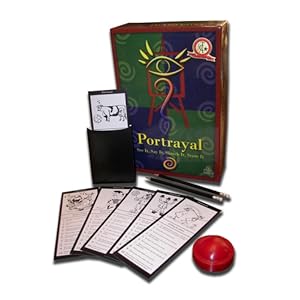
- Portrayal (Identik)
-
There are party games like
Pictionary
that are about drawing and there are others like
that like
Taboo
are about describing, but it's unusual to have both combined.
Here one player looks at a whimsical, even crazy drawing and
tries to describe it in just ninety seconds as all the while
the others are drawing it. After time expires
each player hands his drawing to another for grading.
Only at that time only does anyone find out ten sentences
that come along with the picture and describe items which must
appear in each rendition. Each satisfactory element is worth a
point and one, determined randomly via ten-sided die, is worth
a triple score. The describer is scored too, being penalized for
each item that nobody managed to draw. The sketches are
generally humorous, e.g. two thieves carrying away a mansion
on their backs while a little girl smokes a pipe in the street
or an alligator tennis player wearing a human shirt, etc.
While all of this seems good at first, it turns out that
usefully describing a picture so that it can be drawn quickly
may just be too difficult a task for most people; imagining
what details the illustrators need to know first and which to
save for last is too far from intuitive; as a consequence the
process of drawing can get frustratingly unbearable by the third or
fourth attempt. In addition this feels underdeveloped; the various
picture features should probably be rated for difficulty, not just
all left as equal. Finally, having another player grade the
pictures is kind of dissatisfying because the drawers don't
really get to find out what they did well and what they
didn't – the descriptions no longer being available by
the time they get their pictures back. At least this complaint is
fixable by the consumer. The rather large box includes quite a
generous number of pictures, drawing pads and pencils along
with die and an unusual timer. All in all this tends to only work well
with very select groups. Chances are that those looking for a
drawing game will be much happier with
Telestrations.
Also published as Identik.
[Party Games]
LLLL5 (Strategy: Low; Theme: Low; Tactics: Low; Evaluation: Low; Personal Rating: 5)
William Jacobson & Amanda Kohout; Braincog,
Inc.-2010/Asmodee-2010; 2005; 3-10
- Powerboats
Apart from the recently reviewed
Leinen Los,
games on boat racing do not rapidly spring to mind. Of course
there are some
sail racing games –
Auf Kurs, Regatta and Race the Wind –
but they are concerned with wind changes and are thus a
boat of a different color. Actually, there doesn't seem to be
a good reason for this one to be about boats either –
cars might have served – except maybe for the sake of
variety, always a worthy goal. The key innovations here are
the "three-sided dice". Well, they really have more than three
sides, but two are so rounded that only the sides bearing 1 through
3 can possibly appear. The detailed, hard plastic boats race
around buoys on a large, hexagonal map. Initially each rolls
only one die to move a number of spaces, which is also saved
for the next turn. The only alteration of direction allowed is
one sixty degree change in direction at the start of the turn.
On each subsequent turn another die may be added, or at most
one may be subtracted, plus an existing ones may be re-rolled.
The main problem is that the board is littered with islands to
avoid. Running into one gives damage points in the amount of
one per overrun, four of which sink the boat. The instructions
also specify that a boat must avoid a crash if at all
possible, meaning that it might be forced to turn off course
considerably, often an even worse result. Having fallen behind
there is not much of a catch-up mechanism, except to hope that
the leaders make mistakes, but being leaders they can afford
to be conservative and should be able to do so. It is thus up
to laggards to take risks, pushing matters hoping to get exactly the
right roll to get back into contention without crashing. Doing
this is rendered even more difficult by the fact that leading
boats tend to be obstacles which must not be landed on. The
maps can be re-arranged in different patterns and are two sided,
one more difficult than the other. In addition, each of the
three races in a match is different and very likely different
with each playing as well. The board also holds a scoring
track, nicely represented as a river or canal. Buoy markers
are of assembled cardboard, clever, but tending to fall apart
if not glued. Most of the decisions here are tactical, even
obvious, being maining a matter of counting. Still, one can
decide whether to go for a tight line (shorter but with less
speed out of the turn) or a loose one and one can also decide
the importance of saving a "1" die, eminently useful in
avoiding collisions. There is perhaps one major decision in
each race, i.e. when to take a big gamble which may easily
go very wrong and lead to disaster. But somehow this game
earns more fun than it seems to deserve, the why being
something of a mystery. Of course like most race games
it is very good thematically, but perhaps it's just the
schadenfreude of seeing others' boats totally mess up
that provides extra pleasure? From a design perspective,
there's a lot here to admire. By utilizing dice with a very
small range and drastically limiting turning, Corné
has elegantly modelled an inertial structure that more
complicated affairs (cf.
Bolide)
could learn from. At the time of this writing, a Powerboats
2 expansion has been announced, which apparently adds
seven tiles, presumably new obstacles to avoid.
[6-player Games]
LHMM7 (Strategy: Low; Theme: High; Tactics: Medium; Evaluation: Medium; Personal Rating: 7)
Corné van Moorsel; Cwali; 2008; 2-6; 8+
- Premiere (Showmanager, Atlantic Star)
Game of impresarios putting on stage shows. There is a great
fun factor in the parodic names of the shows and actors and in
particular casting total mismatches. Fun is enhanced by having
each player they read out their cast in the best Broadway promoter
fashion as they launch a new show. This nicely clean system is
good for three to six. Although there are healthy doses of luck
and memory, there is some strategy as well. In particular, try
to delay putting on your first show until you can find out what
show will be in the most lucrative location. Once that is set,
you can put all your energy into making that show your best one
and probably win the game. Usually it is okay to put on a lousy
show in the worst location, or if one happens to put on a good
one there early, feel free to borrow from it heavily in order to
put on excellent ones elsewhere. Premiere is the original
edition with flavor locations set in Germany. Showmanager
provided worldwide locations, including the little-known
Troisdorf, home of the publisher. The Atlantic Star edition
changed the venue to cruise ships and made a minor rule change:
it is permitted to have two performer cards left over at the end.
[6-player Games]
Dirk Henn;
db-Spiele
- Der Prestel Schlossgarten
Somewhat bizarre game of castle garden construction has a
very inviting appearance, but is betrayed by poor rules
editing and underdevelopment that limit balance and
enjoyment. Prestel published its first game in 1998,
another in each of 2000 and 2002, then
followed with four more, of which this is one, in
2004. It appears to be inventor Ulf Siebert's third
publication. Players begin by randomly placing
variously-valued square tiles to form a "board".
As one most often acquires the tiles nearest their starting
position, it can be unfair when these tiles are low valued. Then each
locates his king, builder and gardener pieces and takes a
positioning card. At the start of each turn another card
is drawn – another problem as it adds downtime. We
immediately changed this rule so that two cards are
always held and a replacement drawn at turn's end. In any
case the player must reveal one of these cards and then
use up to 5 movement points to position their figures to
match the card. As the cards can be oriented in any of
the four cardinal directions and since opposing figures
can be used as stand-ins, this can take quite a bit of
time, especially if one wants to find the absolutely best
move. Usually we tended to just take the first or second
we could find. But at least most positions are achievable
since diagonal movement, jumping and bumping are all
permitted. Once this is done, the player flips an unowned
tile adjacent to one of his workers and may
claim it if he can replace it with one of his own
constructions, which come in sizes 1, 2 and 3. Most
frequently a player chooses to replace not only this
tile, but also an opponent's previous construction at the
same time. A few points are left ambiguous, but
apparently this is the way it was meant to work. The
contest ends when someone reaches 21 points without even
guaranteeing the same number of turns for each player,
so clearly the earlier one goes, the better. The box and
tiles are beautifully rendered and it's very inviting to
open up and start playing. The artist has done his or her
job amazingly well, bu the editor must have been very
rushed or not known his job to leave matters in this
state. Recommended only for tinkerers who want to create
their own game with these handsome components.
Strategy: Low; Theme: Medium; Tactics: Medium; Evaluation: Low; Personal Rating: 5
- Preußische Ostbahn (German Railways)
-
It's not uncommon these days to see a German game carrying an
English title, but here we have the rarer case of an American
publisher coming out with a German one. "Prussian Eastern
Railway" is another of those auction a stock or build track
for a railroad in which you hold shares games, this time set
in Germany. As a railroad reaches more cities, it provides
more income per share. When two railroads join one another
dividends are paid.
Each railroad offers a different attribute. Some don't pay
extra to enter cities, some build track cheaply, some get
extra income, some can only build two per turn while the
title railroad can build four per turn.
A new wrinkle in this series of games
has been introduced to address any rich-get-richer problem.
Now in addition to railroads, players are also ranked by
income. To start each turn a player places into any cup a number
of cubes equal to his rank. These are then drawn out randomly to
determine who has a turn, and when. This helps the problem,
but unfortunately does not go far enough, meanwhile
introducing other issues. For even though one gets more turns,
this is not always helpful if the leaders hold significantly
more funds. Any worthwhile stock that can be put up is also
quickly gobbled up by these same leaders. Currently the only
tactic that trailing players can employ is to cautiously bid
up leaders, hoping to trick them into spending more than they should
and then not bid one another up, a task that's very difficult
to accomplish both fairly and effectively. The other issue
with drawing is that it can lead to long periods of downtime
for some players, which in any game is pretty much the antithesis
of fun. The best approach in all of the games of this series is actually
one of restraint. One should generally avoid buying a stock
in the initial buying round, or least avoid paying more than
just the amount needed to raise income by the minimum amount.
Instead, just let others run railroads, then buy into
whichever ones have become the most successful, the key being
to retain enough buying power so as to be able to outbid
others. After that, one should buy into whatever stocks
the last-placed player is holding because that player is most
likely to get the turns needed to expand his railroads. From this
it should be apparent that the chief two talents needed to
play well are evaluating the worth of stocks and deciding the
ideal railroad to put up for sale. The presentation, as usual
for the Winsome line, are typically dodgy, but functional.
Hills, for example, are denoted by bright blue dots; is that
intuitive to anyone? Was a brown triangle so much more
difficult to place there? Track is represented by cubes in
several different colors which are placed on the shiny paper
map. In addition the instructions are a
bit unclear in places. In particular it is important to note
that even if more than two railroads join at the same time
(quite common in Berlin), still only one dividend is paid.
Despite the difficulties and the difficulty of keeping everyone
in contention all the way to the end, the decisions are difficult
to make and there is some tactical decisionmaking on the
board. An experienced group, perhaps totaling not more than
three can make this work. Also available is an expansion called
Preußische Ostbahn: Berlin-Stettiner Expansion,
a paragraph or so of rules plus a half dozen cubes. If
available there is no reason not to include it;
it is mainly used to complicate
play in the all-important Berlin, in particularly having a
strong ability to cut off other railroads. This has
since been re-published as German Railways (Queen),
possibly having rules changes.
LMMH6 (Strategy: Low; Theme: Medium; Tactics: Medium; Evaluation: High; Personal Rating: 6)
Harry Wu;
Winsome Games-2008; 3-5; 90
[Shop]
- Princes of the Renaissance
Martin Wallace multi-player game and negotiation treads where Junta
has marched before. An even closer predecessor is Putsch as there also players
take turns sequentially rather than simultaneously and there
is the same concern with each country's status, here treated
similar to a stock price. Following previous criticsm
of Attila, should
this be called "Lorenzo the Stockbroker"? This
part hearkens back to the designer's 1630something,
but solves one of its main problems – getting stuck with
a weak country – by letting players gradually get into
up to three countries during the course of the contest. Most
of the aforementioned titles are found in the Military Games
section, but you are reading about this one here under Society
Games because the effects of war are amazingly minimal. Players
must win auctions to control one of the combatants and even a
loss never destroys an army card. The only effects are winning
a victory laurel – part of a set collection game –
and the changed city-state status levels. A nice feature are
the many illustrated historical personality
cards available for auction à la Lords of
the Sierra Madre. Here they have dual roles: besides
conferring some minor game advantage, they also constitute
a share in the city to which they belong. The latter reason
means these items have minimum costs which feel a bit too high
compared to the average income. Players may feel their options
a bit too constrained. Also troubling is the apparent dominance
of the military approach. This is exacerbated by there being
so few die rolls, which can increase the chances of a win by
lucky rolling. Since this is a negotiation game, that opponents
could pool money and influence to stop a leader, but it seems
difficult since after the sharing that may not be all that much
to share back. This is another "board game" with an unnecessary
board (see St. Petersburg).
Geography is depicted, but has absolutely no effect on play. The
theme is further obscured by the fact that anyone can control
any city at any time. Warfrog continues to be plagued with
communication design problems with more symbols being needed
on tiles and at least one having a copy-paste error. Not
surprisingly for a venture of this complexity there is a fair
amount of errata again too. With many auctions and negotiations,
a playing can last a few hours, limiting its general appeal,
the likely audience probably being fans of multi-player
war games and for them this is certainly preferable to Diplomacy
or Macchiavelli, but for master strategists,
negotiation and tactics have replaced the more
enjoyable planning that was featured in the designer's Empires
of the Ancient World and Liberté.
Games of the Italian Renaissance]
Martin Wallace
- Die Prinzen von Machu Picchu (The Princes of Machu Picchu)
For those tired of the artificial feeling of a rondel game
(Antike,
Hamburgum,
Navegador,
and to some extent
Glen More
being examples of the genre)
what if the rondel no longer looked like one? What if instead
it were an area map of the lost Incan city of Machu Picchu? But
just the same, each player has one pawn and by moving into an
area, activates it. There are other variations from the
usual rondel pattern too. Since the map has two dimensions
it's not required to only move in a clockwise direction, but
also possible to go laterally or backwards. On the other hand,
there are five spaces which produce goods (corn, llamas,
cacao, textiles or ceramics) which only activate once per
turn. In addition there are two re-usable places to purchase
assistants for one of three temples and the temples
themselves, which tend to use up llamas or other goods. The point
of this activity is to move a player's other pawn around the
twenty-space Inca trail (a real life place, and in a way,
another rondel), a complete circuit of which grants a player a
random draw of three victory point cards, after which two must
be discarded. Also re-usable are two locations permitting
establishing workers in the five production areas. These mean
that whenever anyone visits such an area, one gets production
of the items just by paying a minimum amount. In the central
plaza there is also a simple market where players may buy and
sell products, corn being used as the equivalent of money. Not
moving at all allows the player to claim a moon disk
conferring some extra item or trail progress. When three are
drawn the round ends. The end of play is uncertain: if the
players hire all the temple assistants before the ninth turn
the Inca are considered to have been sufficiently devoted to
the gods and there is a sudden ending. Each victory card
shows a combination of a two products and/or temples. The
player scores by multiplying the number of such card images by
the corresponding workers. However, if the players were
insufficiently devoted and play ends normally, Pizzaro
and co. are considered to have arrived to conquer the
empire and Now the previously meaningless gold
amounts on the victory cards are considered, the player
having the most receives a score multiplier of three, the
second most gold getting doubled, and so on. The large box comes
with a great many brightly colored wooden pieces,
the four product types not being seen elsewhere. The llamas
are even stand up figures. The map is roomy enough to
accommodate them all, but can be somewhat confusing to figure
out, particularly as the adjacencies are difficult to discern.
Perhaps this is meant as an additional challenge for the
players. More problematic is that it tends to be rather
confusing to remember which temple places are for hiring
assistants and which for making sacrifices; there are
double-side cards in English and German to aid memory. The
map is also double-sided to support both English and German.
The randomness of the victory cards can be rather frustrating
if one never manages to draw more of whatever project has been
started. They might better be termed lottery tickets. For this
reason, as well as of downtime and just downright feeling of
making progress, it's best to keep the number of players down,
way down. Otherwise one just doesn't even get enough cards to
put any sense into planning. Another imbalance is that not all
commodities appear to be created equal. Because it's needed so
often, even on others' turns, corn is rather important and
because they permit teleportation and sacrifices, so are
llamas. If then, one happens to draw these particular types of
victory cards – there are the same number of each type
in the deck – simply concentrate on these items
which are already more intrinsically valuable than others.
That win-win doesn't seem quite fair to others, even if the
two places to gain corn and llamas are slightly more difficult
to reach.
All of these imbalances might have been more acceptable if
play didn't require so much time. The added attention to
theme, while admirable, does not go far enough to compensate
either.
MMMH5 (Strategy: Medium; Theme: Medium; Tactics: Medium; Evaluation: High; Personal Rating: 5)
Mac Gerdts; PD-Verlag-2008/Rio Grande-2008; 2-5; 120
Amazon
- Principe, Il
Board game of the Italian Renaissance by Emanuele (Oltremare)
Ornella. For those who know
Marchands d'Empire/Himalaya,
there is a bit of the same feeling here, sans the programmed
movement aspect. Each turn players are dealt a number of cards
which they use in combination to fulfill publically available
"contracts". This grants certain advantages, in particular the
ability to place pieces on the north Italian map where an area
dominance sub-game is underway. It is here that most victory points
are earned. The most novel feature of the entire affair is that
just after receiving cards, each player tosses in two. These are
all collected together, divided into lots and auctioned off. The
entire process has challenging decisionmaking and dilemmas, though
it seems that the subsequent phases might yet be improved to make
it hold even more interest. As to the rest, the area dominance game
is so friendly with respect to ties and second places that the
whole contest seems to lose significance, or can turn on very small
factors. The contract fulfillment phase has the annoying feature in
common with the bad
Empire Builder
"open contracts" variant wherein anyone can fill any contract card.
In this way a player can rather easily and yet completely
unknowingly ruin entirely the day of someone else who was depending
on doing the exact same thing. Finally, the design has been canted
so that upon conclusion of every contract six or seven discrete game
functions must be performed – at which point any pretense to
elegance has sailed out the window. Recommended for logistics
experts, if any.
Games of the Italian Renaissance]
Strategy: Low; Theme: Low; Tactics: Medium; Evaluation: High
- Privateer (Pirateer)
Abstract with ostensible theme of up to four pirates fighting over treasure.
Player pieces travel on a grid using dice to move as in
Backgammon.
Of some interest, probably best as a two player game, but with less replay
value than Backgammon. Questionable marketing
techniques of the publisher on the newsgroups leave a bad taste in the mouth
for many cognoscenti.
Later published in slightly different form as Pirateer.
[Pirate Games]
- Pro Draft
Got this game of drafting a gridiron football team with excitement
as there were cards showing actual football stars like Larry
Csonka, but this was a very long time ago, back when it first came
out. Seemed then that there was too much luck of the draw. Even
worse, there was the ability to trade one's worst player for
another player's best. It didn't get played anymore after that.
LMMM5 (Strategy: Low; Theme: Medium; Tactics: Medium; Evaluation: Medium; Personal Rating: 5)
unknown; Parker Brothers-1974; 3-4; 30
- Probe
Word game of guessing what word other players have hidden behind their
displays is something of a multiplayer Hangman. There are limited
tactical possibilities, but mostly of interest for word fans and
vocabulary building.
- Programmer's Nightmare
Players use cards representing computer instructions, in this
innovative game, to create something
resembling a computer program, but with the important difference
that they have controlling interests in particular cards, i.e.
whether, when the program counter reaches them,
the instructions execute or not. Various wild effects
make matters entertainingly unpredictable, but long term strategy
is still possible. Downsides are the rather simple presentation,
ambiguities in some of the cards and above all,
that some players are eliminated (when
they run out of bits or life points) quite some time before the
end.
[6-player Games]
Tom Jolly; Jolly Games-1998; 2-6
- Pueblo
The design-graphics-publishing team responsible
for Tikal,
Torres, Java and Mexica return to North
America, paying a visit to the homes of the Hopi and Zuni.
It is also something of a return to Torres in the high
level of abstraction as players are essentially solving a
puzzle in building the eponymous pueblo from pieces which are
three-dimensional rectangles, joined at a right angle at one end.
Players hold both neutral pieces and those of their own color,
placing them so as to minimize the visibility of the latter,
by the end producing a complicated, conglomerate structure. This
is a good illustration of "path-dependency", the general concept
that the end result derives less from any wise overall design at
the outset, but more from the tugs and tweaks that happen along
the way. The idea applies well to the body of law produced by
Congress and many other situations. A game unexpectedly similar
to this is Streetcar, as the
course of playing can be mapped to its two stages, first the
building, then the final scoring. (It's true that Pueblo
has scoring during the building phase which Streetcar
does not, but on the other hand the expertness of the latter's
building contributes more in the long term.) I'm not sure if
we will hear all of the complaining about the end game for this
one that we have heard for Streetcar, however. On the
good side, the rules are very easy to understand and there are
not many of them. There is no secret information to worry about
and nothing to bid on or worry about how much to value. The
downside is that the experience is disappointingly tactical as
the pueblo changes so quickly that there is relatively little
long-term planning available. For those who might enjoy it,
forcing opponents to take a bunch of points all in one go offers a
higher-than-average nastiness factor. Andreas Seyfarth, inventor
of Puerto Rico, has written "A game shall be fun and be
based on a storyline - if possible." I don't think he would
find much of the latter here. Moreover, the blocks do not much
resemble an
actual pueblo, either. [Holiday List 2002]
- Puerto Rico
Invented by Andreas Seyfarth, creator of Waldmeister and Manhattan, it is a game
of Caribbean colonization similar in scope and style to Princes of Florence and Traders of Genoa, also published
by Alea. All of these games feature a wide variety of options
and multiple strategic paths, words near and dear to the heart
of the sophisticated game player. In fact, so typical and
impressive are these games that it becomes necessary to coin
the term "Alea-style" and heap praise on Stefan Brück,
their publisher. Just as in Princes of Florence (and
Waldmeister), the player operates on his own tableau,
here divided into town and country. For the country he drafts
plantations of up to five different types and in the city,
mills to process their output or other buildings, which confer
some special advantage not normally allowed. Selling crops
confers cash to buy more buildings while sending them back
to Spain gives victory points. Points are also granted for
buildings at the end. Although the special rules for filling
ships and satisfying the demands of trade are interesting,
probably the most novel feature is the drafting of player
functions. These are seven hardback cards, each of which performs
a different function. Each player will draft one of them in
turn, but all players will then perform the function, with the
drafter getting a minor bonus. Absent but not missed is all the
negotiation from Traders of Genoa (which suggests that the
latter's systems might have been flipped over so that there was
normally no negotiation and that it come into play only when
it mattered enough that the active player was willing to pay
for the privilege). Functions which are not chosen receive a
bonus coin à la Vinci
to make them more attractive the next time around. There appears
to be a lot of strategy to learn, but a few thoughts can be
offered. Buying several quarries early along with a hospice can
be effective for a strategy of collecting buildings quickly.
Quarries may be the nearest thing to the jester in Princes
of Florence. Players not buying a hospice should probably
try for a hacienda. When deciding what crops to grow, the
workings of the ship and the trader make it wise to avoid
what your right hand neighbor grows and to strongly consider
growing what your left hand neighbor does. Corn is good because
it doesn't require processing, but Indigo may be undervalued.
Perhaps obviously, the large buildings can be quite valuable.
The graphic design is wonderfully evocative, although more
color-coding of the buildings would have helped as they are
remotely stored on personal displays. The theme works well,
although it would have been more intuitive to craft the functions
as events rather than occupations. For example, "New Settlers
Arrive" would have worked better than the mere "Settler". The
American edition renames the "overseer" as the "Craftsman".
Overall, should strongly appeal to the fans of the other recent
Alea offerings. It feels slightly less complicated than
Princes of Florence and those bothered by having to
study so closely the activities and holdings of opponents will
enjoy this more as it is not so important and there is nothing
hidden apart from the victory points. Of course, it may still
be over-complicated for the inexperienced. The only thing
which may keep it from being a classic along the lines of Die Siedler von Catan,
Euphrat & Tigris,
and Carcassonne
may be that all of these are wide open enough in their
designs that every game tends to be very different –
this is much less the case here. Surprising that while
everything else pretty much scales for different numbers of
players, the Trader does not. Four may be the ideal size.
Expanded by
Treasure Chest.
[design analysis]
[variant]
[Periodic Table of Board Games]
Strategy: Medium; Theme: High; Tactics: High; Evaluation: High; Personal Rating: 9
Andreas Seyfarth; Alea-2002/Rio Grande-2002; 3-5 (2)
[Buy it at Amazon]
- Putsch
Very involved negotiation card game set in banana republics.
Overwhelmed by a bewildering number of options for the players
and too much importance given to the luck of the draw.
- Pyramiden des Jaguar, Die
Two-player card game features a deck numbered 1 to 40. On a turn
a player offers the opponent two hand cards: the opponent takes
one, then the player, the other. These must be located in the
owners' pyramids in strict ascending sequence. The problem is
how much space to leave between cards; the goal is to offer two
cards where one has space and the opponent does not. Should this
happen, the opponent overlays a card and marks it with a wooden
jaguar head piece. This means that the player gets to advance
on the track and depending on where he lands, possibly perform
a special action, e.g. remove a card from hand, remove a card from board, etc.
The pyramids hold only a few cards, meaning the strategic opportunities are less
than elsewhere, but is probably suitable for those seeking a very light
two-player game with a feeling akin to
Racko.
One can probably do better with something like
Flowerpower
in this vein.
"The Pyramids of the Jaguar"
is a re-make of Pacal, which as far as I can determine,
lacked the scoring track and started the game with the pyramids filled.
Both versions are set in the Mayan empire at its height.
- Q -
- Quacksalbe
Trick-taking card game about various kinds of quacks — bloodletters,
accupuncturists, electro-shockists, pill pushers etc. — trying to
cure the most patients without in the process killing them. This is reflected
in a challenging problem of trying to have the highest total of cards played, but
not exceeding the printed value on the patient.
Mostly a matter of luck of the draw, although almost compensated for by
the very humorous card art and descriptions of different types of patients.
- Queen's Necklace
Card game of pre-Revolution France by Brunos
Faidutti and Cathala is also the topic of a decent
film (with Hilary Swank, Adrien Brody and Christopher
Walken) based on the Alexandre Dumas, père,
novel. The story connection is not particularly strong even
though all of the elements are there, attractively-illustrated
to boot. Instead it's a game of jewel acquisition in four
varieties and then maximizing profits on the sale. The spine of
play is the ability to draft cards worth a total value of up to
ten points. Each card has a cost which declines each time it is
not taken until it eventually disappears altogether. (This dial
interface is nicely handled by use of small golden rings.) Just as
in Citadels, cards confer
a number of special powers forcing players to consider a wide
variety of possible eventualities. There is much to consider,
almost all tactical in nature. In something unusual for its
acquisition type, the rate can be very irregular. One player
may build up a huge lead while another is held scoreless for
the game. But so huge are the possible gains that no lead is
safe – there is really no sure way to guarantee or lock
down anything. It's another good tactical outing for those
who enjoyed Citadels, perhaps slightly less exciting
without the roles. Some male players may need to see if they
can pass their masculinity check as included is a necklace
which play of the corresponding card dictates must be donned.
[Days of Wonder]
- Quirks
Evolutionary card game by the designers of Cosmic Encounter is very
accessible, not very historical
and rather subject to luck of the draw.
Also published
were Quirks Expansion Kit 1 and Quirks Expansion
Kit 2, both of which simply add more cards to the deck.
- Quivive
Abstract for up to five players is of the "disappearing board" type.
Each turn a player's pawn hops one space and then removes an unoccupied piece of
the board. Pawns unable to move are out of the game. The last player
surviving wins. Quick and not without interest, but highly dependent
on the skills and whims of other players.
- Quo Vadis
Reiner Knizia's first big one is a negotiation game about
machinations in the public life of Ancient Rome. Those familiar
with the cursus honorum
(Course of Honor)
actually pursued
by Roman magistrates will readily recognize it in the board.
At first glance appears to be a no-holds-barred negotiation
outing – and therefore prone to long delays and boring interludes
– but actually plays better than it à priori
seems. In fact negotiation is pretty much limited to the first
half, after which it shifts gears into becoming an interesting
match in lookahead and outguess. Features nice plastic pawn
figures representing the acanthus. Title is Latin for
"Where are you going?" – probably deriving from the famous
novel
and
film
of the same name. In 2023 being reprinted with some rules changes
as Zoo Vadis, full of colorful cartoon characters because that's
what grown men want in a serious game (wtf).
- Qwirkle
Board-less tile-placement game. The number 6 pervades play as
tiles each have two traits that come in a variety of that
number, a shape and a color. The hand size is also six.
Players add up to six of their tiles to a single row or column
so long as one row trait is all the same and the other trait
all different, e.g. after finishing, the row might be all blue,
but each tile a different shape, or, each the same shape, but
all in different colors. Often the smart play is to create a
row parallel to an existing one which gives points for both
the row and the resulting columns. Scoring is simple, giving a
point for each tile in a resulting row/column. Another good
play is to complete a row of six which gives double points.
Physically the chunky wooden tiles in bright colors and
interesting patterns – circles, squares, diamonds,
"propellers", etc. – are very satisfying, especially as
they can stand on edge on their own. This is sometimes compared to
Scrabble,
which has some basis, though not for a verbal person who is more
charged by the search through his vocabulary for a word that
works. This is Scrabble for those who dislike spelling
perhaps. Although playing defense has a role here, it is much less
territorial and therefore less competitive than the somewhat similar
Ingenious.
Indeed, this can be reasonably played by children as young as,
you guessed it, 6.
Scheduled to be expanded in 2009 by Qwirkle Cubes which
converts the pieces to cubes that can be rolled like dice to obtain
differing values.
Susan McKinley Ross; MindWare-2006; 2-4
MLMM6 (Strategy: Medium; Theme: Low; Tactics: Medium; Evaluation: Medium; Personal Rating: 6)
On to R
- Main
Please forward any comments and additions for this site to
Rick Heli.