Spotlight on Games
>
1001 Nights of Military Gaming
- I -
- Ice Pirates of Harbour Grace
(Note: a complimentary copy of this game was received for purposes
of review.)
Game for up to six of exploration and combat. Players control
ships which begin at the center of a sea formed by face down cards.
Sailing reveals the cards which come in the following flavors: open
sea, open sea with blocking ice, storm, treasure map fragment,
extra crew, treasure island. Player travel is fueled by the wind
which changes on every storm encounter, i.e. not overly often, and
is directed by player desires to acquire the various ship upgrades
located at the six corners. These enhance either movement, – main
sail, jib, icebreaker – combat, – cannon, grappling hook – or
discovery/pick-up – telescope. Only three of each are available
and the later one arrives, the more they cost in crew. Theme-wise
spending crew feels a bit odd as does having to to go to these
various places, but it works well on its own terms since choosing
which items one wants is a nice dilemma, particularly considering
what others might do and whether it's necessary to sail upwind,
i.e. slowly. The sailing rules work well, a speed of 3 being the
maximum. Eventually someone finds all three map fragments and
recovers the treasure, at which point the second phase begins: all
attempt to seize the booty by combat and escape the map off the
northern edge. Managing this can be quite an elegant puzzle as
there are positioning and movement restrictions as well as changing
winds. Sometimes the best move would be to hover in the right spot,
but even that is difficult as the rules require a move. Often
there is combat which is resolved with the help of dice, each
player's total being the maximum of his crew or his die roll. The
losing player may discard a crew and thus re-start the contest.
This system offers a nice tension and does not outlast its
interest. Production is pretty good, especially for a new
independent. It comes in a clear plastic bag, but the cards are
fairly sturdy and packaged in re-usable sleeves. The plastic chips
are gambling sized and though hardly thematic, are at least a pleasure
to handle. Card artwork is cartoonish rather than classic. The
instructions are ultimately clear, but sometimes need a careful
reading. They tend to err on the side of being a little too
laconic. For example, one section has
A player with a Jib who tacks on her first move may still move
again. If she has a Main Sail she may also tack on her second move
and still move again.
What this means to say, we believe, is
A player with a Jib who tacks on her first move may still move
again, as long as that move is with the wind. If she has a Main Sail
even the second move may be tacking across the wind which can be
followed by a third move, which must be sailing with the wind.
But overall this is recommended as a worthy addition to almost any
collection, especially as it supports six with acceptable downtime.
Strategy: Medium; Theme: Medium; Tactics: Medium; Evaluation: Low; Personal Rating: 7
Carl Chudyk & Erek Slater; Cambridge Games Factory; 2005; 2-6
- Illuminati
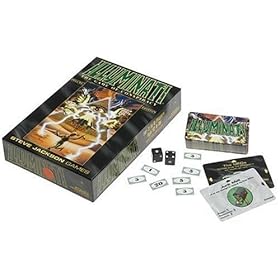
Steve Jackson effort in which players represent secret, conspiratorial
world powers from the complicated mythology presented in
The Illuminatus Trilogy
and elsewhere (read more
about how these conspiracy theories get started in Umberto Eco's
well written
Serendipities).
In game terms players are trying to take control of various
unowned public groups from The Cattle Mutilators to the Fiendish
Fluoridators. Players spend money to help or hurt the chances
of a takeover/destroy attempt which is resolved by dice.
Each player's position has unique abilities and victory objectives.
Has a "blackmail" tendency akin to
Kill Dr. Lucky
in which no
one wishes to participate in stopping an incipient winner for fear of
harming his own chances. Often victory can turn on a lucky card draw
or fortuitous roll of the dice. Some players would probably prefer that
all cash be public. There is plenty of humor inherent in
the characterization of various public groups, although the game sometimes
seems to take longer than one would wish.
The bidding system is very innovative and continues to fascinate as it can
be found in games as diverse as
Republic of Rome,
Verräter,
Meuterer
and others. There are many dimensions to consider including
measurement on a point-by-point basis of just how useful the
current auction is, considerations of what bidding is doing to the remaining
treasuries of opponents and the tendency, once bidding begins, for good
money to be thrown after bad.
Same basic system later released in variously modified editions, e.g.
Deluxe Illuminati,
Illuminati: New World Order
and
Illuminati Y2K
(not described here).
[variant cards]
[Buy it at Amazon]
- Imperator [Vae Victis]
-
War game by Vae Victis probably intended to be a workable
Imperium Romanum
ends up just as flawed, but in completely different ways.
The setup is for two players only and covers the later Roman empire,
i.e. from Marcus Aurelius onward. One player takes Rome proper while
the other controls all the assorted barbarians plus usurpers which can
be generated via Stratagem chit. These chits are a good place to start to understand
what is wrong.
Drawn once per turn by each player, not only are they wildly unbalanced,
but some are so incredibly powerful that they will easily dwarf anything
the players can manage to do on their own. A Mutiny chit for example can
take out an entire stack of Roman army leaving the barbarians to do whatever
they like while the mutiny doesn't even end until the Romans can someday bring
in forces from elsewhere to defeat all the mutineers. And to think that Roman soldiers
are happy to go on strike while Parthia or Germany help themselves to the
best parts of the empire rather strains believability. But even if you can swallow
that, what about the total lack of any need to trace supply? Trajan's campaigns
in the East clearly showed the importance of this vital component of war, but
here there are no rules for it whatever so, for example, Parthia might abandon
its capital altogether and even lose it to Rome, but the "barbarians" simply
don't care. Another strange item in the "don't care department": suppose the
Germans penetrate the Roman limes and actually reach Rome itself.
If the frontier troops have not been declared available, they can't even
go to the defense of the capital. No, they are stuck there by rules which
limit them to their region, apparently so they can defend against barbarians,
even though all of the above are already having an orgy with the Vestal Virgins.
By the way, if you ever do get roped into playing this game, be sure to choose
the barbarians because they are the side that can earn the big points in this
game. Rome earns nothing for conquest outside the empire and
a mere four points a turn for maintaining the peace, but
if the barbarians have any success, they earn at least one point for each unit
that penetrates the empire, which can go up to twenty or more. With all the
problems cited already, there is probably little point in mentioning that the
counters of the two sides are colored almost identically and
worse, that the forts they return to every single turn are not printed on the
counters, but in the rules, where, by the way, the names are not sorted in
any kind of alphaetical order and the words not emboldened although, confusingly,
the other words are. The counters and forts depend on actual legion and fort names,
which while nice for atmosphere are rather obscure and make things even harder.
The publisher obviously has no interest in
the international audience since even though Latin names
are universally understood by all Roman fans, they insist on using the frenchified
"Marc-Aurèle" and "Commode" for the more familiar
Marcus Aurelius and Commodus. Finally, even though one would expect that with
so many corners being cut that at least the game would pass fairly quickly,
but no, there is no luck here as well. There are so many wasted motions
and unnecessary impulses inserted that the AD 161-180 scenario is bound to last at
least 8 hours if not more, and this is one of the shorter ones. If you were
thinking of having this one translated in English, you can save yourself the trouble
as there are no redeeming features here.
[Vae Victis]
- Imperium
Two-player science fiction war game about interstellar war in
which humans have traveled to other stars only to find them
already dominated by an enormous empire. Units are at the ship
level and movement at the system level. Innovative is the fact
that the game is punctuated by periods of war and peace and
the loser of one war tends to receive more resources before the
next one.
In the first edition, it seemed best for the Empire player
to lose a few wars and then appeal to the Emperor to get
a large and budget, then use this to crush the Terrans.
The second edition made this approach less viable. Interesting,
but much of the depth seems to be in local tactics rather than having
much overall strategy. I have heard that the same system was also later used in
Dark Nebula.
At the time of this writing, is being re-published as
Imperium 2000 by Avalanche.
- Imperium Romanum II
War game depicting various battles and campaigns from the Republic and Empire all the
way to Justinian.
Fascinating set of scenarios and maps, but the
accounting necessary overwhelms attempts to play.
It is also disappointing that such a big show of historical accuracy
is made when there are glaringly obvious facts wrong such as including
both Licinius and Severus in scenario 18 when they did not rule at the
same time.
And this is the revised version of Imperium Romanum.
- Insecta
Pseudo-role-playing game about insects. Mix-and-match body
parts to create mutant bugs and try them in combat. Then
mutate into new and larger forms. Detailed simulation of
desert arthropod combat but easy to learn. Rainforest
and Trilobite are expansions to this game. Nice twist
on the RPG genre for the hack-and-slash crowd.
Philip Eklund;
Sierra Madre Games
- Intruder
Basically-solitaire game (microgame)
after the popular science fiction horror film
Alien.
Includes 16"x20" map depicting a tripartite space station and
various intruder information as well as fifty-four counters,
including nine crew members from the command, science and
engineering persuasions (which should please fans of Star
Trek). The intruder can have various powers such as immunity
to vacuum, shock, cold, flame, gas, sleep darts or blasts or
possibly have speed, fast reflexes, great strength or cloning
ability. As you might expect, the crew must find a way to kill
it or self-destruct and escape in a shuttle before they are all
destroyed. A scenario to include a second player who controls
the intruder is also presented, as well as ones representing
return to the station with marines. Perhaps the most interesting
scenario is one in which one player represents science officers
trying to capture the intruder while the other crewmembers
still prefer to kill it, but tantalizingly, if both fail, both
players lose. This can also be combined with the scenario
in which a third player controls the intruder. The intruder
movements and activities are well-handled and make for a taut,
tense game. The system is very clean and also quite pliable
for designing variants, some of which are presented at the site
of Chris Camfield. Designed by B. Dennis Sustare, most of whose
work has been in the RPG world, including creations Bunnies
& Burrows, Heroes of Olympus and Swordbearer
and others.
[chart]
- Invasion America
One of the better SPI efforts, this one concerning a dark future
in which a much-weakened North America is invaded from Europe,
Asia and South America. The much-beleagured American player is
something like the ancient Romans in many games, trying to fend
off multiple invaders by taking advantage of shorter interior
lines. The game works well and has plenty of strategic interest
although a few crucial dice rolls can determine a lot of the game,
particularly for the player of the Asian forces, which are large
but very fragile. A dumbed-down version with plastic pieces
called Fortress America was published by Milton Bradley as
part of their GameMaster series. This general setup has several
sources starting with Philip Nowlan's 1928 "Armageddon 2419 AD"
in the magazine Amazing Stories, Robert Heinlein's The
Day After Tomorrow and others. Anticipates in subject many
games produced by XTR.
- Ironclads
American Civil War naval war game. Control individual ships in the
War Between North and South. Plotted movement, critical hits,
various types of ammunition and many scenarios. Very well done
and satisfying. Later supplemented by
Ironclads Expansion Kit, which added more ships and
battles from the War Between North and South. Yet another
expansion, called Shot and Shell, was later done by
3W.
[ship list by name]
[ship list by number]
[ship list by owner]
[ship list by name]
[ship list by number]
[ship list by owner]
[combined ship list by name]
[combined ship list by number]
[combined ship list by owner]
- J -
- James Clavell's Shogun
Risk-like game of conquest set in Japan. Added
are a large number of event cards and the concept of honor
points. Woe betide any player who loses a battle or two early
as the resulting dishonor probably knocks them out of the game.
[analysis]
- Jihad
War game about the expansion of Islam and the Arab empire. One
player portrays the Arabs, the other the various lands
they try to conquer. In a wonderful, innovative
idea, the civil war splits the Arab force
in two and when it appears that one side is about to
lose, the players exchange pieces and resume the game from
opposite sides! Unfortunately, the game needed a lot more
development. When it first reached me, it had no victory
conditions! When I wrote and finally received these, I learned
that it was trivial to break the game. The player not playing
the Arabs can use the march attrition system (which is borrowed
from The Crusades) to march
their last unit an immense distance and thus be sure of killing
it by attrition. But the Arabs player cannot count a land as
conquered unless it manages to conquer the last unit in combat.
I received no useful reply from the publisher who said only
that they never expected anyone to use such a tactic to win a
game. Obviously a game which fails to consider all legal tactics
has not been completed.
[errata]
- Judge Dredd
Multi-player war game based on the futuristic comic book character.
Each player is a judge and races about to vanquish perps. Much of
the game is purely luck based on the cards, but the humor of the
cards adds a lot of fun to the proceedings. Its real failing is
that it requires a particular style of play to work. For example,
if players want to spend all their cards foiling the chances
of others, the game will ultimately fall flat as well as take
forever. This is not a failing of the players, but of the
system which permits it. Good systems are designed with such
problems already in mind and find ways to solve them.
- Jungle (Animal Chess)
Traditional game from Asia which shows the common origin of
games such as
Chess
and
Stratego.
Here the animals have different rankings
and abilities. Possibly a nice variant for fans of Stratego.
Rules
from the Game Cabinet.
- Junta
Multi-player war game satirically set in a banana republic handles
up to seven players, which is rare. Each player represents
a family trying to siphon government funds into a Swiss bank
account. They elect an El Presidente who in turn distributes the
offices of minister of the interior, three generals, an admiral
and general of the air force. He also distributes funds. Those
not receiving funds may wish to engender a coup upon which the
El Presidente may be overthrown. But beware the minister and
his assassination team. Event cards add a lot of intrigue to the
proceedings, as do rules permitting players to switch sides at
a propitious moment. Requires some level of emotional maturity
as a player who declares a coup every turn isn't doing anything
more than just making the game a lot longer than it needs to be;
in fact, he is probably hurting his own chances as it takes a
couple turns to build up enough cards to make a coup worthwhile.
The more players can get into character, the better.
Putsch
is a later, less successful entry on a similar topic.
On to K
- Main
Please forward any comments and additions for this site to
Rick Heli.