
CRICKETS: Egg-wiped.
WHITE: I never heard of that.
CRICKETS: (exasperated) I'm telling you what it
is. Egg-wiped! Egg-wiped! They spell it "E-G-Y-P-T."
WHITE: Oh, Egypt.
|
Spotlight on Games
>
Ludographies
CRICKETS: Egg-wiped. |

|

|
An den Ufern des Nils
Willfried & Hanno Kuhn; Abacus-1994; 2-5
"On the Banks of the Nile".
Players are farmers growing their crops beside the Nile. They wish to use
the best ground available, but not if it is going to flood. Besides managing
this risk, they attempt to bring something fresh and unique to the market to
enjoy the highest profits. But both the river and the players can make life
difficult.
[more]
Archeoegypt
Antonio Trentadue; Waryson giochi-1995; 2-4; 60
The board is a model of the Valley of the Sphinx with a number of
covered spaces. During the game two players or teams examine what's
beneath trying to find the treasure, but at first finding
hieroglyphs which must be translated to identify various Pharaohs.
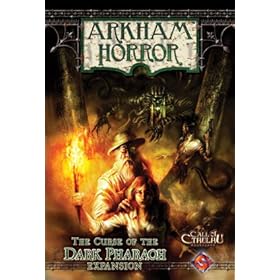
|

|
Baumeister des Krimsutep, Die
Mark Sienholz; Krimus Krimskrams-Kiste-2005; 3-4
"Architects of Krimsutep".
Trick-taking card game using cards showing obelisks, oases, palaces,
slaves, building materials, stonemasons, a foreman, the Nile, etc.
After the trick-taking game, players place cards in a building game.
Caesar & Cleopatra
Wolfgang Lüdtke; Kosmos/Rio Grande Games-1997: 2
Card game of secret card deployments and bluffing plus action cards featuring
special powers in which players try to gain valuable cards and thus
achieve the most points. It's Cleopatra vs. Caesar all over again.
[more]
Carter's Quest
Scott Siedschlag; web-published-2013; 1-2
Set in the 1920s, this is a tile-laying game of exploring Tut's tomb.
Find the four funerary jars and return them to treasury area before
the sun comes up. Find weapons to help in the defense against deadly
creatures. Combat is handled via dice roll.
Cartouche
John Clowdus; Small Box Games-2010; 2-4
Deck-building card game which includes 144 cards in decks
corresponding to six deities.
Cheops
Klaus Paal; Hans-im-Glück-1998; 2-5
A number of items related to Ancient Egypt are set up in pyramid
fashion. Working their way up from the bottom, players in turn
choose which to take, keeping in mind that what they choose opens
the way for the next player to get something.
[more]
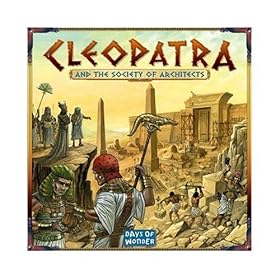
|
Cleopatra's Caboose
Steve Zamborsky; Z-Man Games-2008; 3-5
A humorous train game set in Ancient Egypt?!
Players construct tracks, ship fruit and construct
buildings pyramids.
Cleopatra's Gambit
Victor Talayay; Hammergog LLC-2002; 2
Pure abstract played on three different boards. A piece is played on each
board simultaneously with the goal of forming a particular pattern.
The board which is chosen to be primary determines the location of the piece
on the other boards.
Crimson Sun
John Clowdus; Small Box Games-2014; 2
In this card game players represent leaders of Upper and Lower Egypt
who direct units of the gods Babi, Horus, Kuk and Sekmet.
They build up their forces, use special abilities and influence four
structures.
Crypt: The Pharaoh's Curse
Raven c.s. McCracken;
Line of Sight Games-2002; 1-8
Collectible components game has player character cards fighting one
another on a modular, hexagonal board.
Curse of the Pharaoh
Mo Holkar for Freeform Games-2002; 6-9
Murder mystery game requiring a host. Solve a series of murders
in Luxor, 1894.
Curse of the Pharaoh Expansion
Mo Holkar; Freeform Games-2004; 6-19
Expansion for the above permits adding ten more players.
Curse of the Mummy's Tomb
Stephen Hand; Games Workshop-1988; 1-4
Players are modern day treasure hunters represented by lead miniatures,
all exploring a pyramid at the same
time. Each character has several attributes and also "currency" (represented
by tana leaves). The latter are used in an auction to move the mummy, which
permits the winner to steal or hurt another character. Card play determines
movement, but other players can also use cards to make a character seem to
bumble around in the darkness. There are also encounters: traps, monsters
and items. The outcomes are resolved via die roll.
The eventual goal is to ascend three levels of pyramid and pass a special
test at the secret chamber at the top. Boards are placed at three levels
to form an impressive three-dimensional display.
There is a great deal of randomness in play, however.
Daschur: Die Rote
Pyramide
Pauli Laimerl; Mücke Spiele-2012; 2-4
Worker placement affair of princes building a boulevard for
the Pharaoh. Players use influence cards to buy gems and
position them for use in the grave chamber. Winning game of
the design competition sponsored by components vendor
www.spielmaterial.de.
Daschur: Die Rote
Pyramide - Die Privilegien des Pharao
Pauli Laimerl; Mücke Spiele-2012; 2-4
Promotional expansion item for the above game consisting of
four neutral tiles. It was offered at Essen Spiel 2012.
Day of the Chariot: Kadesh
Gene Dickens; Against the Odds-2008; 2
This is an out and out war game published in
Against the Odds magazine and simulating the biggest chariot
battle in history when the Egyptians tangled with the Hittites and their
allies. Perhaps as many as 5000 chariots participated. Historically, Ramses
II declared victory, but left the city in Hittite possession. Can you do
better? There are 320 pieces and three different scenarios reflecting
different ideas on what the battle conditions and deployments were.
Egizia
Virginio Gigli & Acchittocca; Hans-im-Glück-2009
Ancient Egyptian architects are in competition, from the folks
who created
Comuni,
Ghost for Sale, Maestro Leonardo.
Includes 128 wooden tiles, 100 cards, a large board and various other bits.
Architects need to be "ready neither too early, nor too late".
This was the 4th place in Italy's game design competition of 2008.
Playtesters of this forthcoming affair are said to have liked it and
that it reminded recent resource management games with the addition
of fresh ideas and without becoming overly about numbers.
Egyptian Flood
James Casey, Byron Grimes, Jay LaFountain, August Larson, Erik Lechak, Brad Nordeng, Craig Somerton & Benjamin Sperling; unpublished-2009; 2-6
Web-published card game. A card is played and its effects resolved.
The goal is to achieve as many gold and victory points as possible.
Expedition Pyramide
Grzegorz Rejchtman; Kosmos-2003; 2-4
Gem pieces are arranged on a 12x6 grid. Players move their pawns about this
board collecting jewels in order to fulfill their individual victory condition.
More of a multi-player puzzle solving affair.
Also known as Ubongo.
Feast & Famine
Jason Conforto; Shadow Mountain Publishing-2010; 2-4; 45; 8+
Auction and tile placement game of coping with Egyptian famine as per
the bible. In the first seven rounds of plenty, players gather food in
six types by spending labor points; food gives rewards from pharaoh in
the form of medallions. In the seven years of famine the medallions
are used to save members of the family of Joseph, which are worth
various amounts of points.
Fightin' for the Pharaoh
Matt Fritz; Junior General-2004; 2
Miniatures war game on the Battle of Kadesh (1300 BC) vs. the Hittites.
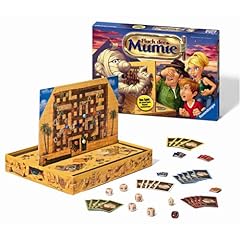
|
Fortune and Glory: Sands of Cairo
Jason C. Hill; Flying Frog Productions-2013; 1-8; 90
Expansion kit for Fortune and Glory,
the cooperative adventure game set in the 1930s.
Cards depict the following:
Cairo, Street Market, Scimitars, Thugs, Desert Swordsmen, Camels,
Buried Tomb, Market Chase, Watched from the Shadows.
Giza
Nikki Lim; Fun Factory/Pegasus-2005; 2-6; 8+
Players are attempting to build three pyramids of the highest quality
for Pharaoh Khufu. Unfortunately rivals keep inserting inferior stone,
demolishing levels and releasing scarabs, which scare away workers.
Luck levels are high, with possible kingmaker effects. Production is
very good.
Giza
Dave Heberer; Mayfair-2012; 3-4; 90
An auction and worker placement (another form of auction) game of
completing Pharaoh's tomb at Giza. No only do players want to
accomplish the most, they need to feed their people and move giant
stone blocks.
Glyphix
Frank Ciofalo; Skrunk Games-2002; 2-6
Basically the same as the traditional game Memory except using
tiles showing hieroglyphs and including the fact that players move tiles
after revealing them.
Gods Along the Nile
Chester Hendrix; Terran Games-2009; 2-5; 45
There are seventy-two cards, fifty-four of them showing a different
aspect of an Egyptian god. Players represent priests and play cards to
add to their temples, trying to maximize sets of canopic jars.
Horrible Histories:
Awful Egyptians
Spartaco Albertarelli; Sophisticated Games-2013; 2-5; 8+
Players represent pyramid robbers trying to steal and then
sell to make the most cash. Rules include card drafting, dice
and trading.
Hounds and Jackals
(unknown); Pyram-(unknown) (2000 BC); 2
This game was actually played by the ancient Egyptians, first appearing
during the New Kingdom. Its rules are similar to Snakes and Ladders.
Horus
Werner Falkhof & Michael Sohre; Theta-2007; 2-4
Players represent Egyptian priests from rival temples competing to equip
the death barge of the dead pharaoh. Obtaining the best offerings requires
trade, purchase, sales, negotiations and conflict. Features very detailed
and attractively-made obelisks and other components, including a
Roulette-like mechanism.
Horus
Jean Vanaise; Amigo/Mayfair-2008; 2-4
Tile-laying game in the tradition of
Carcassonne
with some differences, including the setting, but also that tiles can be
placed half offset. Tile tyles are desert, hill, field, swamp and
river/necropolis. Tile placement is based on which Horus card one draws.
Points are gained in the end for having the most markers in various areas;
some areas can have their worth increased if they are completely surrounded
by water (river).
Horus Line
Spartaco Albertarelli; Kidultgame-2005; 3-5; 20
A game of betting on draws from a bag. A player guesses the number
tokens of a particular color he will draw from the bag. Then in
turn every player can either propose a higher number or challenge.
Im Bann der Mumie
Henning Poehl; Sphinx Spieleverlag-2010; 3-5; 90
Modern adventurers searching for a pharaoh's cursed treasure, but
becoming lost in the valley, must escape the deadly mummy.
One player is the mummy in this card game while the rest play
adventurers. Features attractive monochromatic artwork.
Isis
Horst Alexander Renz; Pharao-Brettspiele-1992; 2-7
Pure abstract made in imitation of a likely game found in an ancient
pyramid. Unfortunately no one today knows how this game was played
so new rules have had to be invented. Pieces move according to the
number of other pieces there are in its section of the board until
they reach a position where they can be personalized. From there, if
they can reach a throne space, they win for their owning player.
This beautiful game is an all-wood production.
Part of a series of games that also includes Ramses and Pharao
It's a Pharaohs Life
Alex Kremer; web-published-2007; 1
Solitaire simulation of a pharaoh's life in 2686 BC.
Mechanisms are action selection and dice rolling against a table.
Iunu
Todd Sanders; Air and Nothingness Press-2013; 2-4; 30
Print-and-play game of feeding the citizens, defending the realm and
securing a place in the afterlife.

|
Kairo
Kimmo Sorsamo; Queen-2012; 2-4; 60
Game of trying to entice customers into shops at the Cairo market.
Previously appeared at Tori.
King Tut
Brian Taylor; Paul Lamond Games-1994; 2-4; 8+
This is a dexterity game similar to Jenga.
Players must carefully de-construct a pyramid composed of thirty wooden
pieces and then construct a triangular structure.
Kheops
Bruno Faidutti & Serge Laget;-2008; 2
Rival architects compete over the Great Pyramid, placing triangular tiles
to fill in the triangular board, the goal being to control the longest
chain of rooms and corridors with the most rooms and best set of
sarcophagi in it.
Includes a suction cup for relocating tiles and is assymmetric as
the first player gets the special Pharaoh piece while the other has the
benefit of going last.
Some tiles have special effects such as prohibiting pawns or relocating
opponent pawns.
Khet
Del Segura, Luke Hooper & Michael Larson-2005; 2

|
Lords of the Sand
John Clowdus; Small Box Games-2014; 2-4
Card game of the Egyptian gods, each player representing one of
Anubis, Khnum, Sobek or Thoth and having different goals and abilities.
Players attempt to gain more abilities and score points by building up
obelisks and other cards.
Luxor
Günter Baars; Ravensburger-2001; 2-4
This time the board is vertical. Players add tiles to it, trying to extract
the most valuable mummies. A match permits maneuvering around the pillars.
Mansuba: Challenge of the Pharaohs
Jim Long; Red Juggernaut, Inc.-2007; 2-6
Each player tries to be the first to get all six of their totem figures
– falcon, woman, crocodile, ibis, jackal and cat –
safely across the board. Figures move by roll of dice-sticks.
My Pharaoh
Alex Kremer-2007; 2
It's Ramses I vs. Ramses II to determine who will be the most famous
and pious pharaoh of all time. Build points are used to construct
pyramids, obelisks, statues and temples. In addition, Ramses II
can denounce and/or deface the opponent's monuments.
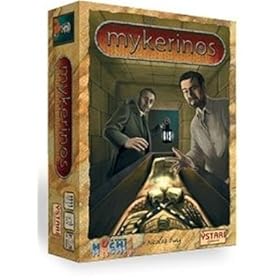
|
Pharaoh's Labyrinth, The
Mark Sienholz; Krimus Krimskrams-Kiste--2013; 1-5; 8+
Players each have their own pyramid boards and tiles. They
each seek to penetrate a pyramid as far as possible and get as
much treasure as they can. An optional rule adds a mummy, each
player controlling the mummy on an adjacent player's board.
German title is Das Labyrinth des Pharaos.
Premier: Essen Spiel 2013.
|
|
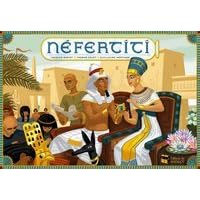
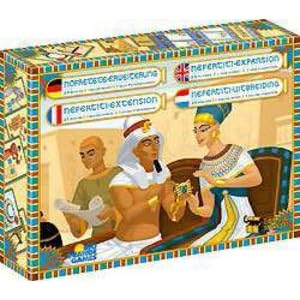
Néfertiti: La Barque Solaire
Guillaume Montiage, Thomas Cauet & Jacques Bariot; Matagot-2010; 3-4
Expansion kit for the above.
Adds another boardlet representing the Khufu solar boat.
Neteru
Marc Di Stefano: mindlink games-2011; 2; 20
Nearly pure abstract with an astrology theme, Egyptian astrology that is.
The board is comprised of 23 circles.
Each player controls six of the twelve signs and seeks to
move one of their six pieces into the opponent's gate.
Pieces are not on the board initially, but must be spawned.
Movement goes to adjacent spaces or by jumping over one's own.
Capture occurs by jumping as well.
The game's cloth bag also forms its board.
Nile: the Dice Game
Daniel Callister; (self)-2010; 1-4
Based on Nile (1967),
but changed to use ten dice.
Nile DeLuxor
Daniel Callister & James Mathe; Minion Games-2011; 2-6; 30; 8+
This indie card game is reminiscent of
Union Pacific
and the
Ticket to Ride
card game. It can be frustrating since it's not unusual that one
can't really do much on a turn, but the ability to do as many trades
with the deck as desired feels abuse-ridden. It can be used
to end the game by going through the rest of the deck.
The Nile Ran Red
John Clowdus; Small Box Games-2014; 2-5
This is a collection of three card games, related only by their
Egyptian setting. Titles:
Osiris
Hartmut Witt & Andreas Steiner; Hexagames-1995;
2-4
Deduction game made of wood in which players secretly distribute
support between priests and gods who move and conflict in a
struggle to reach the top of the pyramid. Magnetic stickers on
the pieces permit the priest and his god to connect in secret.
Eventually the priest attached to the god hidden at the top of
the pyramid is revealed and the player with the most supporters
in the corresponding temple wins.
Pharamis: Le Jeu des Pharaohs
unknown; unknown-1991; 2-4
Abstract strategy played out on an irregular grid having 149 squares.
Each player has pharaoh, guards and soldier pieces
and strives to remove opposing pharaohs.
Pharao
Horst Alexander Renz; Pharao-Brettspiele-1985; 2; 7+
Pure abstract made in imitation of a Senet game found in an ancient
pyramid.
However, the game is completely different in play.
Special dice are used to move both one's own and the opponent's
pieces, the goal being to push all the opponent's pieces
into the water square, to move one's own last piece into the
happiness square or to make the opponent's move impossible.
This beautiful game is an all-wood production.
Pharaoh's Heir
Phillip Lerche-2003 (web-published); 2-4
The Pharaoh is dying and is choosing his successor according to the one who
succeeds best in three areas: harvest, people to build a monument and in
sacrifices to the gods. The game employs a role-choosing mechanism similar
to Puerto Rico. This game employs the PiecePack system.
Instructions
Pharaoh's Labyrinth
unknown; unknown-2013; 2-6; 8+
xxx
Plagues of Egypt
Martin Vetter-2008; 3-4
Players represent a family having four members whose goal it is
to survive plagues and attain the status of the healthiest family
in the land. To do this it is important to race across the Nile
and gather the resources needed for nutrition and building repair.
Which plague appears is entirely random.

|
Pyramid Raiders
unknown; Moaideas Game Design-2012; 3-6; 8+
Players are treasure hunters competing to get the most of the
forty-nine treasure tokens laid out at the start.
But they must avoid the pyramid's guardian. Movement occurs via
tile-laying on a hexagonal map. The guardian's movement and
direction is based both on tiles and a die roll.
Scoring is based on set collection, either variety of
specialization. Ten special tiles confer special abilities.
Wooden obstacle tokens make the board different each time.
Pyramid Scheme: Legend of the Pharaohs
Playcare; 2-3
Pure abstract with each player having
a base pyramid of 9 pieces (8 soldiers plus 1 guardian) and
goal of capturing the opposing playing pieces and treasure chamber.
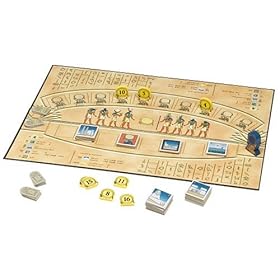
Pyramida
Zbysek Vlasák; unknown; ?; 2
Pure abstract for two played on a square grid representing a pyramid.
Pyramide
Peter Pallat; Edition Perlhuhn-1978; 2
Anthology of games around building up a pyramid with wooden blocks.
Pyramidis
Roland Siegers; Ravensburger/Iron Crown Enterprises-1991; 2, 4
Pure abstract which must be played in teams if there are four players.
Players try to achieve a particular arrangement of pyramids –
a pyramid placement game.
|

|
Ramses
Horst Alexander Renz; Pharao-Brettspiele-1988; 2
Pure abstract made in imitation of Tjau, a game found in an ancient
pyramid. However, the game is completely different in play.
Pieces move orthogonally or based upon the number of other pieces in its
row and column.
The goal is to move one's four pieces into particular positions or box the
opponent in that he cannot move.
There is no randomness.
Part of a series of games that also includes Isis and Pharao
Rise of the First Dynasty
John Clowdus; Small Box Games-2014; 3-5; 30
Card game of area control over the country set in the mythical first
dynasty centered on the Nile. Player actions include
conquer, bless, and issue edict.
Luxor
Günter Baars; Ravensburger-2001; 2-4
This time the board is vertical. Players add tiles to it, trying to extract
the most valuable mummies. A match permits maneuvering around the pillars.
Sacrifice of the Pharaohs
Sean Howard; Knights Crest Games-2010; 2-15; 60
-2002; 2-4
Variable powers game in which each player has for the entire game
a different role with its own special abilities. Each turn players
either increase or decrease their standing with the Pharaoh
by flipping the appropriate card. The player who is least liked is
executed, though gold may be used to pay off the executioner for a
round. Gold can also purchase event cards.
Saqqara
Shem Phillips; White Goblin Games-2012; 3-5
Set in 2125 just before a major historical revolt, players
represent the governors in Egypt and try to develop their
provinces, recruit workers, build pyramids and gain land.
Includes bluffing, auctions, card drafting and trading.
Scarab
Nico Reuter; Silberberg Spiele-2002; 2-4
Represents the priests of Thoth meeting to play a game of collecting scarabs
(dung beetles). In the game players move around a grid aiming for high
numbered tiles. There is a partnership version for four.
Scarabs, Pyramids & Dung Beetles
Tim Schutz and Steve Vallee; The GameCrafter-2009; 3-5
Trick-taking card game. Cards taken are used to build pyramids.
Scarab Lords
Reiner Knizia; Fantasy Flight-2002; 2
Non-collectible card game which nevertheless has some similarities to
its collectible cousins. Each player has a deck of 40 cards which he
customizes to best effect. This is set in a fantasy version of Egypt
which includes mythical beasts and sorcerors.
[more]
Seti
Hartmut Witt & Andreas Steiner; Hexagames-1979; 2
Pure abstract based on a board found in a pyramid.
Players have one pharaoh and several priest pieces
which they try to get to the opposite end of the board.
Sobek
Bruno Cathala; Asmodée-2010; 2-4
Card drafting and set collection game.
Each turn take a goods card, play a character with a special power
or reveal a set of matching goods cards.
Taking some cards earns corruption points.
Having the most of these at the wrong time cuts the owner's income in
half.
Sphinx
Mark Berger & Edith Grein-Böttcher; Ravensburger-1974; 2
Each player creates a hidden maze and the players take turns trying
to solve the other's. Includes both psychology and deduction.
Sphinx
Mark Berger & Edith Grein-Böttcher; Ravensburger-1974; 2
Each player creates a hidden maze and the players take turns trying
to solve the other's. Includes both psychology and deduction.
Sphinx: The Game of Ancient Egypt
Challenge Games-1975; 2
It's Jade vs Amber. Each has six sphinxes, one of which needs to reach the
other side of the board. Dice are rolled to determine where on the grid is
placed a pyramid which removes any sphinx or pyramid there, but otherwise
places a pyramid. Then players move or capture.
Siedler von Catan, Die: Historische Szenarien
Klaus Teuber; Kosmos-1998; 3-4
"The Settlers of Catan: Historical Scenarios."
One of the games in this two game set is named "Cheops" and features
players creating pyramids for Pharaoh.
[more]
Stones Seven Challenges of the Pharaohs
Jon H. Davis; Northern Lights Enterprises-1991; 1-3
This is series of seven abstract games played on a cloth banner using
polished stones. Only one is solitaire. A die is also included.
Tal der Könige
Christian Beierer; Kosmos-1992; 2-4
Game of pyramid building in which players must deploy workers either to
work on the pyramid or steal stones from the other players.
[more]
Thoth
Scott Woods; Woodsman Games/web-published-2013; 1; 30
Seventy-two cards form two decks of cards. The player takes one deck
to fight the rules-driven virtual opponent. Features include units,
buildings and resources.
|
Wadi
Martyn F; Emma Games/Heidelberger Spieleverlag-1993; 2-4
Tiles are used to render a version of an Egyptian desert with
river branches flowing through it. The water is represented by blue
disks. Players attempt to get water to their own tiles.
Alexandria
Jan von Kügelgen; (Self-published)-1987; 2-6; 45
Racing game set in Alexandria harbor in which players roll three dice and
try to make the best moves with them. Possibly similar to
Powerboats.
Ancient Egypt Go Fish for Art
Wenda O'Reilly; Birdcage Press-2010; 2-5; 7+
It's Go Fish, and also
Memory, with an Ancient
Egypt theme. The thirty-six cards include facts as well as
images of gods, pharaohs and mummy-making.
Astérix en Égypte
Jeux Noel-1971; 2-5
A racing game set in which players must cross from Gaul to Cleopatra's
palace and back again, on the way depositing a palace card. Cards dictate
movement and can be used either to help oneself or as a block to others.
Chance cards sometimes allow players to move an opponent.
Cairo
Günter Burkhardt; Schmidt-2002; 2-5; 8+
A representation of the Nile runs down the middle of the board.
Through it moves a ship holding wooden blocks in a variety of sizes.
In turn players use a finger to flick a block into specific areas
to score points.
[more]
Curse of the Cobras
unknown; Ideal/Arxon-1982; 2-6; 5+
Puzzle guessing game in which players insert
plastic ankhs into a holes in a sarcophagus. One hole
sets off the "trap",
which reveals a skull and launches a handcuff-like cobra
ring around your wrist. This person loses.
The location of the trap is then automatically reset.
Curse of Tutankhamun, The
by The Prince and The Pirate Co.-1978; 2-6
A tube containing a laminated map and other materials, including cards.
Players explore the pyramid. Probably created to cash in on the King Tut
exhibit then touring the US.
De Tuin van Amon
Agnes Rammant Peeters; SCIA Herk-de-Stad-1984; 2-4
Based on two games from ancient Egypt, Senet and The Palm
Tree Game,
players are slaves trying to escape the garden of Amon.
During the day phase they run
through the garden, obtaining Fate Cards. At night
players race for a boat, the
first to get five pawns into the boat winning.
Employs throwing sticks, just like back in ancient Egypt.
Egypt
Lloyd Krassner; Warp Spawn Games-1999; 2
Card drafting game in which players try to form melds from seven different
types. Each turn represents three hundred years.
Egypt
Wolfgang Dirscherl; Spielbox-2004; 2-4; 8+
By rolling a die pieces can be placed on the board to earn points.
Lasts ten minutes.
Egyptians
Gary Wyatt; Green Board Game Co.-2001; 2-4; 7+
Players compete to collect a full set of Pharaoh cards.
Roll to move and collect a new card. There are also rules
for trading or battling for cards. Educational.
Expedição KV62
unknown; Pais e Filhos-2009; 2-4
Players are attempting to find the inner chamber of the great pyramid
of Cheops. Dice are rolled to move. The board tiles change by rotating
the board which creates holes; pawns may fall through.
Expedition
Whitehall Games/The Kirk Game Company-1980; 2-6; 9+
Players represent archaeologists digging at various sites in Egypt,
which means rolling dice to move and then drawing discovery cards
to be published.
Eye of Horus
Playroom Entertainment-2002; 2-8; 7+
Players collect cards from the pool on the table by matching or adding
values (something like the traditional card game Cassino). There
is an Eye of Horus card which permits taking all of the cards. Images
are based on actual ones found in the pyramids.
Geheimnis der Pyramide, Das
Thomas Schuster; Espenlaub-1992; 2-4; 30; 7+
-2000; 2-4; 6+
In "Secret of the Pyramid" the idea is to retrieve four parts of a
golden mask. On a turn two dice are rolled, one to move the pawn, the
other to move the lion. Lions block movement. It is also possible to
steal items.
Geheimnis der Pyramiden, Das
Günter Baars; Ravensburger-2000; 2-4; 6+
"Secret of the Pyramids".
Three games in one about moving pyramids to find treasures. Memory and
deduction are involved.
Hieroglyphs Game, The
Finch & Scott; Oxford Games, Ltd.-1989; 2-8
Fast game in which players roll a die to move a scarab around a board showing
the hieroglyphs. Reaching one that matches on on their personal sheet
(aka Bingo card) lets them mark it. First to complete a word wins.
Educational for learning the glyphs.
[more]
Karnak
(unknown); Pelito-1989; 1-2
Fortune-telling affair based on cards and a pendulum.
Questionable whether this should be considered a game.
In the Land of Egypt
Aristoplay-1996; 1-4
Includes eight different games played using pyramid, mummy and rhyme cards
plus special "Egyptian" dice.
Isis and Osiris
Michael Schacht; Goldsieber-2001; Abacus/999 Games/Devir-2010; 2-4; 7+
Tile-laying game in which the value depends on the neighboring tiles.
Memory plays an important role.

|
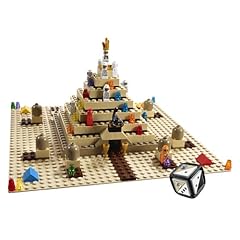
Lego Ramses Pyramid
Reiner Knizia & Cephas Howard; LEGO-2009; 2-4
The rising playing surface is constructed with LEGO pieces. Pawns
climb this pyramid. Moving pieces and the crystals they collect are
also LEGO pieces.
[Buy it at Amazon]
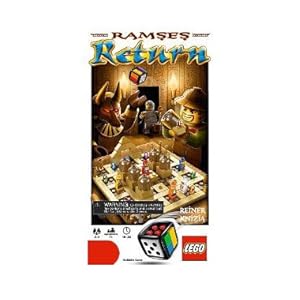
Lego Ramses Return
Cephas Howard, Reiner Knizia & Jesper C. Nielsen; LEGO-2011; 2-4; 10; 7+
Roll-and-move and memory game in which players try to capture three
different golden treasures. Six crystals are hidden beneath temples
on the board and eight more plus four gold treasures are in plain
sight. A die result may match a crystal a player holds, permitting
movement. Otherwise the player gets to inspect a temple; if it matches
the die, the player moves the temple and moves. There is also a mummy
result which lets the player move the mummy, attempting to land on an
opponent, which forces loss of a treasure or cystal. Moving to a
crystal or treasure permits claiming it.
[Buy it at Amazon]
The Mummy Adventure Boardgame
Upstarts-2003; 2-6
Based on the television cartoon program, "The Mummy", one player hides
tokens which the players need to acquire their character cards to get
the clues that permit them to find. Later begins the race to find the
scroll of Thebes. Essentially a party game for children.
The Mummy Hunters
unknown; Universal Pictures-2008; 2-4
Packaged in a DVD box, this is a trivia game in which players move via
spinner and try to collect coins while avoiding the mummy who tries to
steal them.
[Buy it at Amazon]

|
Mummy Rummy
Monty & Ann Stambler; ASS/Gamewright-1994; 2-5; 8+
Rummy variant in which players try to collect sets of Egyptian
artifacts. Some cards can belong to either one of two different sets.
Le mystère des pyramides
(unknown); Milton Bradley-1990; 2; 20; 7+
On a complicated map
an archaeologist must grab the ruby and escape back out of the
pyramid before a mummy can kill him.
Mystery on the Nile
Michael Palm & Martin Drewes; Eurogames/Descartes Editeur-1996; 2-6
During a modern Nile cruise, players try to discover the thief of a pearl
necklace by examining pairs of evidence cards to try for a match.
Probably inspired by the Agatha Christie novel.
Appears to include considerable randomness.
Mystic Egyptian Tomb
4M-2002; 2-4
Treasure hunting game including a plaster block with treasures buried inside,
a digging tool, checkers and dice. Treasures include a cat, mummy case, Ankh-symbol, winged necklace and Egyptian symbol plates.
Nile
E.S. Lowe/Spears-1967; 2-4
Players lay tiles attempting to create a continuous line across the board
grid.
Oh, Pharaoh!
Thilo Hutzler; Kosmos/Überplay-2004; 3-4
Card game in which players try to create as many high quality
pyramids as possible. Players may trade cards with one another.
There are also thief cards that can be used to steal cards
and tax collectors who take hand cards. These two can be stopped
by a pharaoh card.
[more]
Perilous Pyramids
Devin Lewis and James Vicari;
Broke In Games-2012; 2-6; 5+
Fast card game of building up your pyramid of cards, but also
making opponent pyramids more difficult to complete.
Pharaoh's Bluff
unknown; unknown-1997; 2-6
Trivia game with the added bluffing element which other players may
question. Progress measured by moving up the surface of a pyramid.
Pharaoh's Curse
unknown; Disney/Trefl-2008; 2-4; 6+
Disney character pawns such as Mickey Mouse, Goofy, etc. traverse a
3D pyramid by giving the correct answers to questions.
Pharaoh's Quest
Protel Games-1985; 2
Similar to Chess, but the player must capture four of the opponent's
cities.
Pyramid
Hasbro-1978; 2; 8+
You've played Connect Four? This could be called "Connect Five",
but using pyramids placed on a regular board.
Pyramide des Krimsutep, Die
Ralf Sandfuchs; Krimus Krimskrams-Kiste-2005; 2-5
"Pyramids of Krimsutep".
Players represent treasure hunters exploring a pyramid at the same time,
trying to beware pitfalls and the mummy. Rather random.
Pyramide du Pharaon
Martin Tremblay; Editions Gladius International-2010; 2-6; 7+
Short card game of racing to build a pyramid. This requires
collecting various types of cards such as tools, workers,
materials and influence with the royal family. Some cards
permit stealing from others.
Pyramidos
Jens-Peter Schliemann & Kirsten Becker; HABA-2003; 2-4; 6+
Dexterity game played on a board raised high into the air by a wooden
structure. The board is dotted by many holes, most of them of a size
to hold the player marbles. Players must flick or nudge under a
marbles to move it into the goal area, i.e. where the pyramid is
being construction while avoiding the rather large crocodile holes.
A net stretched under the board helps keep fallen marbles from rolling away.
Finishing the game can be particularly difficult as the last marble
must be flicked to rest on top of four others set in a square, thus
forming the pyramid of the title. The board height is more made for
child than adult hands and the whole affair probably goes on a little
bit too long for the amount of interest generated.
Pyramids and Mummies
Marianne Sachs; Aristoplay-1988; 2-4; 8+
Includes The Pyramid Game and The Mummy Game.
The former is cooperative as players try to decipher rebus writing and
together erect a pyramid. The other is more of a race, but also involves
reading rebuses.
Pyramis
Justin Oh; Gemblo-2011; 2-4; 20; 6
A press-your-luck game in which players draw gems from a bag, trying
not to exceed the color limits set for the current round because doing
so loses that color and more besides. The remaining gems are used to
form sets of four, but all gems must be used, if not in one's own
sets, in another player's.
Queops
(unknown); pais e Filhos-2009; 2-4; 120
Roll-and-move trying to find the inner chamber of the Great Pyramid.
The inner board can rotate and change the tiles to create holes or
problem spaces for players inside. Once a player finds the
sarcophagus, must successfully exit to win.
Ramses Rage
(unknown); Shauss Enterprises-1983; 1-6; 45
Dice game featuring six cube-shaped ones and one pyramid-shaped one.
By rolling them players race to acquire ten thousand points.
Reise nach den Pyramiden, Die
(unknown); (unknown)-1840; 2
"Trip to the Pyramids" is a German roll-and-move racing game showing spaces
numbered 1 to 21 and scenes of Egyptian ruins.
Scarabs & Scorpions
Tony Ripley; Gamealogical Institute-2008; 2-4; 8+
Ten minute game of dice rolling is a race to reach the best score and
avoid the scorpions.
Schatz des Pharaos, Der
Wolfgang Kramer; Berliner Spielkarten-1996; 2-6; 8+
"Treasure of the Pharaoh".
Card game in which players
use the ladder, torch, rope and shovel to race through six stages
to reach the Pharaoh's treasure.
Re-published in 2006 by Adlung under the title
Im Bann der Pyramide.
[more]
Secrets of the Tombs
Martin Wallace; Kosmos/Rio Grande Games-2003; 3-5; 8+
Explorers search their way through a pyramid which takes a long time
and sometimes, out of nowhere, they are eliminated.
Seega
by Great American Trading Company 2; 8+
Pure abstract in which players take turns placing marbles on a 5x5 board.
When all are placed they capture the opponent's pieces by moving to
sandwich them between their own. Draws are frequent.
Senet
unknown; 3500 BC; 2; 6+
This was actually played by ancient Egyptians and is similar to
Backgammon.
Differences are safe and trap spaces on the board.
Sphinx
Invicta-1982; 2-3
Pure abstract in which players try to get five pyramids in a row.
Similar to
Pyramid.
Sphinx
Günter Baars; Ravensburger-1999; 2-4; 8+
Players roll special dice to move, attempting to navigate a labyrinth,
collect cards and discover the secret identities of three sphinxes.
Tomb of the Mummies
Patrick Stevens; Numbskull Games-(unknown year); 2-6; 30; 8+
Players represent treasure hunters who follow the maze created by
laying tiles. Employing their powers of deduction they locate relics
that confer protection against mummies. Treasure must be carried out,
of course, but slows the player down, enable capture by the mummies,
which are controlled by other players. Treasure, relics, mummies and
traps are hidden by the players.
Totally Tut
Learning Resources; 2-4; 6-9
Using their arithmetic skills players can advance to the top of the
pyramid.
Treasure of the Pharaohs
Palitoy-1974; 2-6
Roll-and-move game set in a three-dimensional pyramid. The goal is to
pass through all the hazards and reach the treasure hidden in the sarcophagus.
Production in this game for children is rather attractive, even if play is not.
Tut Tut
British Museum Games-1996; 2-4; 8+
Subtitled "The Game of Egyptian Hieroglyphs", this is actually four
games in one.
Tut is a quick identification and matching game.
Dynasties is a word game.
Ankhs is a trick-taking game.
Duel is a trick-taking and word game for up to three.
Tutan Loot'em
unknown; Orchard Toys-2009; 2-4; 5+
Card game of collecting ancient Egyptian artifacts. Be careful not
to get "looted" by your opponent.
Tutankham
unknown; Ideal-1983; 2
Players act as treasure hunters explore Tut's tomb, which is
represented as a square grid. Based on the video game of the same
name.
Tutankhamen's Revenge
Stefanie Rohner & Christian Wolf; Jumbo-1990; 2-6; 8+
This game of excavation begins with each player placing a card in the box
without others being able to see its identity. Then they take turns trying
to remove as many valuable cards as possible. Encountering a negative card
costs points,, however, and forces you to give the next player a chance.
You should have stopped earlier.
Valley of the Pharaohs
Steve Hart; Front Porch Classics-2006; 3-6
Roll-and-move game set in 1926 has players trying to collect
a legendary scepter. Obstacles include bandits, sand storms
and obstacles laid by opponents. Rolling doubles gives control
of the mummy.
Voice of the Mummy
Milton Bradley
Wadjet
Dee Pomerleau; Timbuk II-1996; 2-4
Logical deduction game similar to Clue, but about the
archaeological treasures of Egypt. Features a beautiful production,
but really requires exactly four players and is difficult and long.
Zerstreute Pharao, Der
Günter Baars; Ravensburger-1997; 2-5
"The Scatter-brained Pharaoh".
A board is seeded with various treasures and covered by pyramids.
Players must try to remember/guess where each is.
Also known as Ramses II and Pyramido.
Chariot Lords
Charles Vasey; Clash of Arms-1999; 3-4
Area-based wargame of the ancient world in which one player represents
Egypt as well as several other nations.
Order of nations within a turn is random.
[more]
Chariots of Fire
Mark Herman & Richard Berg; GMT Games-2009; 1-4
Wargame anthology recreating historical battles from the chariot era,
some having Egyptian participation such as
Megiddo.
Civilisation
Francis Tresham; Hartland-Trefoil-1981; 2-7
One of the players is Egypt is this game of man's earliest history.
Later re-worked as
Civilization
and
Advanced Civilization.
[more]
De Bellis Antiquitatis
Phil Barker and Richard Bodley Scott; Wargames Research Group-1990; 2-6
These war miniatures rules include specifications for ancient
Egyptian armies.
Het Huis Anubis: Het levenselixer
(unknown); Jumbo-2009; 2-4
Played on a 3D board, players
collect ingredients for their elixirs by moving around the house
and avoiding getting robbed.
Het Huis Anubis: Uitbreiding
(unknown); Jumbo-2010; 2-4
Expansion for the above which adds extra rooms, characters and a
blocking ghost.
King of Kings
William L. Banks; Good Industries-1990; 2-6
One of the players is Egypt is the scenarios associated with the Roman wars.
[more]

|
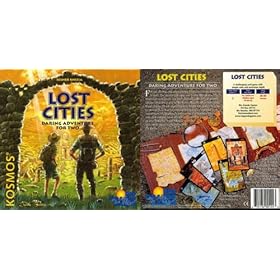
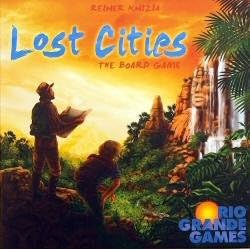
Lost Cities: the board game
Reiner Knizia; Rio Grande-2008; 2-4
Board game version of the above, now permitting four players, each
with distinct goals.
[Buy it at Amazon]
Mystery Party: Meurtre sur le Nil
Guillaume Montiage; Cocktail
Games-2012; 8
Eight-player murder mystery party game set on a Nile cruise in
April 1937, but having many ancient overtones.
Probably inspired by the Agatha Christie novel.
Papyros
moses. Verlag GmbH-2013
This German game is a
Scrabble
variant that adds abilities via three types of cards.
Scoring is implemented using facsimile Egyptian coins.
Playing Cards of Ancient Egypt
The GameCrafter-2009
Not really a new game, but Poker-sized playing cards with
artwork based on that of Ancient Egypt.
7 Wonders
Antoine Bauza; Repos Production-2010/Asmodee-2010; 2-7; 30
The Great Pyramid is one of the possible starting positions
in this card passing game of the Seven Ancient Wonders of the World.
[more]
[Amazon.com]
Tower of Babel
Reiner Knizia; Hans-im-Glück/Rio Grande-2005; 3-5
Auction and placement game about the seven wonders of the world plus
the famous aforementioned tower. Egypt has a place as the home
of the Great Pyramid of Cheops and the Lighthouse at Alexandria.
[more]
Vom Kap bis Kairo
Günter Burkhardt for Adlung-2001; 2-4
In this mostly auction game,
players compete to build the first transcontinental railroad
from the Cape of Good Hope across Africa to the Egyptian capital
at Cairo. Egypt is very tangential here.
[more]
War Gods of Ægyptus
Chris Fitzpatrick; Crocodile games-2002; 2
Tabletop miniatures war game rules for a mythical kingdom which
has clearly been closely modeled on ancient Egypt.