Spotlight on Games
>
1001 Nights of Military Gaming
- K -
- Kampf der Gladiatoren (Clash of the Gladiators)
Reiner Knizia's game of gladiatorial teams in Ancient Rome is really an
American-style game by this German designer. Players attack whomever they
like, prey on the weak, knocking players out before it's over and it's all
resolved by simple dice rolling. But the diverse ways that this German fish
swims in foreign waters throws the differences into sharp relief. Missing are
a long solo phase in which teams are designed, typical stodgy
rules controlling movement and inter-team positionioning as
well as complicated weapon interactions. Present is a nice
team drafting phase and the use of fighting animals to keep the
player involved and in chance of victory even if eliminated. Also
present of course is the typical high quality German physical
design including plastic platforms to hold the team chits
and specialized dice that make resolution much easier. The
creative mind will enjoy deciding what makes for the best teams,
especially considering that they need to work well first against
their neighbors and then in the overall. But as the vagaries
of dice rolling tend to outweigh these considerations, players
wanting a mostly fair contest will want to stay away. Normally
this type of situation makes for a good vehicle for adult-child
play, but this time the gory topic gives pause.
- Kill Dr. Lucky
Simple board game takes up where Cluedo left off, featuring a
mansion-full of players not trying to detect a crime, but to kill
the owner! This darkly amusing stuff is best for a fairly large
group and definitely requires cooperation as murder will occur
unless players are willing to expend their Failure cards. What
tends to happen is that the player to the right of the murderer
gets blackmailed into doing it, but beware as this player may
not actually have the cards necessary for the job, in which
case everyone else loses. For this reason, probably does not
get as many repeat plays as it otherwise might. Reportedly,
versions featuring human pawns are very popular at Origins.
Appears to be the most popular entry from this publisher, at
least as of June 2000. Later efforts include Kill Doctor
Lucky: Craigdarroch which is the same game in a new mansion
and Save Doctor Lucky.
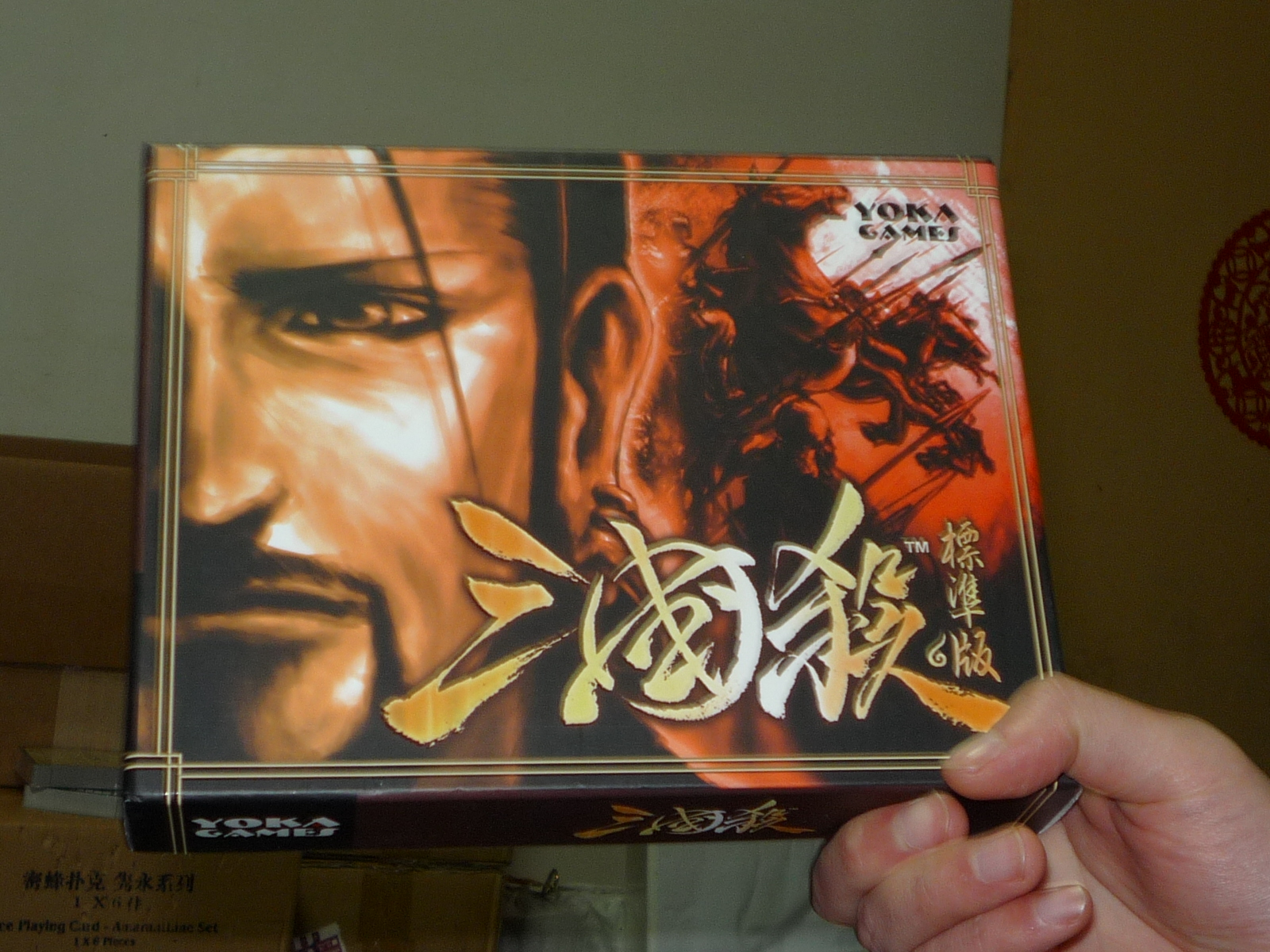
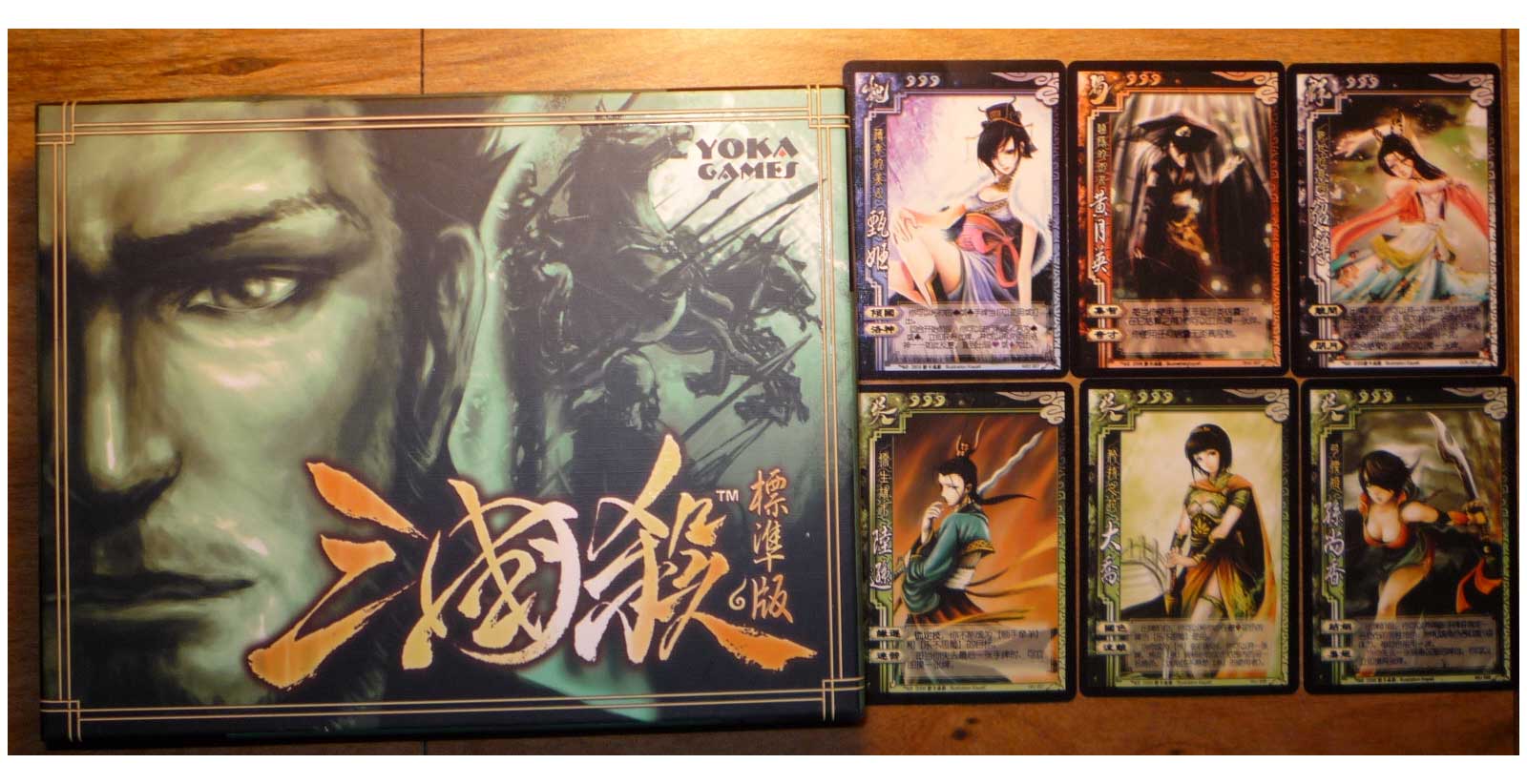
- Killers of the Three Kingdoms (San Guo Sha)
Amid
a flood of counterfeits
this is a rare Chinese original. On the other hand, it is a
counterfeit in another way, following fairly closely the
scheme of
Bang!.
What's good is the wholly Chinese topic: the 800,000 word novel,
Romance of the Three Kingdoms,
which Chinese children read much as their younger counterparts
do Greek mythology or the tales of King Arthur. It's filled
with iconic characters and stirring deeds and is also the
topic of the recent
John Woo film Red Cliff.
What's not so good, beyond the too-close copying of mechanism
is that it's not even a good thematic fit. In the original,
sheriff, deputy, outlaw and renegade are the roles and upon
these goals and activities depend. This version keeps
the same roles, but also assigns to each character
membership in one of the three kingdoms and the possibility of
helping others in their kingdom, which when that player is
an antagonist, makes no sense at all. As in the original,
there are three basic types of cards: those which hit, those
which avoid a hit and those which undo a hit. Beyond this
there are a number of specials, but for the most part these
are just the originals under new names. There are 25 named
characters which feature newly-invented abilities more or less
appropriate to their careers. Although most of the novel is
about the fighting of large armies, the horses and weapons
from the original are still present and affecting attack
range, rather incongruously since they are now hand-to-hand
weapons like swords and spears. The card artwork is well done,
including many muscled or mysterious warriors as well and even
a few sexy ladies. The majority of the rest of the cards are
monochromatic, but look good nevertheless. The thankfully
small box is as well made as one has come to expect in German
productions and there is a good quality plastic insert. Also
included in a VCD, apparently instructional, which probably
won't play for most outside China. Curiously, this seems to
come in different editions as some copies come in reddish boxes
and others in greens. What other differences exist between
the two is unknown.
Reportedly one of the most popular games in China,
this works as well as the original, but of course offers a
language challenge for non-Chinese readers.
[card translations]
[character backgrounds]
MMHL6 (Strategy: Medium; Theme: Medium; Tactics: High; Evaluation: Low; Personal Rating: 6)
unknown; Yoka Games-2008; 4-10
[Shop]
- King of Kings
Multi-player war game has a fascinating set of scenarios, but disappoints
in strategy, rules and flavor.
[more]
[Ancient Egypt games]
- Kingmaker
Early multi-player war game with rather unique card mechanics and point of view.
Topic is War of the Roses, but instead of the contending heirs
controlling supporters, power brokers squabble over heirs, try
to put their favorite on the throne and kill the competitors.
Not bad, although sometimes can go rather long.
The rules need close reading and ambiguities in both them and
the board will need house rules before play begins.
Suggest avoiding the advanced combat rules, instead use the faster dice tables
to see which nobles fall in combat.
Using the optional parliament rules should speed up matters.
Improved by expansion cards later published by Avalon Hill, which among
other things addressed the problem of players sitting out at sea
or in foreign climes indefinitely with impunity.
Strategically, the key trick is probably positioning oneself to take
advantage of a sudden vulnerability of the opponent.
Recommended for fans of multi-player conflict with unusual mechanics
and those having the ability to play a waiting game.
[summary]
[analysis]
[designer commentary]
Update:
In 2023 a new version is coming out. It's a good idea, but I have
mixed thoughts on what they have done:
- Alliance victory – Good. Both realistic and a game shortener.
- Prestige point victory – Not for me. In real life they
kept bashing each other until there was only one man standing. In
real life, surrendering wouldn't have meant going home in peace.
There would have been reprisals. So it's doubtful that anyone would
given up. They would rather die trying, like Richard III.
- Prevent hiding in Calais – Good
- Revising the map for clarity – Excellent
- Adding the DeVere family – Good. The more the merrier.
- Adding Parliament cards in four parts of the deck – Good. Nice solution
- Reducing random death – Unsure. The game may need that level of churn.
- Removing Ambushes – Not sure. A player who is out of it may need that. It's not so difficult for a player to just fall way out of contention.
- Reducing player count – That's the trend these days, so fine.
- Keeping odds results on cards – Should have gone to dice to keep it simple. No need to keep not having certain events occur due to battles.
- Status of variant cards unknown – Bad. Should be mentioned
whether they are included or not.
- Clarifying what the rules mean – Excellent
- Keeping the conceit of nobles controlling royals – My
number one objection. While IRL true in some cases (Henry and his
son), it was completely untrue in others. What should have happened
is that the players represent the actual kingmakers of the era:
Warwick, Margaret Beaufort, Suffolk, and so on. They should each have had
variable powers and starting friends. Let players act as in history.
- Towns have troops – Unsure. Sounds fiddly.
- Kings and Castles
War game on England and her conquests for up to four by the inventors of
History of the World.
As in that game players control a number of different
sides throughout, represented by the individual kings, but here
entirely decided by draft before play even begins. Kings vary by the amount
of extra force they add and in their primary spheres of activity.
Play itself is diceless (and thus reminiscent of
Vinci),
the core of the combat system being a rather strange and unique form
of arithmetic. The active player's forces must defeat the inactive
defenders by the minimum possible amount – pieces are rated at value
1, 2 or 3 – but then only the strongest of these invaders remains.
The other unusual mechanism is that over the entire course only twenty-five
percent of one's forces are guaranteed to be one's own. The rest are drawn
from a bag and may be one's own, but are also often the forces of other
players, rebellious indigenous groups or mercenaries usable with any of the
above. (There are also three levels of fortification.) The need for a player
to clear out his force pool for the next set of forces means that the
player often goes through unusual gymnastics. For example, he may use other player
forces to conquer rebels, then use rebels to conquer them back and finally
use his own forces to conquer the rebels. The other unusual feature is
that in a four-player game, each player has only six turns and only on
half of them may he declare scoring (which occurs for all players).
Although not at the classic level of its predecessor and
initially unintuitive it becomes more interesting as understanding dawns
and finally turns out to be a rather novel challenge that most fans
of lighter war games will want to try. Some concerns may be luck of the
draw and possibly long downtime if players indulge too much in analysis.
And although most play is tactical, players should
find an interesting challenge in trying to design the perfect initial
draft of kings. It seems that one should try to pick at least one early king
so as to get on the board and counted during others' early scoring rounds
and because of the double scoring round at the end, a late king as well.
Beyond that it is difficult to say definitively, but possibilities include
picking kings which offer more extra forces as well as trying to program
around the activities of others. If possible, choosing the last two kings
who operate in France appears a sound idea as these points may be relatively
undisturbed until the end.
Just as in their previous game, the board
is no board at all, but printed on a folded cloth. The monotone counter
silhouettes are the same for each player, but
the colors black, dark blue, light blue, pink and orange often appear
annoyingly similar.
[Ragnar Brothers]
- Kreml (Kremlin)
Struggling for power in the old Soviet Union, players bid on humorously-named
(and biographied) politicians much as in
The Sigma File
(except that bids are not adjustable), attempt to control the Party Chief
and keep him healthy enough to wave three times at May Day parades. It is possible to
put people on trial, condemn them to Siberia and other juicy activities.
The trouble is that all activities start aging the politician
in question, and then they take ill.
First-time players should beware a quick win by a player who places all
influence on the members currently at the top of the pyramid. An
expansion, Revolution, added new, historically-accurate
politician cards from the Russian Revolution period, as well as more
event cards.
[summary]
- Kriegbot
Direct conflict has not been a stranger to games by this
publisher, but instead of the usual combat amid the greater
milieu, this one places it front and center.
On a color, glossy paper hex map, players control robots which come
in six varieties: car, tank, helicopter, hovercraft, rocket and giant
spider. Each is defined by its own player mat on which the
player designs its capabilities by placing cards designating systems,
weapons, skins and pilots. Robots operate in a pre-set order,
all first moving, then all attacking, though some are able to
attack during movement. As the map contains hills, trees and
buildings there are fairly simple line of sight rules. Attacks
depend on range, target silhouette (which depends on movement
speed), defender response and dice whose total must exceed the
final silhouette. A couple years ago
Perry Rhodan
had the rule that results of 1 are added and re-rolled. The same
thing happens here, except with the 5, on the special 0-5 dice.
Robot components are numbered and the attacker chooses the hit
location corresponding to one of the attack dice rolled.
Accumulated damage on a component bleeds through to a predesignated
next system. Some systems are merely disabled; another
possibility is that the target becomes more visible ("painted").
Ten different scenarios are included. Player mats are on
glossy, light cardboard.
The cards are also of light cardboard and there are ninety-two
of them to cut out, meaning this game is worth more "punched"
than not. Also included are three dice, a fair number of
plastic chips and six plastic robot figures resembling their
robots. Play is nicely straightforward without a lot of
needless complication, but sometimes degenerates into a
stalemate situation in which it's nearly impossible for either
side to decisively take out the other. Part of this is
experience. Players need to learn that each vehicle should have
one weapon to paint the enemy, one to set it afire and one to
spray it with chemical weapons. In team situations all of these should
be on each vehicle lest one or more be taken out. These design
questions are one of the more original and challenging
elements. There are also some less edifying aspects. It's
possible to be knocked out of multi-player scenarios and left
with nothing to do. Provision should have been made for some
simple robocops, low-powered neutral participants in the fights
that such players could control and thus stay in the action.
Another issue is that sometimes damage requires remembering
game state. The rules writing unfortunately sometimes uses
terms before they are defined. This causes the reader to gloss
over the term the first time and not truly understand the
rule. Then the definition comes later and one needs to loop
back and re-read the rule and then figure out where to resume.
This whole looping process leads to confusion and unnecessary
extra learning time. Also, with the advent of television
pre-programmed robots over the past decade, it's surprising
and too bad that there is no programming element here. On the
other hand there are three excellent pages discussing the
scientific background behind the various systems.
Matt Eklund;
Sierra Madre Games; 2008; 2-5
Strategy: Medium; Theme: High; Tactics: Medium; Evaluation: Medium; Personal Rating: 5
- Kung Fu 2100
Originally a magazine game in a science fiction cum kung fu setting.
In a dystopia, a cloning expert
bent on personal perpetuity has set up a lab defended by
guards and martial artists. Meanwhile three fanatical kung fu
experts are determined to break in and destroy the lab. Combat is largely
deterministic, being mostly resolved by play of known combat chits.
Flows well and makes for a nicely-balanced contest.
Mainly a two-player situation, but can be reasonably expanded to four
by having a team of three each play one of the kung fu masters.
Main limitation is in the eventual repetition of the possible situations
which may develop.
[analysis]
On to L
- Main
Please forward any comments and additions for this site to
Rick Heli.