Im Fluge durch Deutschland, Oesterreich und die Schweiz
(unknown); Spear's Games-1920?; 2-6; 30; 6+
"In flight through Germany, Austria and Switzerland."
Roll-and-move game of traveling across the three countries and
trying to avoid hazards.
Stratosphere
Parker Brothers-1933; 2-4
This game was inspired by the record-setting high altitude
balloon ascent into the stratosphere by Auguste Piccard
in August of 1932. His grandson's record-setting flight around
the world was the inspiration for
Balmy Balloonists.
The box cover depicts a very tall, billowy balloon such as used
in the actual ascent with the word "STRATOSPHERE" displayed across
it in a very typical for the 1930's
typeface.
Copies of this game today are worth $100 and more.
 Ballonrennen
Eric W. Solomon; Ravensburger-1977; 2-5
With 1977 we come to a game which I have actually played.
Published by Ravensburger, it was designed by Eric W.
Solomon, who may be better known for some of his other
titles such as Billabong, Black Box and Conspiracy. The
title means "Balloon Race", but there is a little bit more
going on as the balloons are not just trying to reach a
destination, but also to deliver the mail! I very much
doubt that balloons have ever been trusted anywhere with
anything as serious as the mail and this game proves why.
All too realistically, players can spend a long time trying
to get to where they are going. Since the sequence of play
is that a player first chooses altitude and then turns over
a wind card to see how the speed and direction change, it
can be almost maddening trying to get anywhere with certainty.
And it is not simply a matter of crossing a line, but
actually landing on a specific spot. Some nice ideas are
the accurate reflection that stronger winds exist at higher
altitudes and at least in some sense the interplay between
gas and ballast in piloting. What will not fail to impress
are the nice-looking plastic balloons which adjust altitude
by traveling up and down on a tapered plastic stick,
nicely-formed plastic tokens and large plastic hexagons in
three different heights to indicate the current wind speed.
 Fantastische Ballonreise
Tom Werneck; Ravensburger-Promotion-1977; 2-5; 7-99
Appearing in the same year, this one also came from
Ravensburger, but as a specialty game made for the soft
drink Fanta. Both games use virtually identical balloon
pawns, although in this one they carry the Fanta logo. The
title means "Fantastic Balloon Voyage," – notice the
similarity between "Fanta" and "Fantastiche". It's interesting
to speculate on the relationship between this game and the
one above. Did Fanta come with their request first and
Ravensburger decide that as long as they were ordering
balloons anyway they might as well make a game on it? Or
did Ballonrennen fail to sell well and Ravensburger look
for a way to re-use the pieces? Or perhaps it was one of
lifes happy accidents and both ideas came in at the same
time. Whatever the case, Fanta's game was designed by Tom
Werneck, one of the German gaming pioneers, founder of the
famous Spiel des Jahres prize and author of the short book,
Leitfaden für Spieleerfinder (Guide for Game Inventors).
The game itself has something of the flavor of Empire
Builder as players are dealt several destinations and must
strategically order these to find the shortest path. The
map stretches from the Alps to Amsterdam, and from Hamburg
to Paris. Paths are delineated on a square grid plus there
are diagonal lines, but curiously only in the northwest to
southeast direction. As it means the board travels faster
in one direction than the other, this is totally weird!
But weird does not mean bad; rather, players are forced to
think a little harder and take this into account in their
planning. The game is rated for ages 7 and up and illustrated
accordingly with a dazzling series of colorful images
which are particular to the folklore each locale. The map
is traveled according to altitude just as in Balloonrennen
with the only restriction being an ascent limit of just
one level. Wind direction is controlled by a special die
which the player always throws to alter the current wind
speed indicator. This is more forgiving than it may sound
as the indicator just gives the maximum allowed speed rather
than the required speed and it is always possible to travel
at least one. Upon reaching a destination the player
follows the instructions on the card which provide some
background information and sometimes grant an extra turn,
require a landing, etc. Occasionally, as in Elixir, a
player may receive an extra advantage if able to answer a
trivia question, tell a joke or draw a picture. The die
also contains indicators for drawing Chance cards, which
appear to be even-handed. The most significant of them
are probably those which permit a player to trade a
destination with one of another player or to immediately
fly along a line toward the next destination. Overall it
is a game with plenty of atmosphere and color, but probably
not satisfying for strategists. It would possibly be of
interest for those playing with young children.
Rules (this site: English)
 200 Jahre Montgolfieren
Jürgen Hagedorn; Hexagames/TST-Enterprises-1983; 3-6; 7-99
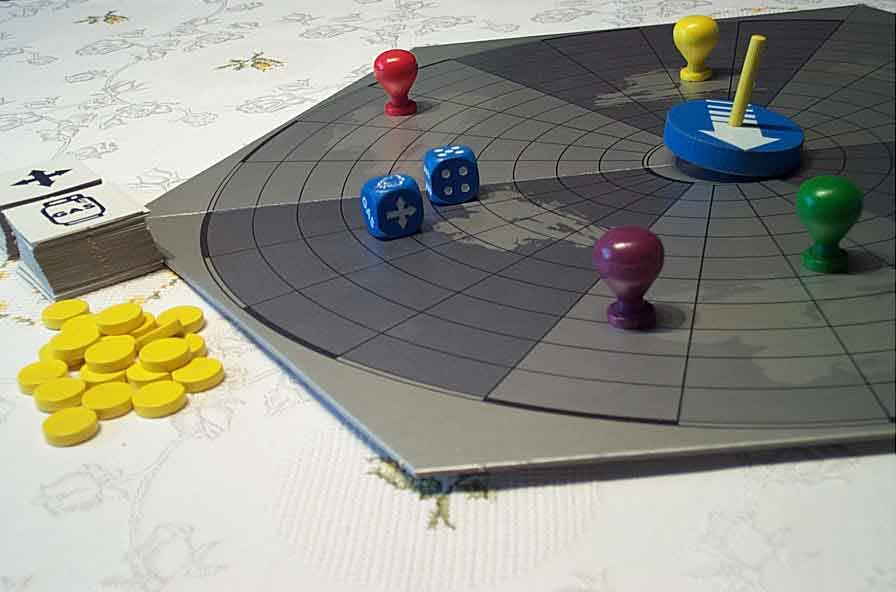
Six years later Jürgen Hagedorn and Hexagames presented
this game whose title "200 Years of Hot Air Balloons"
commemorates the bicentennial of the original 1783 ascent
of the Montgolfier brothers. As they were French, it seems
strange that so far we have not encountered a French game
on ballooning topic, but we will remedy that later. This
designer created several titles during the 1980's, none of
which I have ever seen, including this one, although I have
read the rules. According to German reviewer Andreas Keirat
to whose review and picture I am indebted, this should be classified
as a dice game. The board is circular and divided into
ten concentric rings. Twenty-four "spokes" combine with
them to form a grid. Players each have a wooden balloon
which shows its altitude by stacking it up, insecurely it
seems, on small wooden disks. They also receive at start
four ascent cards and four descent (gas bottle) cards. A
wooden arrow on a disk at the center shows the current wind
direction. Players move by rolling two dice, a special
one which describes a change in wind direction or a
requirement on the player and an ordinary one which gives
the amount to move. There are actually three games in one,
all centered around getting a balloon to a specific location,
the first two based on real life balloonist games: a chase
or "fox hunt" and a target race. The third scenario
describes a race to the center of the board. Andreas seems
to feel that the game is average for a dice game, while
giving high marks for the components apart from the cards.
Hot Air Ballooning Game
Balloon Race
Balloon Race
The game itself is one of tactics and bluffing, a bit in
the style of games designed by Bruno Faidutti (Citadelles/Ohne
Fürcht und Adel) and indeed he has a favorable
review of the game at his website. The board is a curved
track with whimsical depictions of European landmarks along
the way. There are eight nicely-made large, plastic balloons,
differentiated only by color (a potential problem for the
color blind). Players do not "own" any balloon in particular,
but are each secretly supporting a unique set of three of
them as determined by a secret card dealt at the start. A
turn is comprised of a die roll and a movement of any
balloon. There are special spaces on the carefully-designed
track which may send balloons backwards, back to the start
or stop its forward movement. There are also special rules
by which balloons may be bumped. A great deal of the
interest here is in the bluffing and deduction. Obviously
these activities can go on even on others' turns so there
is very little "down time" between turns. Overall, although
bearing relatively little connection to actual ballooning,
this forty-five minute game is rather enjoyable, certainly
much more so than might first appear.
Montgolfière
Players familiar with Hol's der Geier or Raj
will recognize the influence of Alex Randolph's ideas as
each player starts with an identical set of cards, chooses
a random subset and adds one card each turn. The higher
the card played, the more likely one is to move up, but
there are other interesting plays such as grappling onto
another balloon, using soporific gas on lower balloons or
storms which defeat the leaders. It can be especially
interesting to compete against the non-player Black Baron
who has been known to win the game from time to time, even
playing randomly. All of this makes for a light psychological
battle not requiring a great deal of thought or effort,
but nice artwork and components make for a pleasant experience
which doesn't last more than thirty minutes. For those
wanting a denser game, we have successfully played a variant
in which each player has the full deck of cards available from the outset.
This adds to the strategy, especially with respect to
cooperative play.
Balloon Race
Himmelsstürmer
Steampunk – War Balloon
Cloud Nine
Joe & Maggie Cordova; Hot Air Ballooning Game-1983; 2-5
Published for the Albuquerque International Balloon Fiesta,
features balloonists racing past a series of obstacles.
Movement is via spinner. They
can attempt to change the wind direction.
There are also event cards.
Balloons are mounted on 1-foot plastic rods.
Hungry Owl-1984; 2-5
In 1984 there appeared, uncredited and unheralded, one of
those games where the goal is to fly has high as possible,
once again in fact, to the stratosphere. But this time each
player is simultaneously piloting not one but four balloons
which attempt to traverse a tall grid, rendered whimsical by a
number of wavy lines. An exotic 10-sided die is used to move a
player's pawn on the track that runs around the outside edge
of the map. Every now and then it passes an action points
indicator (numbered 1-4) which permits the player to make that
many moves. Besides pure advancement of their balloons, some
spaces are storm clouds which have the side effect of dropping
one of the ten hail stones down a square – upon hitting
a balloon they send it all the way to the bottom from which it
must re-start. Other special effects are spaces which force a
move to the side, random hail stone activity, squashing a
balloon between two others and using one's own balloon as a
stepping stone. While the board is rather colorful, the
balloons are simply represented by plastic chips. Apparently
sponsored by Alka-Seltzer or at least that is the logo
prominently displayed on the box.
Nick Sewell; Three Wishes-1990?; 3-6; 6+
as The Great Balloon Race for Parker-1991, also for
Tactic
in German as Himmelsstürmer for Parker-1991
in French as Poursuite en Ballon for Parker-1991
With 1990 players no longer had to wait half a decade for
a new balloons game to appear as three were due to appear
over the next three years. Perhaps part of the reason was
that the year's entry proved quite a successful one, being
published in three different languages. The game seems to
have begun life as a self-published effort by Nick Sewell
(under the label Three Wishes) who did a few other games
in the late 80's and early 90's, the other most recognizable
names being Die Erbraffer and S.P.I.V.'s. The game was
then picked up by Parker and published in the UK as The
Great Balloon Race and in Germany as Himmelsstürmer
("Sky Stormer").
Review (Clarke/Billabong: English)
English Rules Translation
Dominique Erhard; Eurogames/Descartes-1992/1999; 2-6; 7+
Balloon games returned definitively to the land of their
birth with this game by Dominique Erhard (better known for
Condottiere, Serenissima and at the time of this writing,
the brand new Die Weinhändler) and published by
Eurogames/Descartes. Re-released in 1999 with new artwork,
it is my guess that this is the ballooning game best known
in the United States today. It differs from all of the
others discussed so far however in that now the race is no
longer a lateral one, but rather to see which balloon can
ascend the highest, in fact, as the board whimsically
suggests, all the way to the moon.
Review (Oakes/Sumo/Game Cabinet: English)
Review (Irons/Just Go Play: English)
John Escott; World International Publishing-1993; 2; 4+
Roll-and-move air race over Greendale.
Manfred Franz; Jumbo-1994; 2-6; 7+
as Wolkenstürmer for Jumbo-1995
Two years later there appeared another entry, again for
children, and again about flying as high as possible.
Designed by Manfred Franz for Jumbo, it was renamed as
Wolkenstürmer (Cloud Stormer) a year later, perhaps
because of the overlap with the game of 1991? This designer
is also responsible for Die Schlangen von Delhi (The
Snakes of Delhi) and Schweinerennen (Swine Race),
also games for children. Nor are animals limited to those
as here players must contend with crows whose deadly
attentions may spell disaster for the daring balloonists.
As in the previous game of this name, a player's support
of a particular balloon color is secret, although here just
of one rather than three balloons. Instead, each balloon
has multiple colors depicted. The board shows several layers
of air with specially-marked positions at which the crows
begin. A turn consists of rolling a die which gives a
balloon color. The player may move a balloon with this
color up or sideways or, alternatively, move a crow sideways,
the crows politely declining to change altitude. A third
option is available if a crow happens to start the turn
next to a balloon. In this case, the crow can be used to
attack the balloon, after which it, having done its damage,
retires from the scene, as does a balloon which has been
twice attacked. As unfortunately I have been unable to ever
encounter this game, I am indebted to the review of Andreas
Keirat once again, as well as that of Peter and Birgit
Koeltringer for the information here. Both seem to indicate
that this is a pleasurable combination of bluff, tactics
and luck lasting no more than twenty minutes.
Alessandro Manitto & Massimo Torriani; Hobby & Work-1994; 2
Far less well known was this war game in which on a square grid
board the two combatants try to shoot one another down.
Dice play a role and damage is taken by drawing damage cards.
The balloons are represented by cardboard standups.
Aaron Weissblum; F.X. Schmid USA-1999; 2-6; 8+
Five years passed. Balloons flew and landed, no doubt
trying to avoid crows and soporific gas along the way, but
no new games could be added to the ballooning games ledger
until this 1999 publication by F.X. Schmid. American designer
Aaron Weissblum's other games are co-designed with Alan
Moon: Knights of the Rainbow, Time Pirates and San
Marco. This game breaks with its predecessors by
abandoning the idea of competing balloons and instead puts
all of the players into the same basket, one which is
climbing through the clouds. On each cloud, the current
player must roll the dice which show cards in four colors
and two blank sides. Whatever cards are rolled must be
matched by that player, but the other players may either
jump off the balloon (and score points depending on how
high the balloon is) or stay on, gambling that the needed
cards will be played. If the cards are matched, the balloon
continues to rise. If the match is not made, the balloon
ride is over and all players still on the balloon score
zero. Umbrella cards are "wild" and considered a match for
the entire needed set. The "Pass the Barn" cards allow a
player to force somebody else to make the match. Unfortunately
my plan to try out this game fell through and I was not
able to play it before completing this article. Thus I have
relied here on the reviews of Dan Becker and Trevor Clarke,
which describe the game as reminiscent of the Sid Sackson
(Hasbro) classic Can't Stop, the similar quality
being that players need to decide when to quit while they
are still ahead, but differing in that card counting may
help success whereas in the former, one is always at the
mercy of the dice. This rather light game rarely
lasts more than forty-five minutes.
|
Pass the Gas
D.J. Stamper;
Fun City Games-1999;
2-6
In the same year, but only very recently brought to my
attention, another ballooning game was published by Fun
City Games, a Florida outfit, who were previously unknown
to me. The games designer, D.J. Stamper, who also seems to
maintain an on-line comic book shop, is also a new name to
me. Production is reminiscent of the Cheapass Games approach
to publishing, including only a rules set, cards and four
large cards all monochrome to form the board. In an
arrangement that must give pleasure to dice retailers,
players must supply a twenty-sided die and a four-sided
die for each player. As in Montgolfière,
Himmelsstürmer/Wolkenstürmer and Cloud
Nine the goal is once again to reach maximum altitude,
but unlike the latter, the players are once again back in
their own balloons (and represented by the four-sided dice).
Airspace is divided into six vertical lanes with tossing
out ballast (in the form of cards) being the primary activity
each turn. Humorous imagination was applied in the naming
of these items such as the kitchen sink, an encyclopedia,
a refrigerator, etc. The same goes for the naming of the
different balloon teams. A balloon rises toward its eventual
goal of five thousand feet depending on the size of the
ballast card. However, this card does not simply land on
the earth – instead it will be more fun to try and hit
another balloon via a "to-hit" roll which if successful,
gives the ballast card to that player and forces his balloon
downwards. In addition, it may hit a crew member, knocking
him out and forcing out a piece of ballast, causing the
balloon to rise again. Each player also has one dart and
one dynamite which may be launched at an opponent instead.
With the latter, unless the player happens to have the one
nonflammable gas card (the gas cards are passed each turn),
the balloon bursts and the team is forced to re-start from
the ground. Players may be somewhat reminded of the game
Skyrunner or even Devil Bunny Needs a Ham and the game may
last a bit longer than players expect as it is relatively
easy to burst other balloons and send them hurtling all
the way down to the ground.
 Balmy Balloonists
Philip Vogt & Rick Heli;
Up & Away Games-2000; 1-6
Although perhaps only dimly remembered now, 1999 also saw
the world's first balloon circumnavigation. Except for
those who followed its progress on the worldwide web, the
drama of the race seems to have been little shared by the
general public. In fact it was an occasion of high adventure
hearkening back to the historic automobile and airplane
contests of the early century, complete with diplomatic
overtones, frequent mishaps and not a little genuine peril.
Although a $1,000,000 prize beckoned, the typical team was
to pay up front costs of more than twice that. This was
to be a race not for the gold, but for the glory.
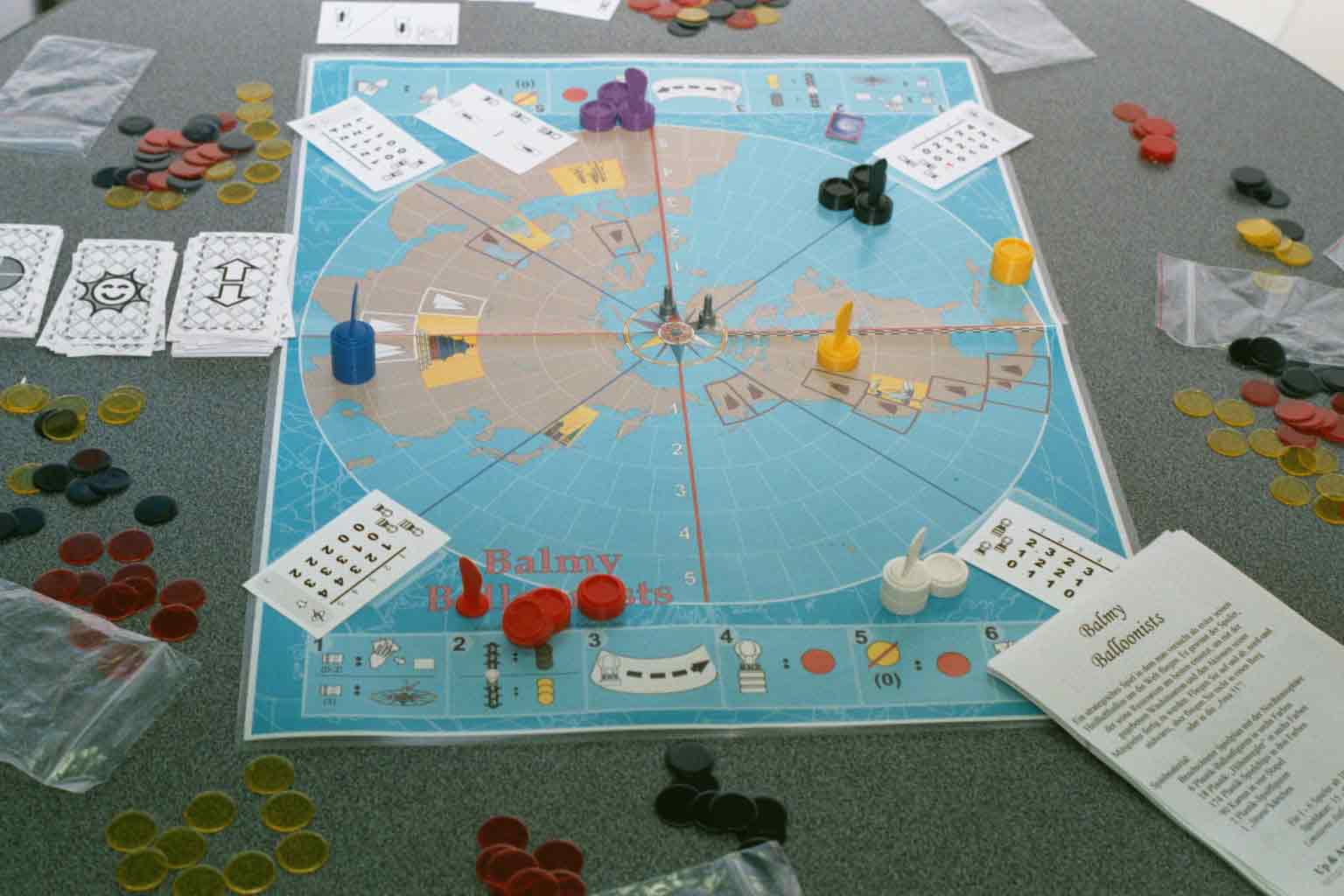
This is the departure point for this first game by Philip
Vogt and, surprise!, myself. We found ourselves truly
inspired by the balloonists' sense of adventure, the romance
of ballooning itself and the many difficult strategic
decisions involved. Publishing under the label Up & Away
Games, we decided to posit the game as a more familiar
race, one with a common start line and time. By the way,
just such a real-life race is planned as an annual event
starting in 2001. Philip's background in meteorology was
invaluable in designing textless cards which represent
actual weather and jet streams patterns. The balloons
represented by stackable plastic pawns carry limited supplies
of ballast, gas and fuel which must be carefully husbanded,
just as the real ones are. Of course in every flight there
are unfavorable winds and events and in the game these are
for the most part triggered by the players, thus giving a
way to slow down a leader. But it is not an open season to
blow anyone off course at will as we rely on a color system
to limit which balloon may be manipulated at any given
time. (To avoid the most common red-green color blindness
problem we eliminated one of these colors.) The successful
player will use lookahead ability to successfully navigate
this system and claim a virtual sip of the traditional
winner's champagne.
English rules
German rules
FAQ
Interlude
With this game, we come to the end of our ballooning tour. Or is
it? Are there more ballooning games in our collective future?
Only time will tell. But one positive sign will have already been
noticed by buyers of this year's Die Siedler von Catan: Das
Buch (expansion kit for The Settlers of Catan) by Kosmos.
In it are six colorful balloons as well as "Ballonfahrer" (Balloon
Travelers) rules which can be added to any Settlers game, thus
revealing another potential for ballooning in games, i.e. just add
them as a variant to any of the games you're already playing.
Perhaps some readers will come up with some very inventive ideas
in this area. Who knows what excitement may develop!
Die Siedler von Catan: Das Buch
Kosmos-2000;
3-6
Contains balloon pawns and rules for a "Ballonfahrer"
variant for adding balloons to
Die Seefahrer von Catan.
Rules (this site: English)
Die Siedler von Catan Variant
Thomas Hnizdo; 3-4
Rules for another "Ballonfahrer" variant adding balloons to
Die Seefahrer von Catan.
Rules (this site: English)
Balloon Cup
Balloonacy
Balloons in the Wind
Hot Air - Solitaire
Mad Zeppelin
Magnificent Flying Machine Rally, The
Airship Games
Ace of Aces: Balloon Buster
Aeronef
Aether Captains
Air Ship Game, The
Airship Adventures
Airships
Banzai Zeppelin
Batalha de Zeppelins
Der Blinde Passagier im Zeppelin
Cloudbusters
Conquest of the Skies
Dirigibles of Doom!
Stephen Glenn; Kosmos/Rio Grande-2003; 2
Game of various ballooning competitions. There
isn't really any connection to ballooning apart from the
artwork. The idea is that players are competing over a series
of ballooning competitions, represented by cards placed in a
line between players. Players then play cards on either their
own or the other player's side to represent how well they have
done in the a competition. Winning a competition earns a
wooden cube. Earn enough of these in a color and receive a
trophy which gives victory points. Play is very tactical and
one wants to do many things, but only one is permitted. The
important skill is to evaluate which is most important, often
based on whatever can be deduced about the opponent's goals and hand.
It's refreshing that both low and high cards are useful, greatly
lessening the possibility of losing due to poor luck of the draw.
Unfortunately the theme is very thin.
Walt O'Hara-2003
Diceless miniatures game where the player controls altitude via ballast.
Wind and Terrain are determined by card draw.
Walt O'Hara Site
(unknown); (web-published)-2007; 2-8
Print-and-play dice game. Win by crossing the red line into
the park.
Michael Eskue;
(web-published)-2008; 1
Card game of navigating with a limited amount of fuel and
trying to avoid birds, lightning, planes and gusts of wind.
Olivier Pauwels;
Alderac-2010/Dust Games-2010; 2-5
Card game set in the Industrial Revolution. Players represent
traitors trying to sabotage a valuable zeppelin shipment, a
zeppelinment, of supplies to a great emperor while trying
to avoid being caught by the guards.
(uncredited); The Master Herbalist, Ltd.-(unknown year); 2-6
A simple dice race from London to Paris during the age of
early aviation. Two of the racers are balloons and one is an
airship.
Alfred Leonardi & Hal McKinney; Nova Game Designs-1985; 2
Booklet game about shooting down tethered observation
balloons during the first world war.
Part of the Ace of Aces series.
Steve Blease and Matthew Hardey;
Wessex Games;
1999;
2
Air combat with 1/1200th scale miniatures in a
Victorian science fiction setting. Players control several airships
at once.
Todd Sanders; Mage Company-2010; 1; 20; 8+
In a fictional, steampunk world the player commands an
airship versus pirates. The airship consists of six
dice positioned so as to make up various parts of the
ship such as guns, command deck and engine. Damage to
these sections, which may later be repaired, is
indicated by dialing down the pips. Six dice also
represent the pirates.
Spinoffs to this system, all from 2011, include the following:
Aether Captains: Capek Golems
Aether Captains: Clockwork Cabal
Aether Captains: Dread Supremacy
Aether Captains: Pirate and Traders
Aether Captains: The Search
Aether Captains: Triad
Aether Captains: Triad 2
(unknown); McLoughlin Brothers-1904; 2-4
Roll-and-move game of racing to the north pole via airship.
Lloyd Krassner;
Warp Spawn Games;
2005; 2-4
In 1850, players pilot Victorian airships, completing various
missions around the globe. Airships have six attributes: Military,
Exploration, Diplomacy, Transportation, Rescue, and Speed.
Attachments and Crew cards help improve various traits.
Employs two ten-sided dice.
Andreas Seyfarth; Queen-2007 2-4
This is a dice and technology tree game around
the perfection of airship technology like that of the Hindenburg
(wartime uses carefully sidestepped). The four players represent
Germany, France, Italy and USA and the play materials reflect that
(though this is not really a variable powers game). Also thematically
nice is the separation of cards the players can acquire into six types:
engines, pilots, scientists, tools, hangars and funding.
All of this is realized in some quite lovely artwork by Jo Hartwig,
the faux "designer's notes look" being especially fetching.
What's more is that the internationalized communication design
is clear and well done. Along with these materials, there are
some unusual dice in three colors. White dice show results in the
range 1-3, red – 2-5 and black – 4-8. A number of cards
are laid out,
each specifying the types of dice and the total needed to acquire them.
To the total the player may afterward add a bonus chit; failure grants
another such chit. Turning in three chits permits a double turn.
A player can only hold one of each type of card which means there
are sometimes difficult decisions and also that the order that new
cards appear is a bit of randomness perhaps more decisive than that
of the dice. Eventually players try to create actual dirigibles by
taking the more difficult cards which grant victory points. Doing so
gives the nice wooden blimp piece and another dice roll bonus. Starting
work on the major airship overrides all lesser ones, however. The
fact that this ship may never be finished and that the game ends not
when all four of lesser airship stacks are depleted, but when each is
down to just one card shows judicious wisdom that prevents matters
from going on past the point of fun, something less often seen in
American games where normally, come hell or high water, every last
possibility must be played out long after Fun has left the building.
Often the winner is the one who was most often able to roll an 8
on a black die as it always seems that that will win the prize while
failing to roll an 8 will lose it. There's a bit of strategy
– low-risk/low-reward v. high-risk/high-reward – but the
main skill is evaluation of probabilities. On the other hand it's
short enough and the choices and setting otherwise interesting enough
to make this one of the better possibilities in the dicing sphere.
[Buy it at Amazon]
(unknown); Löffler & Co.-19??; 2-5; 6+
German roll-and-move race around the world. An important
feature is the requirement to reach particular points
withing a set amount of time; getting there early provides
extra cards.
Probably published in the late 1930s.
Antonio Marcelo; Riachuelo Games-2002; 2
Microgame of aerial battles of airships before the advent
of the use of the airplane as war weapon.
Web-published in Portuguese.
(unknown); Verlag Schmidt Zwiebeltürme-19??; 2-6; 6+
This German game from the 1920s or 1930s is about getting
your passengers into seats on the zeppelin. The mechanism is
dice rolling. Results of 1-5 put a passenger into a
corresponding waiting possition while a 6 gets them into the
zeppelin. Rolling an occupied position sends a passenger
back to the start.
Title means "Blind Passenger in the Zeppelin".
Martin Wallace; Warfrog-1998;
3-4
Wargame set on a Victorian world where only the
tops of mountains are habitable. The only way that
the tribes can get around is by airships.
Jake Staines; web-published-2012; 2-3; 60
On an alternate history earth players vie to retrieve a
recently discovered ore that is the key to a
superweapon. They're all in a big hurry so of course
they go in airships, which can also engage in combat.
Other aspects include exploration, research, technology
development and food harvesting/feeding the populace.
(unknown); Irrational Number Line Games-2012; 2-4
Miniatures game that affords dirigible duels in the
sky. Momentum and response latency are taken into
account, rewarding good planning. Includes seven
scenarios, cut out models and maneuver cards.
Forbidden Desert
Fortune and Glory: The Cliffhanger Game
Game of To the North Pole by Airship
Game of the World Flyers
Graf Zeppelin Graf Zeppelin's Reisen durch Deutschland
Great War at Sea II, The: The North and Baltic Seas
In 80 Tagen um die Erde
Kings of Air and Steam
Leviathans
Luftschiff
Quicksilver
Riesenflugzeugabteilungen
Rise of the Aeronauts
Round the World Flyers
Sky Galleons of Mars
Über Stadt und Land: Der Fliegende Musketier
A Voyage Through the Clouds
Wings of War: Balloon Busters
Zeppeldrome
Zeppelin
Zeppelin
Zeppelin Attack
Zeppelin Attack: Doomsday Weapons
Zeppelin Conquest
Zeppelin Derby
Zeppelin: Peter Strasser's Blitz
Zeppelins Over London: WW I Airships (1916 AD)
Zippy Zepps
Zombies & Zeppelins
Related
Around the World in 80 Days
Bunte Ballone
Flieg Luftballon, Flieg!
Magnificent Race, The
Moderne Zeiten
If you liked this Ludography, you may also enjoy traveling back in time to the
SILK ROAD.
Matt Leacock; Cocktail Games/Competo / Marektoy/Devir/Gamewright/Schmidt/White Goblin-2013; 2-5; 45; 8+
Cooperative game with a modular board and variable player powers in
the tradition of Forbidden Island.
The players must recover a legendary flying machine buried deep in the
ruins of an ancient desert city and escape before it's too late.
Includes 49 cards, 24 tiles and 6 pawns.
Jason C. Hill; Flying Frog Productions-2011; 1-8; 90
In the height of the Great Depression, adventurers hunt down ancient
artifacts, explore deadly temples, and fight the powers of darkness.
Characters include the Flying Ace, the Night Club Singer/Martial
Artist and the Master of Science.
There are thirty-nine 28mm plastic miniatures and even an
original cd soundtrack.
There is also the possibility of playing cooperatively.
(unknown); McLoughlin Brothers-1898; 2-4
Roll-and-move, probably inspired by the 1897 attempt of the
Swede
Salomon Andrée to reach the north pole.
All-Fair-1926;
2-4
Subtitle is "Around the World Flight Air Race" shown on the cover
along with three dirigibles, a ship and city.
Includes four metal dirigible as playing pieces.
Board shows various flight paths from New York to Paris
including ones passing through South America and Africa.
Also included are two dice and an 18x9" board.
The back of the board was marked as for Checkers
and a full set of pieces was included for playing this game.
Said to be valued at over $200.
(unknown); Klee-1960; 2-6; 6+
A roll-and-move German racing game
named after the zeppelin's
inventor. Players race around Europe, stopping at the
major cities and obeying the instructions on special
spaces.
(unknown); Klee-(unknown); 2-6; 25; 6+
A roll-and-move German racing game from the 1930s
named after the zeppelin's
inventor. Players race around Germany – from
Friedrichshafen and back.
Avalanche-1999 (?); 2; 10+
Wargame includes World War I zeppelins.
Wolfgang Kramer; Otto Maier-1986;
2-6
in English as Around the World in 80 Days for
Ravensburger-1987
Review
(Farquhar/Game Cabinet: English)
Scott Almes; Tasty Minstrel Games-2013; 2-7; 90
In America's early 20th century players represent shipping
barons operating both airships and railroads.
The airships deliver cargo to depots where they are picked up by
trains. Actions include building depots, upgrading airships/trains,
operating the train and getting loans. Airship movement is via planning card.
There is a market and prices are always changing.
There are modular boards and
seven teams, each having a different special ability.
Randall N. Bills & John Haward; Catalyst Game Labs-2012; 2-8; 90
War game miniatures rules set in a 1910 alternate history.
The basic set includes eight ship miniatures and twelve ship cards.
There have been a number of subsequent expansions:
Leviathans: British Fleet Box,
Leviathans: French Fleet Box,
Leviathans: Ship Quirks & Crew Abilities Card Deck.
Phil Eklund; Sierra Madre Games-1993; 2
Zeppelin bombs Britain during World War I, tactical level.
Review (Richtmyer/Murphy/Web-Grognards: English)
Paul Imboden; Split Second Games-2013; 2-6; 60
Victorian Age airship racing on a course customized by the players
using ships they modify to suit. Dice are involved, as are attacks on
opponents.
Phil Eklund; Sierra Madre Games; 2
Expansion for Luftschiff which adds the Gigant-types,
i.e. enormous bombing airplanes.
Review (Murphy/Web-Grognards: English)
Review (Murphy/Web-Grognards: English)
Austin Bennett, Jacob Chaney, Sam Schirmer; Mystic Ape Games-forthcoming; 3-6 60
Steampunk-themed game of fighting to build the world's first airship
in 1851. Players acquire resources by conquering others' territories.
Each player represents a different faction which has its own
abilities.
Wolverine Supply and Manufacturing Co.-1925
The metal board shows bi-planes and a blimp in the corners.
The description on the box cover reads
"A New, Interesting and Instructive Game for Children /
This game is played by moving miniature aeroplanes around a map
of the world, following the exact course of the U.S. Army Aviators
in the first round-the-world flight. Every stopping place is marked,
and the actual incidents of the flight add interest to the game.
Teaches children the map of the world and the flags of many nations."
Part of the company's "Sandy Andy" label.
Company was located in Pittsburgh, Pennsylvania from 1903-1961.
Patented in the USA on August 18, 1925.
Is said to be worth $80 or more.
Frank Chadwick; GDW; 2
The sky galleons in this science fiction setting seem to act
very much like dirigibles.
Terror of the Skies: The Airship Pirate Board Game
Robert Brown; The Game Crafter-2013; 2-5; 7+
Players control airships intent on a life of air piracy over
the American wilderness, which in a Victorian age is ruled by
an emperor, criss-crossed by railroads and inhabited by Bedouin types.
Based on the Airship Pirates role-playing game.
Wicküler Brauerei-1973; 2-5
Promotional game for a brewery whose
title means "Cross-country: The Flying Musketeer" and is an
airship race across North Rhine Westfalia.
The airships move via dice and action cards.
Components were said to be of very good quality.
(unknown); Spear's Games-1910; 2-6
Roll-and-move race game across seven countries, with
thirteen different hazards, e.g. storms, on-board fire, etc.
Andrea Angiolino & Pier Giorgio Paglia;
Edge Entertainment/Nexus/Fantasy Flight-2009; 1-2
Part of the Wings of War series. Includes a
Caquot - Ae800 balloon miniature and an Allied Nieuport 16 with
Le Prieur air-to-air rockets.
Some of this was previously
published cin Wings of War: Burning Drachens (2005).
Anthony J. Gallela & Jeff Wilcox; 12SP Entertainment-2014; 2-4; 90
Puzzle and "take that!" racing game in a steampunk setting.
Features route planning via cards, ten board modules, obstacles and humor
like "Tragic Lemming Migration". Includes 86 cards and a number of
tokens.
B. Koff and M. McVeigh; Decision Games-1993; 2
Zeppelins bombing Britain during World War I, strategic level.
Errata (Web-Grognards: English)
Questions and Answers (Web-Grognards: English)
Steven Cole; Jagdpanther-1974; 2
Zeppelins bombing Britain during World War I, tactical level.
Eric Vogel; Evil Hat Productions-2014 (forthcoming); 2-4; 45
Deck-building game of mastermind villains planning to dominate the
world. Cards include weapons, defenses and operatives who attack others.
Includes 112 cards.
Eric Vogel; Evil Hat Productions-2014; 2-4; 45 minutes
This expansion for
Zeppelin Attack
features 47 cards including atomic attacks and defenses,
experimental attacks, science zeppelins, and more.
Eric Vogel; Evil Hat Productions/(web published)-2014; 2; 10 minutes
Thirty-six cards permit two evil masterminds to fight across
the globe via zeppelins and soldiers. Uses the majority
control mechanism in which players must consider three
different targets. Released as a Print and Play backer reward,
as part of the Kickstarter campaign for
Zeppelin Attack.
Todd Sanders; Good Little Games/(web-published)-2013; 2; 15
Zeppelin racing fueled by 17 cards and 5 dice, including a few dirty
tricks.
Part of the
Aether Captains
universe.
Glyn R. Sparkes; battle-market-2007; 2; 120
World War I game of the battle between the German Naval Airship Division
commanded by
Peter Strasser
and British aerial defenses includes 1 A4-sized map, 2
tracking aides, 50 counters, and four pages of rules plus a
background article. Features plotted movement.
Three different types of zeppelins are available.
Each turn represents a month.
Special rules cover weather, accidents, etc.
Peter Pellegrino;
Junior General;
2008; 8
Historical miniatures air combat game designed for classroom use played
by teams representing the British and German forces. The British have
five divisions of Bristol fighters while the Germans players
have 12 airships.
All-Fair/Fairchild Co.; c. 1925
The game box shows a long Zeppelin air ship named ZZ1 and has the subtitle
"Air Game". The two part board shows three cities inside large circles,
Berlin, Paris and New York from left to right. Connecting the cities
are curved, color paths, demarcated into spaces by crossing lines.
The zeppelin pieces are made of metal. There are also cards showing
zeppelins. The publisher was also known as AllFair and as E.E.
Fairchild and operated at different times out of Rochester and
Churchville, both in New York. Designers were Harry O. Alderman
and Elmer E. Fairchild, publishers of paper boxes and novelties
since 1900 who got into game publishing in 1922. For a while
Herman G. Fisher was vice-president before going on to found
Fisher-Price. Their games were known for their vivid color,
detailed illustrations and contemporary themes, of which this game,
made to tie-in with the then new transatlantic dirigible service, is an
example. Copies of this rare game are said to now be worth over $400.
Scott W. Leibbrandt; web-published-2012; 2-4; 60
In 1922 the world is being overrun (overstaggered?) by
zombies. On a world map delineated by twenty-five
regions, players use a card-driven system to work together
to fight the undead.
A few games on related topics for further delectation.
Transogram-1957
Ravensburger; 1-4; 3-5
(unknown); Spika-1972; 2-6; 15; 3+
"Fly Balloon, Fly!" is a game of rolling a die and placing a
chip over a balloon of the same color as the result.
Bill Cooke; Parker Brothers-1975; 2-4
The balloon is one of the four travel modes in this game for children.
Dan Glimne and Gregorz Rejchtman; Jumbo-2002;
3-5; 8+
"Modern Times" features six very nice zeppelin figures.
Auction and shares game set in the large construction world (trains, planes,
automobiles, telephony and skyscrapers) of the 1920's.
Players bid for a set of randomly turned up shares, and for the right to act
first. Similar to
Traumfabrik,
the winning bid is distributed to the other players.
Then each player either draws two shares from the deck or plays any number.
If the latter results in the player showing more shares in the industry sector
than any other single player, he moves his zeppelin piece forward on the spiral
track to the next space showing that sector. This space also names a city
(New York, London, Paris, Berlin, Chicago, New Orleans). Sector and city are used
to index a location on the clever central board matrix which the player now marks.
At the end, points are granted for dominating rows and columns of this matrix,
as well as for having the most shares in each sector and the most money.
As shares appear, they are counted and once they hit a limit, whichever sector
has the most shares out crashes and they are all lost so this is one of those
games where it is a good idea to aim for the tricky goal of being in second place.
Strategically, with a full complement of five players,
it seems that a lot of points can be earned by being diverse in holdings and
conservative about spending, but it's hard to advise since maddening
ambiguities in the instructions seem to ensure that there is no consensus
about the correct rules of play.
If one can somehow get over this, "Modern Times" is an appealing construction
which because of the variable starting and appearing shares should have plenty
of replay value. Fans of the somewhat similar
Union Pacific
should enjoy this as well, but those who didn't care for it should like this
even better as what happens on the board matters more.
The look reflects the interesting theme very nicely, even though the artwork
feels a bit bland. One wishes for a bit more quality in the flimsy play money
which sticks together too easily and is difficult to count.
spotlightongames.com