|
|
But back in those days, it was pretty unusual for us game connoisseurs as well. For one thing, it was using what has been dubbed "the paragraph system". In games of this type, the players have a booklet separate from game's instructions, which regulates play. In effect it works something like a flow chart or finite set of states that players navigate by making various decisions without knowing the outcome in advance. I believe the first detailed use of such a system in board games (there are earlier examples in book-only form) was actually by Metagaming, which published it first in its Death Test, an adventure for fantasy role-playing. In the RPG realm, Metagaming's main competitor was TSR's very popular Advanced Dungeons and Dragons, a system which made very heavy use of a combined non-player referee and world designer, the Dungeon Master, to control play. Publishing a rather bare bones system in tiny packages called micro-games, Metagaming didn't really have a guide, or even much of a role, for such a person. Perhaps being a bit more rational in their system, and fearing the excesses that a megalomaniac DM can wreak, it's not clear that they even wanted one. But still there was the problem, how to run the adventure as you can't keep the challenge nearly as interesting if all the obstacles are laid out in plain sight. So this game was really making a virtue out of a deficit. It worked quite well and Metagaming went on to publish Death Test II, Grail Quest, Security Station, Treasure of the Silver Dragon and Treasure of the Gold Unicorn which had an ignominious outcome that we'll skip here.
But all of these programmed adventures were unflinchingly about combat. And this remained the case when other companies caught onto the idea. Dwarfstar did Barbarian Prince. SPI published a few in its "we're on the fantasy and science fiction bandwagon" magazine, Ares, and Victory Games, the heir of SPI, did Ambush! and three sequels, moving to a World War II storyline. They also did the award-winning Mosby's Raiders, in which the Confederate leader attempts to disrupt Union forces. TSR even got into the act with a programmed ending to The Awful Green Things from Outer Space, but only in an epilog. SPI also did an interesting variation on the form with Citadel of Blood. Set in the world of the aforementioned Swords & Sorcery, it is a paragraph system in which the paragraphs are created at random by rolling dice against various tables. But apart from some folks out in the San Francisco area creating the wonderful Sherlock Holmes, Consulting Detective (1984), it seems no one had considered the possibilities of the system for a society game.
Description
But new ground was broken for this unusual and daring project. If its inventor had not
also been running the company, it's hard to say if it would have been published at all.
Thank goodness for maverick independents. Another evidence of the game's venturesome
nature is that this vehicle for 2-6 players is actually four different games in a single
package. All are centered, however, around the historical stories of
A Thousand Nights and a Night, probably most familiar to the West as the stories
of Aladdin, Ali Baba and Sindbad, although there is more, much more.
The backbone of all the games, however, is the wondrous paragraph book, the Book of Tales. Fairly well-written, it contains 1,400 distinct paragraphs, obviously a prodigious amount of work. I don't think that all of the paragraphs are "reachable", some being added, especially near the end, as decoys for any who would cheat, but I suspect that the vast majority of them are. To give an idea of what the paragraphs are like, here is a sample drawn at random:
527 You question the other rudely, and he cries indignantly, "How dare you speak to me that way?" He beats you about the head and shoulders; none will come to your aid.
The basic player turn consists of Move - Encounter - Card Play/Skill Use. Movement occurs on a very attractively-illustrated 22"x17" full color map showing regions from Britain to Ceylon (and the mysterious P'an P'an beyond) and from Timbuktu to Samarkand. Locations are depicted either by a rendering of a city or an icon representing a terrain type: mountains, forest, desert, sea, island, etc. Linking lines indicate either land or sea movement. A player's movement allowance is conveniently indicated on the player display and is cleverly tied to his wealth level. As wealth increases, so does speed, but only at first. Once one reaches "Princely", speed at sea continues to improve, but land speed decreases sharply. Thematically this can represent the character's increased responsibilities and entourage, but it also neatly works as a balancing or "catch-up" mechanism.
The Encounter begins by draw of a card, which may itself be an encounter or which may be a Fate card which is instead kept for later use. If there is an encounter, the six different terrain types will be listed, each referencing a different number in the Book of Tales, helping to keep the encounters fresh and different. Further variation occurs because the player rolls the dice on a twelve-item table to determine exactly what has been encountered. This roll itself has modifiers such as whether one is in the uncivilized area of the map (you know, Europe and that lot) and how many destiny points one has (a probable indicator of how far one is into the game and a possible balancing feature). So a great deal of care has been taken to always keep the encounters fresh, and at relatively little cost to the players.
The player's response to the encounter is one of the game's most interesting facets. For one thing, it needs no prior games experience -- anyone can do it. Also, it is something akin to computer games as one is essentially playing against the inventor. "What would he have created here?" the player wonders. An an example, suppose the player has met an Impudent Hunchback. What should one do? The options are presentable in everyday English: Beat, Enrich, Rob, Avoid, Question, Attack, Follow or Hire. Which would be best to employ in this case? In deciding, the player must not only consider which is the most appropriate for the type, but what he wishes to achieve (wealth, escape, movement, experience) and which might allow him to use one of his skills.
Skills, or Talents, allow each player to have a different character as well as to exert more and more control over his activities. At the beginning each player chooses three from Acting & Disguise, Appearance, Bargaining, Beguiling, Courtly Graces, Luck, Minor Magic, Piety, Seduction, Stealth & Stealing, Storytelling and Weapon Use. One other, Major Magic, can be gained during its course. In addition, each of the skills may be improved to Master level. These force the player reading the Book of Tales to consider alternate paragraphs which might give special advantages if the player has the skill. To continue the sample paragraph from above, if the player had only possessed Courtly Graces, he would have instead read the following:
Something about the other's bearing makes you speak softly and with deference. This grotesque creature is in actuality a favorite of the sultan -- a storyteller, prankster and shrewd thinker, well-respected by the Prince of the Faithful. You are judged interesting enough to be introduced to the sultan.The player would then be rewarded with 2 Destiny and 1 Story points as well as the the Luck skill.
Skills can also come in handy in the third part of the turn since they are usable on others in the vicinity. This can lead to many interesting chase and bluff situations, as well as attempts to keep a leader from winning. Failing that, a card may be played, either to cause a special effect or to have a special encounter at the city listed on the card. This last is a good idea because it gives the player a good reason to plan routes around the board in a form of the "traveling salesman" problem.
The flip side of skills are Statuses, the great majority of them unfortunate. Gained during encounters and sometimes devilishly difficult to be rid of, there are even more of them than skills: Accursed, Beast Form, Beloved, Blessed, Crippled, Determined, Diseased, Enslaved, Ensorcelled, Envious, Fated, Grief Stricken, Imprisoned, Insane, Lost, Love Struck, Married, On Pilgrimage, Outlaw, Pursued, Respected, Robe of Honor, Scorned, Sex-Changed, Sultan, Under Geas, Vizier and Wounded. As you can see, almost all of these will restrict a player's options in some way, some of them like Imprisoned and Lost, rather dramatically. In the original paragraph example above, the player earns the Scorned status.
Victory in the Standard game occurs when a player is granted the status of Sultan in an encounter, which is rare. Much more common is the use of a mechanism borrowed from Careers. At the start each secretly decides a goal of twenty points, divided between Destiny and Story points. When this is achieved, a player wins by making a trip to Baghdad, which as the game goes on is increasingly viewed as a suspicious activity.
The Adventure game adds the idea of quests. Quests are listed as secondary features of Fate cards, listing a character that the player must meet. The Book of Tales explains where each person is to be found and what may happen in the encounter. An encounter result of "Q:S" indicates that the quest has been satisfied. This causes generation of a new quest. A player wins by completing two quests and returning to Baghdad. Generally, completing two quests seems to take about the same amount of time as the Standard game victory conditions, so it is entirely feasible to let the players themselves choose how they would like to win, possibly even changing tactics midstream.
The changing tactics part is less true of the Merchant game since merchant players really need to choose Bargaining and Evaluation as starting skills, skills less useful for the other tasks. Merchants are entirely concerned with manipulation of 14x12 grid of products, an excerpt of which is given here:
| Spice | Jade | Carpet | ||
| Wine | Salt | Aloe | ||
| Silver | Paper | Tea |
Cities on the map each have two or three product names printed next to them. Merchants use this information to create trade routes on the grid. First they have an encounter in a city. Then they declare they are starting a trade route and draw at least one arrow counter at random. They can get extra ones by having Bargaining and spending wealth. These arrows are placed in the blank spaces on the grid according to one of two rules: (1) to point away from the product listed in the current city or (2) to continue from a prior arrow (but only if the arrow was acquired by spending wealth). The merchant succeeds if he builds a chain or arrows to another product and then enters a city on the map that lists this product. He increases wealth levels equal to the number of intervening arrows. Or, instead of three wealth levels he may instead draw a treasure at random. In addition, some of the arrow counters are marked "Wealth" and merchants possessing Evaluation can use these to earn every more wealth. The merchant victory condition is to reach the highest wealth level and return to Baghdad.
The Storytelling game is one that unfortunately I have never had a chance to try. In this one, instead of reading aloud from the Book of Tales, players read their own paragraph and make up their own three-minute story. It needs to follow the basic outline given, but the goal is to charm and entertain the other players. "The tale is in the telling." Other players can be included by assigning them roles or by providing sound effects. Only afterwards does the player read the paragraph provided and propose a reward for himself. The other players compare the two, thinking about entertaining and how inclusive of all the story elements it was. Then, one-by-one, they rate the story as Unremarkable, Satisfactory or Outstanding. This determines whether the storyteller receives the standard award, a minor extra reward or the proposed extra reward. There can also be an award for the best supporting player. As the rules say, this version requires that players somewhat suppress their competitive urges, criticize constructively and perhaps most significantly, be willing to feel somewhat awkward at first. The instructions do a great job giving a lot of hints on how to do this well, so players should see if they can forget their inhibitions and give it a try some time. This goes for the groups that I play with as well.
Finally, the Solitaire game requires all of the above to win, i.e. achievement of Fabulous wealth, fulfilling the formula and completing two quests. The kicker is that this must be accomplished before the deck is exhausted and whenever a player draws cards from the deck, he takes two, ignoring the one he does not like. This difficult challenge seems to be balanced and does not require the player to make any schizoid decisions as some solitaire games do.
Variants
The most popular variant is quite a natural one and one that I endorse after each
player has played at least once.
The rule on statuses is that a player may only have one at a time and receipt of a new
status cancels the previous one.
This is dissatifying on a thematic basis since it is unclear why one status should have
anything to do with another. A character who is Wounded shouldn't automatically lose this
status just because he is now also Insane. Morever, the player display facilitates tracking
multiple statuses and some paragraphs even grant multiple statuses.
Admittedly, tracking all of these statuses with their multiple effects can sometimes prove
taxing if the player gains too many, but somehow it feels more "right" than the given
alternative.
This variant could also be used as a balancing mechanism by having those who have played
before use it while those who have not, do not.
In Summary
In its day this was a seminal design, one of the first society games to employ the
paragraph system.
For many it remains an exciting player even today.
It may become too familiar, but only after many plays.
If this happens, players should just put it away for a while
and bring it out again when memories have faded.
In a good idea,
it has been re-published with additional paragraphs, as
Geschichten aus 1001 Nacht,
the Book of Tales being entirely in German.
It works well with one, two or many players.
Being very intuitive and easy to learn, it is an excellent introductory
game for those who don't play much, yet is not without tactics and ploys
to interest the more experienced. Finally, it should easily draw in anyone
who loves a good story.
The only real problem I find is that after so many plays the Book of Tales is starting
to fall apart. If only the text could be loaded into a Palm Pilot, it would be ever so
much more convenient.
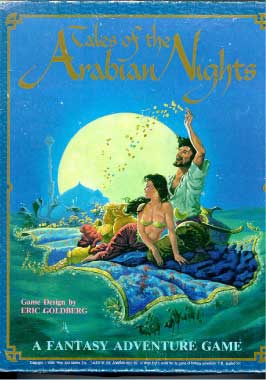
Others credited in the creation of the game: Doug Kaufman and Ken Rolston (development); Larry Catalano (graphic design); Chris Miller (cover and map art); Stephen Crane (interior illustration); Greg Costikyan and Paul Murphy (editing); Steve Gilbert, B.C. Milligan, Nick Quane, Mike Rothschild, Carl Skutsch, Robert Tuftee (playtesting). Included in the box should be map, 160 counters, instructions booklet, Book of Tales, deck of 64 cards, pair of dice, six player displays, reaction matrix display, component summary, merchant display, two plastic bags.
But what about the more obvious changes? The first thing to notice is that the box is quite a bit heavier. The much thicker adventure book has well over 2000 adventure paragraphs (compared to 1300 odd previously) and is spiral bound, which we can hope will help this one to last longer. The player mats are made from thicker cardboard, as are the skill tiles. Added are round cardboard markers which players use to indicate their victory goals. The former status markers have been converted to cards – more on this anon. Player pieces are no longer flat, but large – almost too large – standing cardboard figures. To top it off, everything looks very attractive, the card illustrations especially so.

|
In terms of actual play, the game has lost weight with the deletion of three of the previously included variants. The Quest, Merchant and Storytelling games are gone, though are apparently recoverable at Z-Man Games. The Quest idea has been introduced into the main game, however, in the form of cards. These state a task and the rewards for achieving it (usually skills, destiny and story points). Often the quests are requirements to travel to pick up one's quest markers, which often get distributed around the map by opponents. Fulfilling these are optional and so the concept is a good one. They give a purpose to travel in the early game and inject additional thematic material in an entertaining way. Combining the two most interesting ways of playing without causing matters to drag out is very neat trick.
Another big change is that holding multiple statuses is now the default way to play. This has been made more practical by the single wisest change in this entire production: putting the statuses on full-sized cards. Now it's possible to know the effects and escape methods for statuses without having to look them up in the book, a great time saver and insurance that the game is played according to the rules. The same sorts of cards were created for the treasures by the way, which have the same positive effects.
Another communication design improvement is moving the destiny, story and movement tracks to the board. They're less likely to get dislodged by rolling dice or other things that way and are far more easily read by all. The only downside is that movement track might be a bit far away for players on the far side of the board.
There isn't much to complain about here. The only noticeable gaffe is that some skills and statuses only last one use or one turn, but there is no way to indicate this. Perhaps unused one point destiny and story point markers can be appropriated for this purpose. Another possible issue is that too many adventures seem to start in the same place. In one playing we must have achieved the "Wonderful Artifact on Table E" result a dozen times and so of course knew exactly how to play it. Perhaps the Destiny track additions to the dice roll should be ignored to avoid such situations. The other possible issue is that the adventure book is large and in a project of such size there are bound to be bugs. Whether this is the case no reviewer can know for sure without many, many plays. Perhaps players should agree beforehand to take a vote in case of any inconsistency or impossible situation.
In general, it appears this is one of the few hits of the 80s which has been updated in a wise and successful way. It has had few successors and is well worth exploring.
More Information: |
|