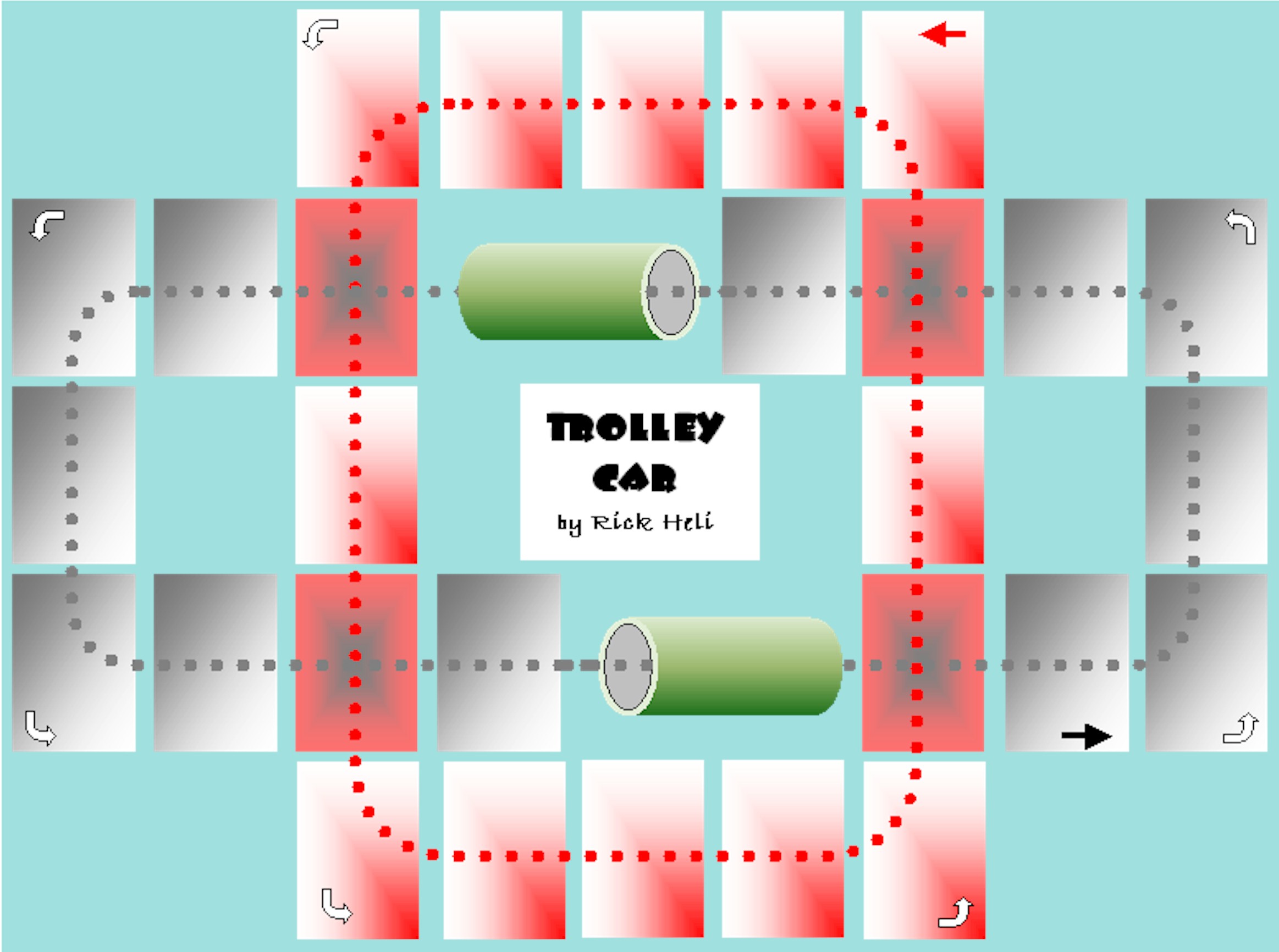
When using this optional board, the start cards go on the special
arrows instead of the locations mentioned in setup rules 3 and 4.
|
Original Game
Tue Jun 30 19:31:31 UTC 2009 |
Introduction
Trolley Car is a game for 2-6 players in which two trolley lines
compete to be the first to cross contested intersections.
The players speed them along by trying to be the first to get rid
of their trolley cars (cards).
Background
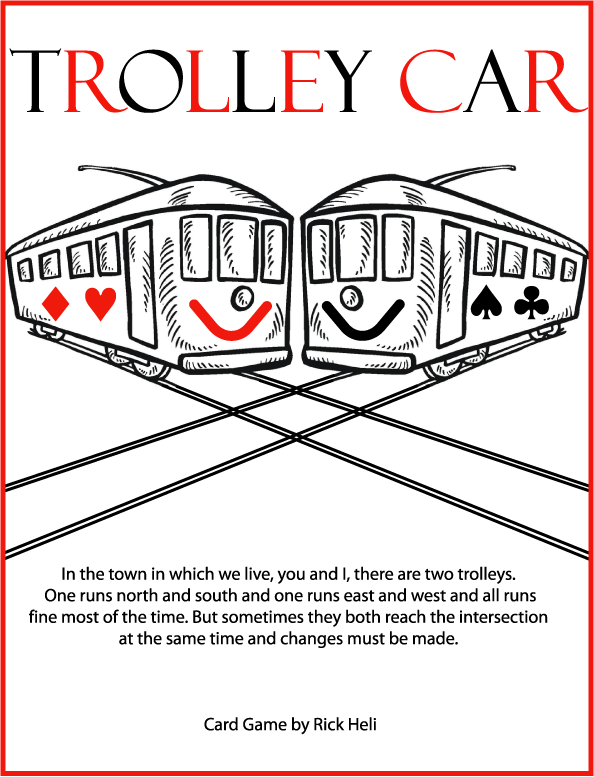
In the town in which we live, you and I, there are two trolleys.
One runs north and south and one runs east and west and all runs
fine most of the time. But sometimes they both reach the
intersection at the same time and changes must be made.
Components
Two standard 52-card decks of playing cards
(probably best, but not strictly necessary, if the decks have identical
size and backings)
Setting Up the Game
Set up the game as follows:
Goal of the Game
Players seek to play out as many of their trolley cards as possible.
The game ends when a player manages to play out all of his cards or
when the deck has been exhausted and no player is able to play a card.
At this time, each player receives one point for each card still in hand.
Depending on which line had the most cards laid during the game (it is
usually easiest to determine this by counting the number of cards who
have not been played), players
which declared for that line have 3 points deducted from their score.
If there is a tie, all players have 3 points deducted. It is permitted
for player scores to be negative.
The player with the fewest points wins.
Sequence of Play
Play begins with the player to the dealer's right. Each player plays
at most one card and then play proceeds to the right until the game ends.
The game should be played in rounds so that each player has the chance to
be dealer once.
Playing the Game
In turn, a player seeks to lay a card from the hand onto either of the
trolley lines. Black cards (spades and clubs) may only be played on the
Black Trolley Line and red cards (hearts and diamonds) may only be played
on the Red Trolley Line. In addition to this restriction, a played card
must be of the same rank as the most recently played card on the corresponding
line, or, at most, one rank different from it. Note that the Ace differs
by one from both the King and the 2.
Example: The most recently played card on the Red Trolley Line is the King of Hearts. The player could add to the Red Trolley Line by playing the King, Queen or Ace of Hearts or Diamonds.Players unable or unwilling to play a card, instead take one from the top of the deck. If this card is playable, it may be played immediately. Otherwise, it is added to the hand.
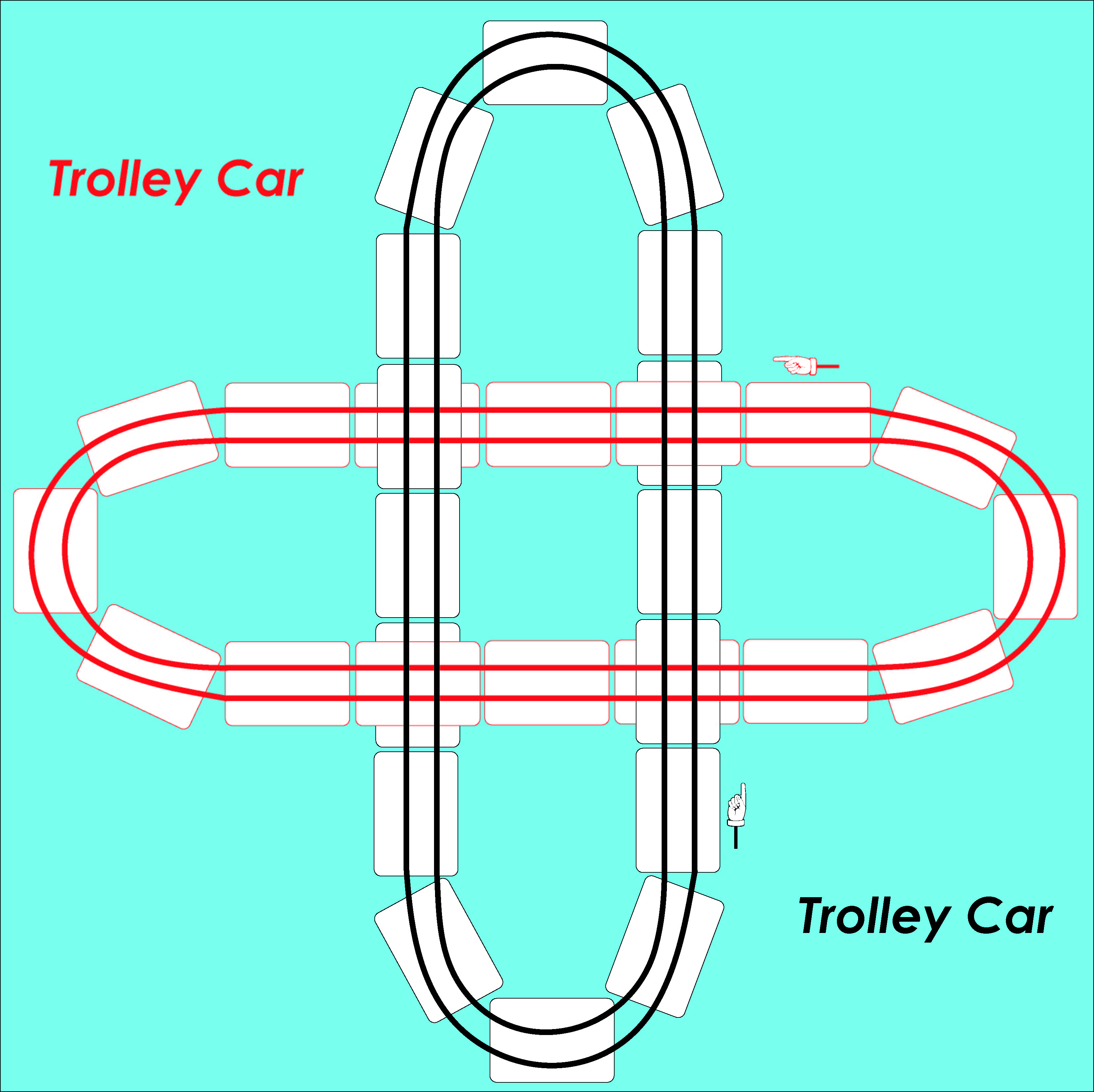
Players will notice that the trolley car lines intersect at four locations. At these locations, the first trolley car which reaches the intersection controls it. This means that the other line does not place a trolley card at the intersection and in addition, the rank, though not the color, of the car which was placed in the intersection becomes the rank for the line which reaches the intersection second.
Example: A game has begun with the red line starting with the Jack of Diamonds and the black line showing the 7 of Spades.After fifteen cards have been played -- some of which may have come from the other line, a trolley car will have reached its starting point. At this time, set aside for later all of the line's cards except for the last one played. These cards will be used in determining which line played the most cards during the game. Players continue playing cards from the last one played.Example continued: After a few plays, the red line has been continued with, in order, the 10 of Diamonds, the Jack of Hearts, the Queen of Diamonds, and the King of Hearts. Similarly, the black line has been moving too, with the 8 of Clubs, the 9 of Spades, the other 9 of Spades and the 8 of Clubs. Now both lines happen to reach the same intersection at the same time. The red Trolley Line is showing the Jack of Diamonds while the Black Trolley Line is showing the 8 of Clubs. Ottokar now plays the 7 of Spades to extend the Black Trolley Line into the intersection. This means that no red card is played in the intersection and the next card played on the red Trolley Line -- in the next position following the intersection -- must be a red card with a value of 6, 7 or 8 as the 7 controls the intersection. In fact, Babu has played the 8 of Hearts to continue the red line. 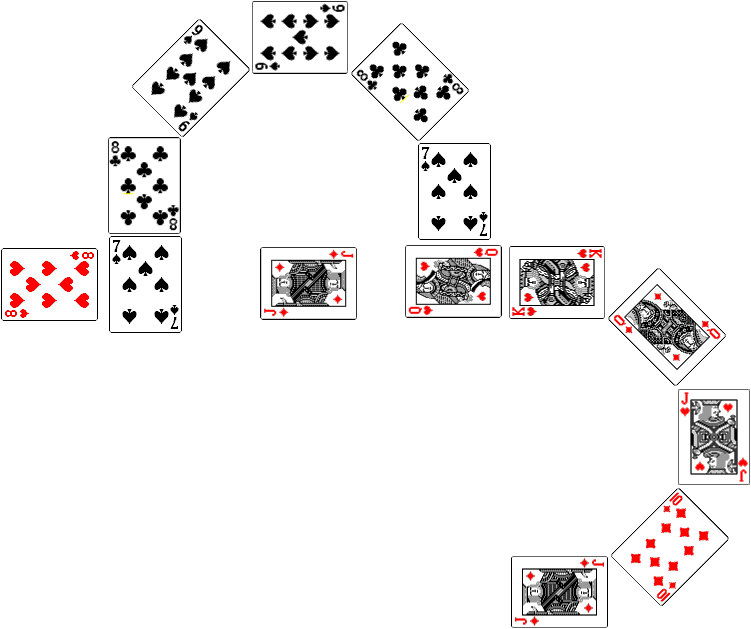
(Notes: Removing cards can create gaps in the other line. Don't worry about them. Also, you will notice that the starting spot for this line moves backwards by one position each time cards are removed, but if this doesn't make sense yet, don't worry about it.)
Players are permitted to play the face up card which they have used to declare which trolley line will be fastest. In this case, they are no longer eligible to deduct 3 points if their declared trolley line comes in first.
Variants
In the variant, a player may increase his bet. To do so, instead of playing
a card to a trolley line, he places another betting card before him of the same color.
However, this card must be of the same rank and color as another card already
declared, including declarations by other players. If the player's declaration
is correct, 5 instead of 3 points are deducted from his score.
However, this card only counts for 5 points if the matching card is still on the table
as a declaration.
Credits
Trolley Car has been designed by Rick Heli.
If you try the game, I would love to
hear
how your game went and what you thought of it.
Many thanks to playtesters (in alphabetical order): Phil Apps, Richard Brettschneider, Matt Crawford, Shay Gal-on, Chris George, Gordon Hua, Richard Irving, Hareesh Kesavan, Matt Leacock, Andrew Martin, Dave O'Connor, Grant Moy, Ray Tsai, Phil Vogt, Kevin Whitmore, Bernard Yeh.
Note that this game has nothing to do with the card game Trolley, published by Snyder Bros. of Elmira, New York in 1904 which I only learned about three years after this game was invented.