|
|
To get started I asked Remo to introduce himself, how he spends his time and how he got started in the games hobby.
My name is K. Remo Rehder (36) and I live in a town called Sandvika, about
15 kilometers from Oslo, Norway's capital. Norway is a good country
to live in apart from the winter time, which I unfortunately strongly
dislike. Apart from ice hockey, the only good thing about winter is that we
spend a lot of time indoors. That gives me time to be sociable, bring out
my games collection and introduce friends to my latest music findings. After
finishing my masters degree in strategic management from the Aarhus School
of Business in Denmark, I started my own music promotion company which later
became a
record company
that I still run on a daily
basis. So you may conclude that my two main interests are taken care of!
As with most Norwegian children my age, I got started at card games with
the family, then board games like Jakten paa den forsvunnede diamant
(Diamond Hunt), Pachisi, Chess, Checkers, Monopoly and so forth. I played
Chess a lot when I was a kid, but switched to Mastermind and Othello when
they hit Norway in the mid seventies. My uncle introduced me to them and we
had some good times. Gaming slowed down a whole lot when I became a
teenager. Between school, soccer and girls there was little time left to
play games. I got into gaming again when I found Risk and the gang
enthusiastiaclly embraced it. I guess I was 16 or so. From 18, five of my
friends and I started playing Draker & Demoner, a Swedish counterpart to
Dungeons & Dragons. Most RPG gamers consider this a rip-off game, but we did
not know of D&D, and once on the way it is hard to go back. This game
stayed with us for 3-4 years, until it phased out when everybody started
spreading for different reasons. We naturally played other games as well
(especially Avalon Hill games), but nothing as much as Draker & Demoner. Around the
same time computer games set their mark on us as well.
In 1993 I moved to Aarhus to study, and started playing Bridge and spent a
lot of time in various cafes playing Backgammon and Darts. When I got back
in the summer of 1995, a friend of mine had picked up Magic: the Gathering: Portal
at some fair and it spread like wildfire amongst us. It quickly turned into
Magic: the Gathering as a regular weeknight affair, but we played with a twist:
everybody agaist each other - no duels! We had a blast, and one thing lead to another and
suddenly we were a "large" group and other games started turning up.
Around 2000 I was getting fed up with never getting any information on new
games and the very limited number of titles carried by the bookstores. From
the mid eighties there was mainly
one store in Oslo
that carried imported games, so I presented the idea of promoting games to
Kathrine, my girlfriend (now wife), and two other couples and we started
BrettSpillGuiden
in 2001. Our main goal is to be like a guide in the jungle
of board games for the casual gamer more than the hardcore ones. Although we
usually are considered the latter ...
I need to mention some of the other games that kind of stand out as games
that drove me even further into this interest: Enemy in Sight, Mahjongg,
Civilization, Canasta. I really enjoy heavier games, but they were harder
to come by and even harder to find opponents for, so I they have not made
the impact of the games mentioned above.
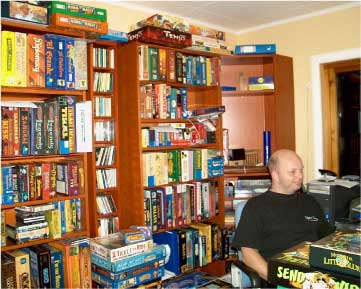
Remo
Q2. What sorts of music do you manage? Do you find that your love of music and love of games are entirely separate parts of your personality or are they connected in some way? Is there a common thread running through both?
|
|
Ah, those are interesting questions ... Music has been my true life companion since I can remember. I had a childhood friend about 3 years older than me and he got records from his stepdad; Kiss, Queen, Sweet, Nazareth and the like. They laid the groundwork until I came across heavy rock/metal when I was about 12. AC/DC, Motorhead, Thin Lizzy and the Clash really made my head spin – I was hooked ...
Through a period with heavy rock and metal, I found blues and "roots music" and from there singer/songwriters which today is what I listen to the most. Naturally, I am still fond of weird stuff on the side. Artists who break all the rules and mixes, unlikely styles, or whatever.
As to what I do today, the music that I release is music that I like and it usually is a bit on the "awkward" side. I guess this reflects what I hold dear. Pop music has never interested me, but music that has some "realness" to it, preferably with some lyrical content that makes you understand or feel something does. My friends have always stated that I should be reading poetry instead of listening to music, but to me the whole point of good music is that when music supports or contrasts the lyrics "it makes three".
To me music, games, movies and books are very connected, although they may seem chaotic. My common thread in music, books and movies seems to be driven by drama/emotions. I'm a sucker for emotional roller coasters (although I may not necessarily like them). If this shows itself in games as well I do not know, but I have a tendency to enjoy either the thoughtfulness of real strategy or the lighthearted games. I think music and games share another important thing – people. The interest and joy of both music and games is very much a social experience, so a ridiculous game may become extremely funny with the right crowd. Or a very good one destroyed by the wrong people. I mean try playing Advanced Squad Leader with your neighbour or Würmeln with your Advanced Squad Leader buddies! I guess my fondness for abstract strategy is a bit like listening to melancholy music or watching a sad movie – but I love it!
If a shrink were to analyze me according to my collection of music, movies, books and games I would most surely be labeled with a multiple personality disorder. You will find Dvorak and Slayer, the Indian runner and Starship troopers, Knut Hamsun and Pretchett, Bluff and Advanced Squad Leader in my collections. Things for all eventualities, I guess ...
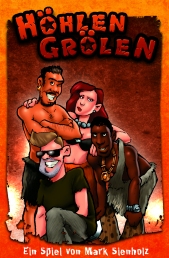
Höhlengrölen |
Q3. There have been a few games – Evergreen, Schrille Stille, Höhlengröhlen, Rock 'N' Roll
-- on the music industry. Being in the industry yourself, what do you think of them?
I'm also reminded of an ad a few years ago to the game designer's list from
Lou Bega's management asking someone to design a promotional game
about him. You haven't run into anything like that, have you?
It is strange though that there aren't more games on the industry as such,
when you think of how many people who are interested in it. I know of a
couple of PC/Net based games, but they are not too interesting. There are a
lot of possibilities for doing games on the industry: economic themes (start
and run a record company), strategic themes (manage an artist), luck oriented
(how to become a pop idol).
So far I've not come across any opportunities to make a promotional game
for an artist or anything else, but an industry colleague and I have joked
about making a game, the problem being he wants to make it a competitor or a
variant of Monopoly. I am not a fan of economic games, and especially not
Monopoly, so it kinda ended there. I would nevertheless be more than happy
to be a sparring partner for anybody who wants to make a good game of the
industry. Until then I guess being a part of the industry is a game in
itself.
Q4. In a
previous interview
we learned that in Finland most game fans get
their games in a few shops in the capital with some ordering directly from
Germany and that most games are played "in English". Is it similar in
Norway? Is there a database web site supporting translations into
Norwegian?
There are also a couple of Warhammer stores, but I guess they keep the same
profile as the chain does throughout Europe.
Although most Norwegians are knowledgeable in English, non-translated games
will naturally not be a regular part of the bookstores product lines. Almost
every gamer in Norway is used to English rules and plays these games with no
problems. The two online stores also host forums, databases of translated
rules and such. Both of these stores also translate the rules of the games
they sell in order to attract more people to gaming.
Midgaard, the main distributor of foreign games in Norway/Scandinavia, also
recognized this problem last year and launched their own brand called
Midgaard games. So far they have released 6 nimmt, Bohnanza, Carcassonne
(with all expansions), Elfenland, Formula de, Lobo 77, Lost Cities
Settlers, Solo and Space Beans. They have also translated most of the games
from Fantasy Flight, apart from Battlemist and so on. All their games are
translated into Danish, Finnish, Norwegian and Swedish. So, they are
definitely doing some ground work worth mentioning.
Q5. Where do you play your games? In homes? Are there public places to play? Conventions?
For most Norwegians, playing games is a social activity that one does in the
comfort of the home. Norwegians are very home-loving people, which means we
usually go out when we want to party. Naturally, board games are not included
in such events.
So I, personally, play games at home or at friends' houses. Since the
mid nineties we have been able to, more or less, keep a good gaming group of
approximately 25 friends together. It has not always been too regular, but from
2000 up to now we have had a fortnightly gathering where usually 8-16
friends show up. Being Friday evenings, we make it a social happening with
some wine and light food and snacks kinda thing.
There is actually a convention in Oslo called Arcon, but I have never
attended. It takes place at the University, and is very much student driven.
The main focus there are still Avalon Hill games and RPG's, so it is keeping the
flame of serious games alive. In addition to Arcon, there are a couple of
regional games happenings like Spilluka i Arendal and Bergen Spillfestival.
The guys behind Spillskrinet also started up a gathering this year:
Spillorama. Apart from that there are of course the inevitably Magic: the Gathering
tournaments. Rummikub, Monopoly and Othello all have Norwegian
Championships. Even Settlers of Catan got its Championship last year! This all sounds
like we are crazy up here, but I don't expect them to have too many attendees
unfortunately. They are basically run by gamers who have a special interest
in a given game.
Public places ... Well, there are cafes where you may borrow
Backgammon or Chess boards, but in general you seldom see folks playing
games in public places. Quiz games are huge in Norway, with both Cranium and
a local game called Passport, have been the largest successes over the last
couple of years. And this fascinating knowledge competition has wandered off
into the nearest pubs for weekly Quizmaster events. From what I have seen on TV, it
looks like it's a good social gathering where friends form teams and compete
against the other teams. I even think there some kind of series going on,
but this is not my scene...

Passport
Q6. Can you tell us more about Passport? Any particular reason that quiz
games have become so popular?
We had a leading book/games publisher called Damm until it was bought by the
Swedish Egmont conglomerate. They keep the Damm brand in Norway, but
normally release translated American party games or games developed by a
Swedish company called Användbart Litet Foretag AB. Besides them there is
Christian Olsen-Mittet, but they have become more of a wholesaler, even though
they have a Ravensburger license.
Passport was nevertheless an overwhelming success, which even led Aschehoug
to consider putting up a games division. That has yet to materialize. So
we'll just have to wait and see. The game itself is very nicely designed
-- everything is kept in a suitcase. As a variation on the quiz theme
Passport focuses on the knowledge of other countries and cultures. With a
wide range of questions including economics, wild life, religion, politics,
language, food etc. Each player receives a passport and must visit and
correctly answer questions from each of the 5 continents. When the
passport is full, you head for the grand finale - which in this game means
you are allowed to buy your plane ticket. [Hmm, this reminds me of the American game
Travel Buff. –editor]
Passport is a strong and well designed game, although questions from one's
local area seem too easy compared to questions from the island cultures of
the Pacific. Naturally, you might say, but my gaming group argued that it
must be possible to make the questions of the local area harder so they
don't become obvious and henceforth unimportant.
Why quiz games have become so popular is harder to explain. I have not seen any study of this,
so this must be my very personal analysis. I think Norwegians like to compete socially,
but the church in Norway more or less banned gaming for ages. A natural way of competing then became
knowledge. No game parts, no boards, no cards. Until the late 50's when the
status of the church started declining, all the newspapers, magazines and
lets' not forget TV had weekend quiz competitions. It even evolved into quiz
books to bring on your holiday to the mountain cabins. I remember having
lots of such books as a child, even Disney-themed ones. On TV the
Scandinavian countries even had the highlight of the week with a classical
music quiz where teams from each country competed! In addition to this most
Norwegians attend university and are therefore highly educated. I guess, an
academic mind wants to show off! Only joking, but there seems to be a link
between my educated friends and their fondness for quiz games.
In the stores now we may choose from the following quiz games: Passport,
Passport Junior, Trivial Pursuit Genus, Trivial Pursuit Jubilee, Trivial
Pursuit Junior, Trivial Pursuit Globetrotter, Trivial Pursuit Family,
Cranium, Norge Quiz, Norge rundt, Norges spillet, Alle tiders spill,
Det Store Norske Kunnskapsspillet, Kunnskapsspillet Jackpot, Who Wants to be
a Millionaire, Jeopardy and Verdens Underverker!
Unbelievable for a population of 4.5 million ...
Q7. Do you have any idea how many people in your country are playing new
strategy games and what the demographics are like? What’s the overlap
with RPG, CCG, war games, computer games, video games, comic books, anime?
Are there any special reasons why gaming is popular or not there?
Personally, I think the most obvious recruiting possibility for board
gaming lies with the PC gamers. The problem is that very few board games can
compete with all the "shoot-'em-up-games" which I think the majority are
playing. But, the players of, let's say, Warcraft, Allied General and such
should be possible to convert. At the same time, it should be possible to
attract more new gamers by opening the stores to more interesting
games, together with more media coverage. The euro games did not hit
Norway for real until last year, when suddenly both Carcacassonne and
Settlers of Catan could be found in the regular book stores. These games may open the
market to a new audience. At least I hope so.
Q5. Are there any traditional board or card games, perhaps even
non-proprietary, that have particular popularity in your country and how
have they informed the gaming scene?
Like I previously said, board games do not have a long tradition in
Norway, but we have enjoyed card games. Well known and partially popular
card games are Bridge, Hearts, 500 (a variation of Canasta), Amerikaner
(a bid and trick taking game, Mattis (trick taking), Crazy Eights, War (trick
taking game on even cards), Hei, Knekt (physical, humorous game), 7 kamp
(trick taking game over 7 rounds) and Casino (two player trick taking game)
to name a few. Card games with special cards that are well known in Norway is
Svarteper, Gnav (of Italian heritage) and De loeyerlige familier, which are
still available. Not many play adults play these games, but they tend to be
a part of the Norwegian upbringing.
Q9. There are several here which are not familiar to me. Perhaps you would
like to say a bit more about them? How would you translate their titles and
what are they like?
(American) - Usually a 4 player game, where you bet for tricks
and the highest bidder chooses a colour and a card he wants and asks for it
by playing a card in that colour. The player who has the named card becomes
the highest bidder's partner for the round. One has to follow colour unless
void, at which it is possible to use the first colour as trump.
If the partners makes their bid they get the value added to their score.
The other players score the tricks they take individually. Should the partners
not be able to make the bet, they get the total bet deducted from their score.
A nice little Whist twist.
(Is just a Norwegian name) - I can't remember how this was played
although I played like crazy in high school.
Hei, Knekt (Hi, Knight) - A game where the stock is divided evenly amongst
the players who keep them in a pile face down in front of them. One at a
time the players turn over their top card. If it is a Knight everybody must
say "Hi, Knight!", the person who is the last to do so gets the cards in
all the turned piles. If a Queen shows up, they must say "Good day, Dame". If
a King shows up they must salute and if an ace shows up they must touch the
card, which usually means slamming your hand down, especially if you're the
last one.
5, 7 or 10 Kamp (# battle, same as in athletics) - This game is played in
many variations, but the main focus is to avoid taking different cards,
which all will have different point value, in tricks for the first number of
turns. For instance; first round - no hearts, second round - no 2's, third
round - no Queens, fourth round - no King of spades and so on. The next to last
round none of the previous rounds' cards are to be taken and in the last
round there is a 4 player solitaire. In this solitaire the starting player
must play a 7, and all the players must play a card if possible, or pass.
One builds up and down from the 7's and the players try to get rid of their
hands first. The players get a sum deducted from the score according to
their end positions.
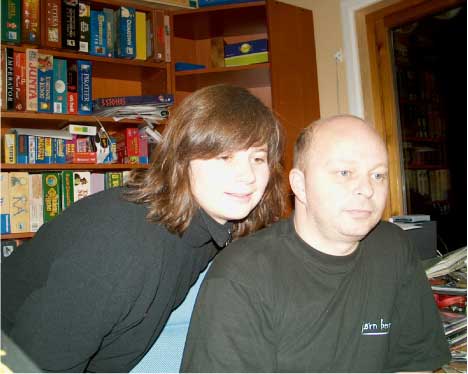
Remo and Kathrine
(Black local name) - Consists of a stack of paired cards and an
odd card called Svarteper. The players takes turns drawing a card from each
other and laying pairs down. Eventually one players is left with the
Svateper card. [Name reminds of Schwarzpeter or Black Peter. –editor]
The Norwegian version of
Cuckoo
played with pieces similar to Chess pawns with the identity of the card
shown on the base of piece, so that they all look the same when stood on the table.
(The funny families) - I have personally never played
this game, so I don't know how it works.
Q10. I wonder if you have any idea which of the modern strategy games seem
the most popular there? Any games which have found particular success that
may surprise us living elsewhere?
Since most of the aforementioned games are not sold through the normal book
stores, the games that have more sales are Lord of the Rings, Risk
variations, Axis & Allies variations and to some extent
Settlers of Catan and
Carcassonne. The latter becoming a part of the board game range in the usual
stores last year.
So, I guess, there is no big news here.
Q11. Can you give us some overview of home-grown game publishing? What
original games have been published there? What attempts have there been to
translate and reprint foreign titles?
When it comes to translations and reprints of games, there are several
different options. Like I've stated earlier, the larger publishers focus
heavily on the trivia/party game successes from the US. So that is well
covered. The strange thing there is that there never seems to be anything from
Germany or Holland or anything ... Never mind. When it comes to strategy
games, which the large ones have yet to try, except from Dan-Spil/Nor-star
(Settlers of Catan), Midgaard used to be the sole deliverer on this market. They
didn't translate, so it was just imports. Since 2003, after
www.spillskrinet.no
and
www.brettspill.no
established themselves in the online market, they understood there was some
competition coming and set up their own publishing called Midgaard Games.
To my knowledge they also have some interest in Fantasy Flight, and started
translating and printing, most importantly, Carcassonne and the lighter Fantasy
Flight games as well as their own versions of some card games.
Apart from that nobody is reprinting foreign games, but
both of the online stores translate most of the games they sell either from
German or from English. Although, as I've mentioned earlier, most Norwegians
understand English well enough to understand even the old Avalon Hill games, it is a
very nice gesture to their customers. I guess it is also cheaper to get the
games from Germany and translate them than to buy imports from the USA.
Q13. Sounds like it. :) Perhaps not that many have heard of Valhall,
however? I have to admit I never have. Also, earlier you
mentioned television ads. How much mass media presence is there for board
games there and what is the nature of that presence?
Let's leave that matter now. Board games are pretty much non-existent in
mass media here. Almost all marketing goes into the catalogs of the book
store chains twice a year and that's it. Every other year some newspapers
find it a good idea to have a test before Christmas or Easter or
whatever, usually with no basis and a panel with no knowledge of the
subject. The only board game that gets some coverage is Chess, mostly
because we have a couple of good players and it's viewed as a serious game –
a contest for the people with a more than average IQ score.
Passport was one of the first TV commercials I've seen of a board game, as
far as I remember, and it has now been followed up by Ticket to Ride.
Cranium was presented on national breakfast TV last winter, but apart from
that you only see ads for board games in combination with a wide range of
products - like we also have Trivial Pursuit ...
The past two years we, at
BSG,
have been trying to correct this a bit, and have
been part of two tests in the third largest news paper in Norway. There are
separate categories of party games and card games, a test of economic games for
the leading consumer focused magazine and a monthly spot on Norway's largest
national commercial radio. Now we are trying to get one of the papers to do a story
on Settlers of Catan and Carcassonne as well as maybe doing something on
the most prestigious award in the business – the Spiel des Jahres, which very
few outside the gaming community know of. We are trying to get more coverage
of the business into the media, and so far it has at least become better,
although it's still a long way to go.
Q14. What do you think is the societal view of board games and their
players? Is it positive, negative, no opinion?
You are making me guess again, but in my experience it's more like wonder.
For the most part traditional board gamers are, I believe, looked upon as
geeks, but not necessarily as a bad thing. It depends on what kinds of games
I suppose. Since most Norwegians are familiar with the game packs I
mentioned earlier, people know of games, but they at the same time may look
at it as something for children to do. Board games for adults should be
Chess or trivia games.
Personally though, my experience is somewhat different. Most people find it
fascinating that we spend so much time gaming, and of course the wide range
of games we have. It is on these grounds that I would argue that this
business could become more important in Norway. So far people in general
do not know what is available out there ...
Q15. With your business background, what do you think can be done to improve
the industry there?
We have a couple of hurdles to get over before the business will make a
bigger impact. First, that the outlets of board games are generally book stores
or toy stores is in my view a drawback since the largest chains are
owned by the two largest book publishers and consequently focus their
energy solely on books. When there is centralized buying with no focus on
quality, but rather which games give the highest mark up, the customer
loses. When it comes to toy stores, I don't know if serious/adult games
should be there in the first place. But in lack of alternatives they become
important. Second, the businesses are not working together to raise the
prestige and exposure of board games. Most media coverage is created by
independent or enthusiastic sources. Third, it's almost impossible to get
numbers in this business. This means that getting an overall picture of
national statistics is not possible. How big is the market? What are good
sales? How is the sales in regard to categories? Etc, etc.
The business should start to look at possible solutions to these problems,
without giving out compromising financial information by opening up
business statistics, making more of an effort media-wise and maybe having
other arrangements with the outlets. In this way the business may become an industry.
Q16. Now a question you can really have fun with :) What makes the games fun
and interesting for you? What are some of your most favorites? What’s your favorite game
that few, or at least few around you, seem to like? Do you have a favorite
type or type that you are best at, e.g. abstract, auction, bluff, business,
tile placement, heavy, light, fantasy, war game, etc.?
First of all I perceive board games as a social gathering among friends, so the
interaction between the players are essential. As a result of this I would
argue that a good game is the game that fits the individual group playing
it. Getting trivia fans to play Republic of Rome is hopeless. Second, I
argue that which games to play is similar to what music to put on; it
varies according to mood and circumstance. Sitting down with a friend in the
winter dark with the fire place burning and hot chocolate in the cup is very
different than playing a game with friends on the porch in the summertime
before you're heading out to party. So the answer to your first question
would be that it all depends ...
Some of my favourite games include Britannia, Formula De, Sequence,
Scrabble, Kokkelimonke, Guillotine, Attila, Gipf project, A-Å, Wallenstein
and Titan.
Games I like, but few others do? ...
There are, of course, a lot of games that didn't spring to mind amongst the
games mentioned earlier, but they at least show some of the range of games I
like. In many ways I don't demand that much from games. I enjoy playing.
This means that any given game must really be bad before I refuse to play.
Most likely I'll even join then – what the heck ... Again this has
similarities to my view on music. Every musical style has something to
offer – it's more a question of finding the right record or artist. The other
similarity is that I don't need stereo equipment for a million to enjoy my
records. I would rather have many records ...

Kokkelimonke
When it comes to game mechanics, I have a tendency to like the abstracts:
tile placement and war. I guess strategy at some level is important. Totally
luck-oriented games usually turn me off, unless I am playing it in a party
mood. When I say war games, I don't necessarily mean simulation, but
rather games with direct conflict. War simulation games fascinate me
greatly, but there are few possible players and the time they consume are
limitations. There is usually practical problems as well; too many counters,
rules and space – think of a full scale Napoleon's Waterloo. To me, these
are the games that have turned me on to PC gaming. Instead of never being
able to play simulation games at all, I would rather play Battleground, Panzer
General, Close Combat and the long awaited Codename: Panzers.
Q17. You seem to have pretty wide tastes, which is not all that common, but probably
ideal for a music publisher. :) I suppose you always enjoy fine artistry regardless of
the genre ... I wonder how much you have also played RPG's and CCG's?
Thanks. I'll take that as a compliment. I guess I just follow the moods I'm
in, but I also find variety important. Like I've mentioned before I've had
some years playing Drakar & Demoner, a Swedish variation of D&D. My friends
and I also had 2-3 years with Magic: the Gathering, before going back to
board games.
Apart from those games, I've not tried that many others. Because of
BrettSpillGuiden I've looked at some, but not gotten too excited.
Q18. What about your own involvement in the games industry? Have you had any
participation there?
|
|
We also supported the launch of Cranium in Norway, but that came about after we had made our test of the game. As a panel, we loved it and consequently agreed to join Richard Tait (Hi, Richard!) on national TV and included the game in the monthly interview on national radio. We did not make any money for this, but supported the game as a very good novelty in the market.
The last couple of months I have made some new plans for BSG for next year, which I hope will be well received by the industry. If not very soon, so at least in the future I think I would like to try working within the industry. It may be fun to be responsible for launching a catalog or finding suitable games for the market.
Q19. Is there anything I've left out that you would
like to say? And finally, what are the words for game and board game in your
language?
Game translates to spill and board games translate to brettspill.
Thanks very much for the interesting thoughts, Remo!
If they're interesting or not is up to the readers to decide, but at least I
tried answering the very interesting questions. I really appreciate the
opportunity both to share some information about my region and being forced
to think about it as well. Thanks, Rick!
Links Cited in this Interview:
Spotlight on Games
>
Interviews